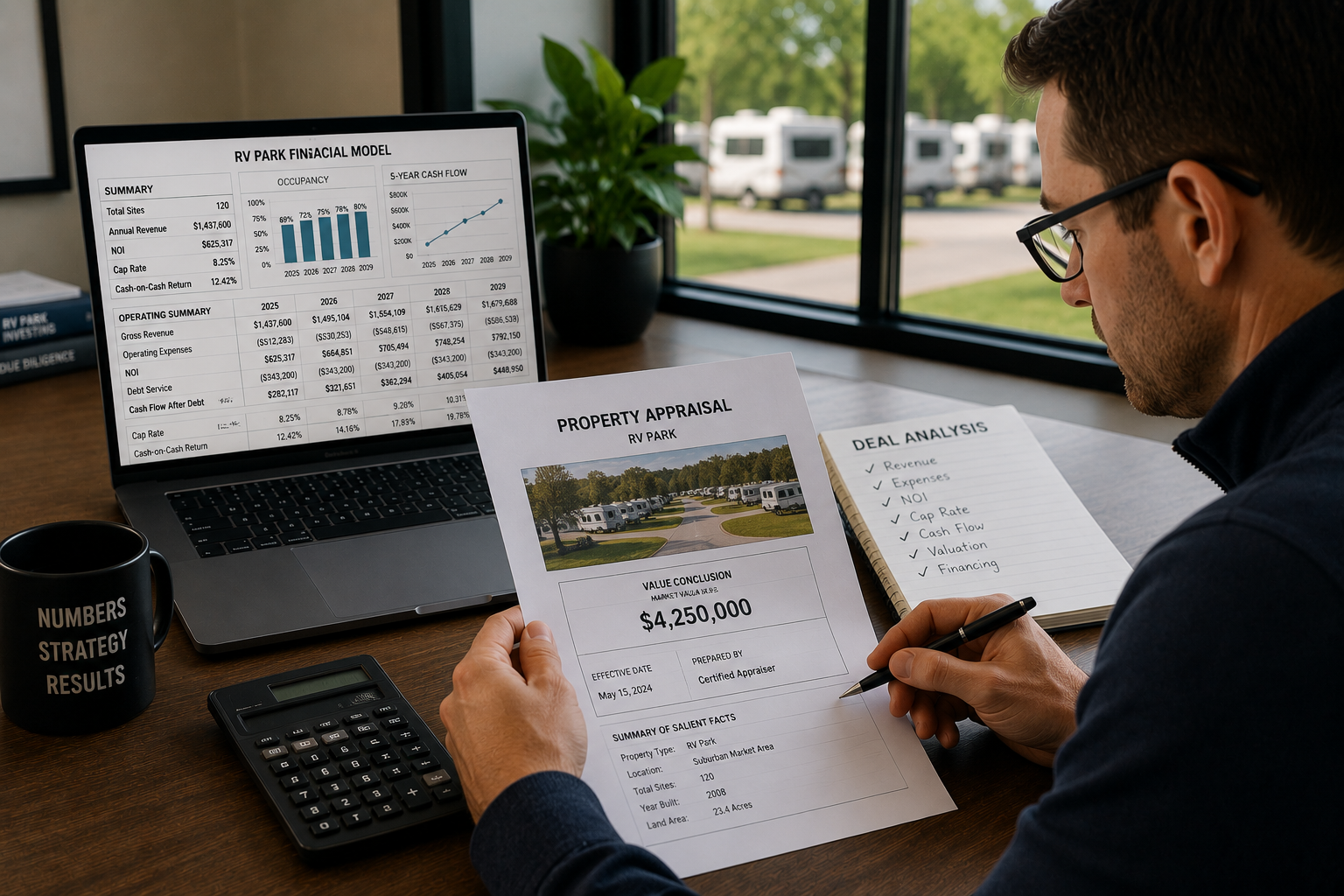
RV park valuation is where deals are won or lost before a single offer is ever submitted. Get it right and you buy with confidence knowing exactly what you are paying for and why the price makes sense. Get it wrong and you overpay, your cash flow suffers, and you spend years trying to dig out of a hole that started the day you closed.
Most buyers do not have a structured approach to RV park valuation. They look at the asking price, glance at the broker’s cap rate, and form an opinion based on whether the number feels reasonable. That is not RV park valuation. That is a guess. And in a market where parks are actively priced to maximize seller returns, guessing is expensive.
This post breaks down the three methods every serious investor needs to understand to do RV park valuation correctly. Use all three on every deal and you will never overpay for a park again.
Here are the three methods that reveal what any park is really worth:
1. The income approach
The income approach is the most important method in RV park valuation and the one you should always lead with. It values the property based on the income it produces, which is exactly what you are buying when you acquire an income producing asset.
The formula is straightforward. Take your reconstructed Net Operating Income and divide it by the appropriate market cap rate for this type of park in this location. The result is the indicated value based on income.
Reconstructed NOI is the key phrase here. RV park valuation using the income approach is only as accurate as the NOI you plug into the formula. If you use the seller’s NOI without rebuilding it yourself, you are valuing the park based on a number that was built to make the asking price look reasonable, not to reflect what the property will actually produce under your ownership.
Rebuild expenses from scratch. Add management fees if the seller manages the park themselves. Include a capital reserve of 3% to 5% of gross revenue. Use realistic occupancy based on actual historical data, not projections. Then and only then apply your cap rate.
For a step by step walkthrough of how to rebuild NOI correctly, read How to Evaluate an RV Park Deal: The 6-Step System That Exposes What the Numbers Are Really Saying.
RV park valuation using the income approach gives you a defensible, lender-supported number that you can anchor your offer around with confidence.
2. The sales comparison approach
The second method of RV park valuation is the sales comparison approach, which values the property by comparing it to recent sales of similar parks. This is the same method a residential appraiser uses when they pull comps for a home sale, applied to commercial outdoor hospitality assets.
The challenge with RV park valuation using the sales comparison approach is that comp data for RV parks is not as readily available as it is for residential properties. Parks trade less frequently, many transactions are off-market, and the data is not centralized in a public database the way residential sales are.
That said, there are ways to find useful comp data. Brokers who specialize in outdoor hospitality often have access to recent transaction data and can tell you what similar parks have traded for in your target market. Industry publications and conferences can also surface transaction data. And if you work with a lender who specializes in RV parks, they will often have a strong sense of recent comparable sales in the markets they operate in.
When you do find comps, look for parks that are similar in size, location, amenity level, and revenue mix. A 50-site seasonal park in a rural market is not a good comp for a 200-site year-round resort near a national park. The more similar the comp, the more useful it is for your RV park valuation.
For more context on how location and park type affect value, read Not All RV Parks Are Created Equal: What Every Investor Needs to Know Before They Buy.
3. The cost approach
The cost approach values the property based on what it would cost to replace it, meaning the land value plus the cost to build all the improvements from scratch, minus any depreciation for age and condition of existing improvements. That is why the cost approach is rarely the primary method in RV park valuation but it plays an important supporting role.
The cost approach is the least useful of the three methods for RV park valuation of an operating park because it tells you what it would cost to build the asset, not what the income stream is worth. A park that would cost $3 million to build from scratch might only support a $1.8 million valuation based on its current income, and that income-based number is what matters to you as a buyer.
Where the cost approach does add value is as a sanity check. If the income approach and sales comparison approach both point to a value of $2 million and the cost approach suggests replacement cost of $4 million, that tells you the park is trading at a discount to replacement cost, which can be a meaningful data point about barriers to entry in that market. New supply is unlikely to come in and compete if building costs significantly exceed what operating parks sell for.
The cost approach is also useful when you are evaluating a park with significant newer infrastructure, recent capital improvements, or unique structures that have not yet been reflected in the income stream. In those cases, the cost of the improvements can justify a premium over what the income approach alone would suggest.
How to use all three methods together
The most reliable RV park valuation is not based on any single method, it is the synthesis of all three. Here is how to use them together on every deal:
Start with the income approach and calculate your indicated value based on reconstructed NOI and a market cap rate. This is your primary number and the one your offer should be anchored to.
Then check the sales comparison approach. Are similar parks trading at prices consistent with your income-based valuation? If yes, you have confirmation that your number is market-supported. If comparable parks are trading significantly higher or lower, understand why before you proceed.
Finally run the cost approach as a sanity check. Is the asking price significantly above or below replacement cost? If it is well above replacement cost, be cautious about the seller’s rationale for the premium. If it is well below, understand whether that reflects a distressed asset or a genuine market opportunity.
When all three methods of RV park valuation point to roughly the same number, you have strong confidence in your offer. When they diverge significantly, you have questions to answer before you commit.
RV park valuation done this way takes more time than glancing at a cap rate on a broker package, but it is the only approach that gives you genuine confidence in what you are paying and why. The Appraisal Institute has additional resources on income property valuation methodology that are worth reviewing if you want to go deeper on any of these approaches.
If you want help running all three valuation methods on a specific deal, I offer acquisition underwriting often with a 24-hour turnaround. You send me the financials and I hand you back a complete valuation analysis so you know exactly what the park is worth before you make your offer. Reach out at PVIFinancial.com and let’s make sure you are buying at the right price.
~Wendi | Fractional CFO | PVIFinancial.com
Leave a Reply