Tag: Fractional CFO

  • How to Calculate Break-Even for Your RV Park (And Why It Changes Everything)

    How to Calculate Break-Even for Your RV Park (And Why It Changes Everything)


    Break-even is one of those terms that gets used a lot in business conversations but rarely gets defined precisely enough to be useful. Most people have a general sense of what it means. Fewer people know their actual break-even number, and almost nobody is tracking whether they have truly crossed it.

    For RV park owners, this matters more than it does in most businesses. Seasonal revenue, high fixed costs, and the gap between a strong summer and a slow winter make break-even awareness a genuine operational necessity, not just a finance concept.

    What Break-Even Actually Means

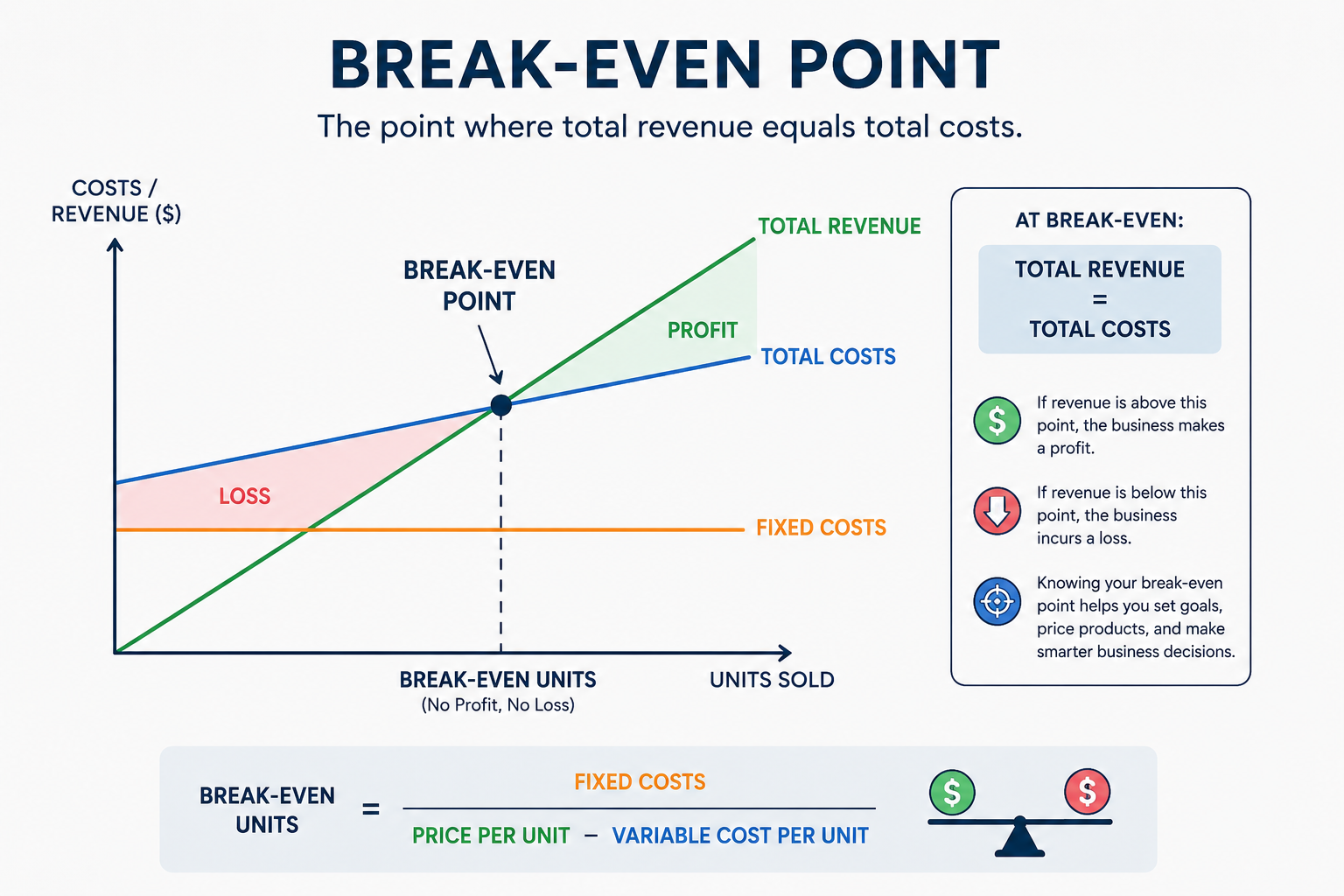
    Break-even is the point at which your total revenue equals your total expenses. Below it, you are losing money. Above it, you are generating profit. Simple in theory. Complicated in practice, because not all expenses behave the same way.

    Your fixed costs stay constant regardless of occupancy. Debt service, insurance, property taxes, management salaries, utilities with base minimums, and software subscriptions are examples. These bills arrive whether you have 10 rigs on property or 80.

    Your variable costs move with revenue. OTA commissions, credit card processing fees, cleaning supplies, and seasonal labor scale up when business is strong and down when it is slow.

    True break-even accounts for both. It is the revenue number at which your fixed costs are fully covered and your variable costs, scaled to that revenue level, are also covered. Everything above that number is profit.

    Why Seasonal Parks Have a Break-Even Problem

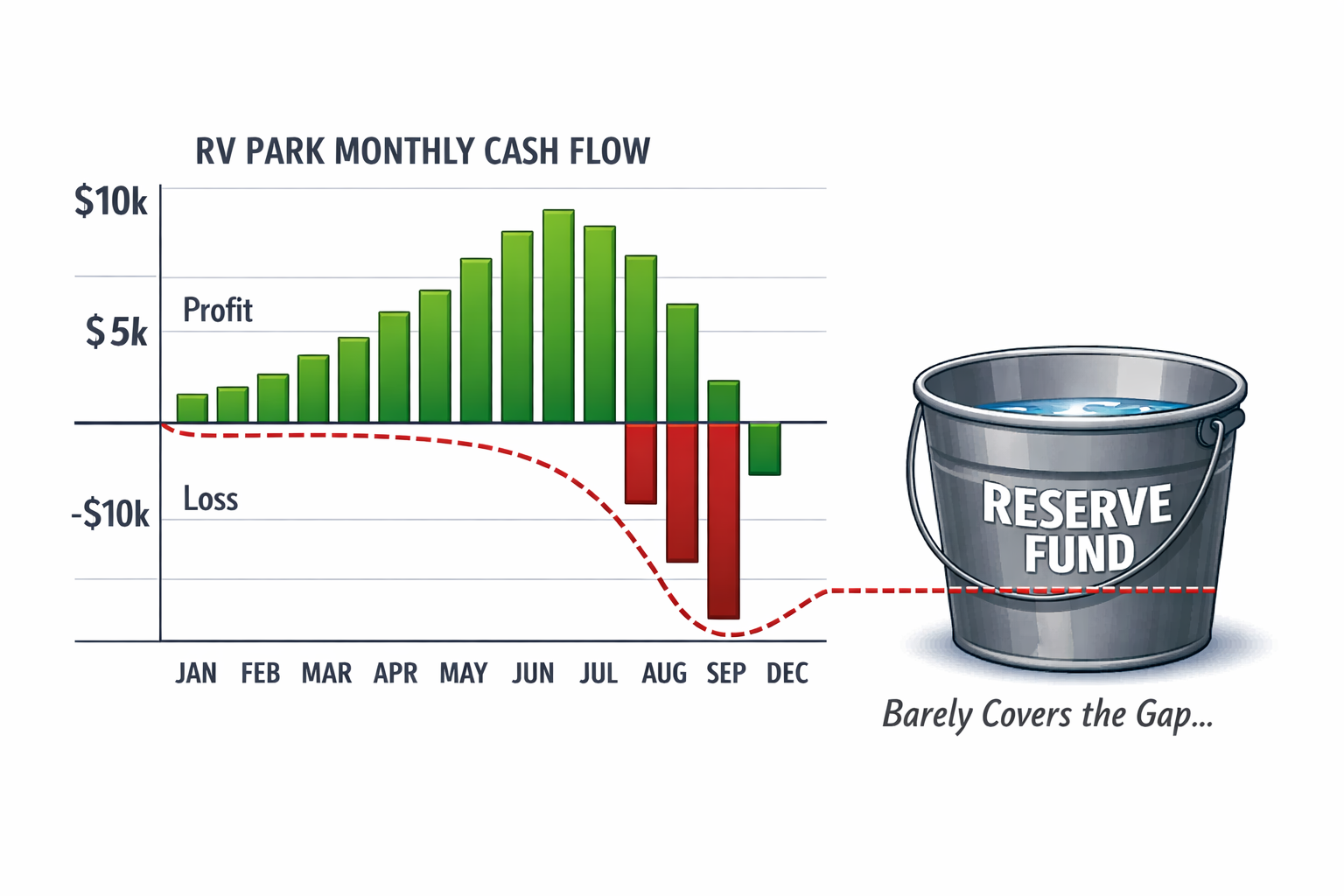
    A park that generates 70% of its annual revenue between Memorial Day and Labor Day is not operating at break-even in October. It is drawing down the cash reserves it built during peak season to cover fixed costs that do not stop just because the rigs do.

    This means a park can be profitable on an annual basis and still run dangerously low on cash in the off-season. The break-even question in outdoor hospitality is not just annual. It is monthly. You need to know which months you cover your costs from operations and which months you are living off of summer’s earnings.

    How to Calculate Your Break-Even

    Start with your total monthly fixed costs. Add those up and that number is your floor. Every month, no matter what, you need at least that much revenue coming in or you are going backward.

    From there, calculate your variable cost ratio. If your variable costs run at roughly 30% of revenue, then for every dollar you bring in, 70 cents is available to cover fixed costs and profit. Divide your total fixed costs by that 70 cents per dollar and you get your break-even revenue number.

    Run this calculation for each month of the year using your actual fixed cost schedule and your historical variable cost ratios. What you end up with is a monthly break-even map that tells you exactly where you are vulnerable and how much cushion your peak season needs to build.

    What to Do With the Number

    Once you know your monthly break-even, a few things become clear. You can see how much cash reserve you need to carry into the slow season to cover the months you will not break even from operations. You can set a minimum acceptable occupancy target for each month. And you can make smarter decisions about off-season rate strategy, because you know exactly what revenue you need to hit instead of guessing.

    The park owners who weather slow seasons without stress are almost always the ones who knew their break-even number going in and planned their cash position accordingly. The ones who get surprised are almost always the ones who never ran the math.

    If you want help building your break-even model, that is one of the first things I build with every new client. It is not complicated, but it is foundational, and having it changes how confidently you run your business.

    And if you have not grabbed a copy of my book yet, ๐—™๐—ฟ๐—ผ๐—บ ๐—ข๐—ณ๐—ณ๐—ฒ๐—ฟ ๐˜๐—ผ ๐—ข๐—ฝ๐—ฒ๐—ฟ๐—ฎ๐˜๐—ถ๐—ผ๐—ป: ๐—ง๐—ต๐—ฒ ๐—–๐—ผ๐—บ๐—ฝ๐—น๐—ฒ๐˜๐—ฒ ๐—ฅ๐—ฉ ๐—ฃ๐—ฎ๐—ฟ๐—ธ ๐—œ๐—ป๐˜ƒ๐—ฒ๐˜€๐˜๐—ผ๐—ฟ’๐˜€ ๐—š๐˜‚๐—ถ๐—ฑ๐—ฒ ($49), it covers the full financial and operational management framework for running your park with the discipline it deserves. You can get it direct here: wendipvifinancial.gumroad.com/l/kqmyb, or Amazon has it too, just search author Wendi Rook.

    Read this next: “Why Your RV Park’s Best Season Can Also Be Its Biggest Financial Risk”

  • The Hidden Tax on Messy Books: What Disorganized Financials Are Costing Your RV Park

    The Hidden Tax on Messy Books: What Disorganized Financials Are Costing Your RV Park

    If you ever plan to sell your RV park, refinance it, bring in a partner, or take out a business line of credit, your books are not just a back-office function. They are a core component of your asset value. And most owners do not realize how directly the quality of their financial records affects the number they walk away with.

    This is not about having perfect books for some hypothetical future event. It is about understanding that messy financials cost you real money, and that the cost is not small.

    How Parks Are Valued

    RV parks are valued primarily on Net Operating Income. A buyer, a lender, or an appraiser takes your NOI and applies a cap rate to arrive at a value. The formula is straightforward: NOI divided by cap rate equals value.

    That means two things matter above everything else. The NOI number itself, and the confidence a buyer or lender has in that number. Clean books produce both. Messy books undermine both.

    What Messy Books Actually Do to a Deal

    When a buyer or their due diligence team opens your financials and finds inconsistent categorization, missing records, commingled personal and business expenses, or revenue that cannot be traced and verified, a few things happen in sequence.

    First, they discount the income. If they cannot verify that a revenue number is real and repeatable, they will not pay full price for it. They will apply a haircut to the NOI they are willing to underwrite, which flows directly into a lower offer.

    Second, they extend the timeline. Every question your books raise adds time to due diligence. Time kills deals. Buyers get cold feet. Financing terms change. The longer a deal sits in due diligence, the more likely it is to fall apart or reprice.

    Third, they renegotiate. Issues found during due diligence become leverage. A buyer who finds $30,000 in unexplained expenses or inconsistent revenue does not usually walk away. They come back with a lower number and a take-it-or-leave-it posture, and you are negotiating from a weak position because the problems are in your own records.

    A recent report from North Star Brokerage noted that clean, organized, verifiable financials are one of the most consistent factors separating properties that close at or near asking price from those that reprice or fall apart in due diligence. That tracks exactly with what I see working with park owners.

    What Lenders See

    Even if you are not selling, your books matter every time you need capital. A bank evaluating a refinance or a line of credit is doing the same analysis a buyer does. They want to see that the income is real, that the expenses are reasonable, and that the business is being run with financial discipline.

    Lenders have gotten more conservative in 2025 and 2026. Clean financials are not just nice to have in this environment. They are often the difference between getting the loan and not getting it.

    What Clean Books Actually Look Like

    Clean books mean your income and expenses are categorized consistently every month. They mean personal and business expenses are completely separated. They mean your bank statements reconcile to your books. They mean you have a profit and loss statement, a balance sheet, and a cash flow statement that are current and accurate. And they mean you can hand your financials to a stranger and they can understand your business without needing you to explain it.

    If you are not there yet, the best time to fix it was the day you closed. The second best time is today. Because the longer messy books compound, the more expensive the cleanup becomes, and the more it costs you when it matters most.

    And if you have not grabbed a copy of my book yet, ๐—™๐—ฟ๐—ผ๐—บ ๐—ข๐—ณ๐—ณ๐—ฒ๐—ฟ ๐˜๐—ผ ๐—ข๐—ฝ๐—ฒ๐—ฟ๐—ฎ๐˜๐—ถ๐—ผ๐—ป: ๐—ง๐—ต๐—ฒ ๐—–๐—ผ๐—บ๐—ฝ๐—น๐—ฒ๐˜๐—ฒ ๐—ฅ๐—ฉ ๐—ฃ๐—ฎ๐—ฟ๐—ธ ๐—œ๐—ป๐˜ƒ๐—ฒ๐˜€๐˜๐—ผ๐—ฟ’๐˜€ ๐—š๐˜‚๐—ถ๐—ฑ๐—ฒ ($49), it covers the full financial and operational management framework for running your park with the discipline it deserves. You can get it direct here: wendipvifinancial.gumroad.com/l/kqmyb, or Amazon has it too, just search author Wendi Rook.

    Read this next: “What is NOI and How to Find the Real Number”

  • The Real Cost of Online Travel Agent (OTA) Dependency

    The Real Cost of Online Travel Agent (OTA) Dependency

    If your RV park fills up every summer, you might think your booking strategy is working. And maybe it is. But if most of those bookings are coming through Hipcamp, Campspot, Outdoorsy, or any other online travel agency, you are paying for that occupancy in ways that do not always show up where you expect them to.

    This is the real cost of OTA dependency, and it is something every park owner needs to understand before they look at their revenue numbers and feel good about what they see.

    What OTAs Actually Cost You

    The commission structure on most OTA platforms runs between 8% and 15% per booking. On a $50 nightly site that does not sound catastrophic. But run it across a full season on 40 sites and you are handing over tens of thousands of dollars in revenue that never hits your bank account. It shows up in your gross revenue line but disappears before it ever becomes cash you can use.

    That is the first problem. Gross revenue looks strong. Net revenue tells a different story.

    The second problem is data. When a guest books through an OTA, the platform owns that relationship. You get a name and a date. You do not get an email address you can market to, a phone number to follow up with, or any real ability to build a direct relationship with that guest. You filled the site. The OTA built their list.

    The third problem is pricing control. Many OTA agreements include rate parity clauses, meaning you cannot offer a lower price on your own website than you list on their platform. So even if you build a beautiful direct booking system, you are not allowed to incentivize it with a better rate. You are competing with a platform that has a bigger marketing budget than you and your hands are partially tied.

    What It Does to Your NOI

    Net Operating Income is the number that determines what your park is worth. Every dollar you lose to OTA commissions is a dollar that does not flow through to NOI. And because parks are valued on a cap rate multiple, losing $20,000 a year in commissions does not just cost you $20,000. At a 7% cap rate, it costs you nearly $285,000 in property value.

    That is not a rounding error. That is real money that disappears because of how your bookings are structured.

    What a Healthy Booking Mix Looks Like

    This is not an argument against using OTAs. They have a place, especially for filling shoulder season gaps, reaching new guests who have never heard of your park, and maintaining visibility on platforms where your competitors are listed. The goal is not zero OTA bookings. The goal is not being dependent on them.

    A healthy booking mix for a stabilized park trends toward 60 to 70 percent direct bookings over time. That means your own website is converting, your repeat guest rate is strong, and you have an email list you actually use. OTAs become a tool you deploy strategically, not a lifeline your revenue depends on.

    Getting there takes time and intentional effort. It means building a direct booking engine, capturing guest emails at check-in, creating a reason for guests to come back and book directly next time, and tracking your booking source every single month so you know whether your mix is improving.

    How to Track This in Your Books

    If you cannot see OTA commissions as a separate line item in your financials right now, that is the first thing to fix. Gross booking revenue and net revenue after platform fees need to live in different places so you always know what you are actually keeping.

    From there, track direct bookings as a percentage of total bookings monthly. Watch that number. It is one of the most important operational KPIs your park has, and most owners are not tracking it at all.

    The parks that build long-term financial strength are the ones that treat their booking channel mix as a financial strategy, not just a marketing decision. Those two things are the same thing, and the sooner you run them together, the better your numbers will look.

    And if you have not grabbed a copy of my book yet, ๐—™๐—ฟ๐—ผ๐—บ ๐—ข๐—ณ๐—ณ๐—ฒ๐—ฟ ๐˜๐—ผ ๐—ข๐—ฝ๐—ฒ๐—ฟ๐—ฎ๐˜๐—ถ๐—ผ๐—ป: ๐—ง๐—ต๐—ฒ ๐—–๐—ผ๐—บ๐—ฝ๐—น๐—ฒ๐˜๐—ฒ ๐—ฅ๐—ฉ ๐—ฃ๐—ฎ๐—ฟ๐—ธ ๐—œ๐—ป๐˜ƒ๐—ฒ๐˜€๐˜๐—ผ๐—ฟ’๐˜€ ๐—š๐˜‚๐—ถ๐—ฑ๐—ฒ ($49), it covers the full financial and operational management framework for running your park with the discipline it deserves. You can get it direct here: wendipvifinancial.gumroad.com/l/kqmyb, or Amazon has it too, just search author Wendi Rook.

    Read this next “What Financial Reports Should You Review Every Month”

  • The Three Numbers That Expose Every Problem in Your RV Park Before It Costs You Money

    The Three Numbers That Expose Every Problem in Your RV Park Before It Costs You Money

    Numbers run every business. But not all numbers are created equal. Some tell you what happened. Some tell you why. And a few, if you track them consistently, tell you where you are headed before you get there.

    Stick with me on this one. It gets a little technical but I promise it is worth the read. These are the numbers that tell you the real story of how your park is performing, and once you understand them you will never look at your financials the same way again.

    In an RV park there are three operating metrics that matter more than any others. They are not complicated. They do not require sophisticated software or a finance degree to calculate. But they are the metrics that separate owners who manage their asset with precision from owners who manage it by feel, and over time that difference shows up dramatically in the financial performance of the park.

    Here they are, what they mean, how to calculate them, and what they are actually telling you when you look at them together.

    Occupancy Rate

    Occupancy rate is the percentage of your available site nights that were actually occupied during a given period. It tells you how full your park was relative to its capacity.

    How to calculate it: divide occupied site nights by total available site nights and multiply by 100 to get a percentage.

    Here is a simple example. Your park has 50 sites. In the month of June there are 30 days. Your total available site nights for June are 50 sites multiplied by 30 days which equals 1,500 available site nights. If 1,050 of those site nights were actually occupied, your occupancy rate for June is 1,050 divided by 1,500 which equals 70 percent.

    What it is telling you: occupancy rate measures demand. A high occupancy rate means guests want to be at your park. A low occupancy rate means either demand is weak, your marketing is not reaching the right people, your pricing is too high, or some combination of all three.

    One important nuance. Occupancy rate alone does not tell you whether you are making money. A park running at 95 percent occupancy at $20 per night is generating less revenue than a park running at 60 percent occupancy at $65 per night. That is why you need all three metrics together, not just one.

    What to watch for: track occupancy rate month over month and year over year. A declining occupancy trend over two or three consecutive months is an early warning signal worth investigating before it shows up as a revenue problem. Rising occupancy combined with flat revenue means your pricing needs attention.

    Average Daily Rate (ADR)

    Average daily rate, or ADR, is the average revenue you earn per occupied site per night. It tells you how effectively you are pricing your inventory.

    How to calculate it: divide total site rental revenue by total occupied site nights.

    Using the same example. Your park generated $68,250 in site rental revenue in June with 1,050 occupied site nights. ADR equals $68,250 divided by 1,050 which equals $65 per night average.

    Some sites rented for $85 a night. Some rented for $45. Some had weekly discounts applied. The ADR blends all of that into one number that tells you on average what you earned per occupied site per night.

    What it is telling you: ADR measures your pricing effectiveness. It reflects the rate you are charging, the mix of site types you are selling, and any discounts or promotions you are running. A low ADR relative to comparable parks in your market suggests you have pricing upside. A declining ADR over time suggests you are discounting more than you should be or your revenue mix is shifting toward lower rate site types or longer stay guests.

    What to watch for: compare your ADR to comparable parks in your market at least once per season. If you are consistently running 15 to 20 percent below market rate and your occupancy is not significantly higher than competitors, you are leaving money on the table. Rate optimization is often the highest return initiative available to a new owner because it requires no capital investment, just pricing discipline.

    Revenue Per Available Site Night (RevPAS)

    Revenue per available site night, sometimes called RevPAS, is the single most powerful operating metric in an RV park because it combines both occupancy and rate into one number. It tells you how much revenue each site in your park generated on average, whether it was occupied or not.

    How to calculate it: divide total site rental revenue by total available site nights.

    Using the same example. Total site rental revenue of $68,250 divided by 1,500 available site nights equals $45.50 RevPAS for June.

    Notice the difference between ADR and RevPAS. ADR was $65 because it only counted occupied site nights. RevPAS is $45.50 because it counts all available site nights including the empty ones. The gap between those two numbers, $65 versus $45.50, reflects your vacancy cost. Every empty site night is a missed revenue opportunity that cannot be recovered.

    What it is telling you: RevPAS is your most honest measure of overall revenue performance because it does not let high occupancy mask low rates or high rates mask low occupancy. Two parks can have identical ADRs and very different RevPAS numbers if their occupancy rates differ. Two parks can have identical occupancy rates and very different RevPAS numbers if their pricing differs. RevPAS captures both simultaneously.

    What to watch for: track RevPAS month over month and year over year. This is the number to compare against your original pro forma projection because it reflects the combined impact of every pricing and occupancy decision you make. A RevPAS that is consistently running below your pro forma means either your rates are lower than projected, your occupancy is lower than projected, or both.

    Reading the Three Metrics Together

    The real power of these metrics comes from looking at all three simultaneously and understanding what the combination is telling you.

    Occupancy up, ADR up, RevPAS up. Everything is working. Understand what is driving it and replicate it.

    Occupancy up, ADR down, RevPAS flat. You are filling sites but discounting to do it. You have a pricing discipline problem.

    Occupancy down, ADR up, RevPAS flat. Your pricing is working but your marketing or demand is lagging. You have a volume problem.

    Occupancy up, ADR up, RevPAS flat or down. Check your math. This combination usually means you have more available sites than you are accounting for, or some sites are being taken out of inventory for maintenance and not being tracked properly.

    Occupancy down, ADR down, RevPAS down significantly. You have a fundamental performance problem that needs immediate investigation. Check your reviews, your competition, your marketing, and your pricing against the market before you do anything else.

    How Often to Track These

    Monthly at minimum. Weekly during peak season if your reservation system makes it easy to pull the data. The value of these metrics comes from the trend over time, not from a single data point. A single month of low occupancy might be weather or a local event. Three consecutive months of declining RevPAS is a pattern that requires a response.

    Build these three numbers into your monthly financial review alongside your P&L review. They contextualize everything else on the income statement and they tell you the operational story that the financial statements alone cannot tell.

    A Note on Data Quality

    These metrics are only as reliable as the data behind them. If your reservation system is not accurately tracking occupied site nights, if you are not recording discounts properly, or if some site types are being categorized inconsistently, your metrics will be misleading.

    Clean data starts with a properly configured reservation and property management system and a consistent process for recording every booking, cancellation, and discount accurately. If you are not confident your data is clean, that is the place to start before you invest time in tracking metrics that may not reflect reality.

    If you want help setting up the tracking and reporting framework to monitor these metrics consistently every month, reach out at pvifinancial.com.

    And if you have not grabbed a copy of my book yet, ๐—™๐—ฟ๐—ผ๐—บ ๐—ข๐—ณ๐—ณ๐—ฒ๐—ฟ ๐˜๐—ผ ๐—ข๐—ฝ๐—ฒ๐—ฟ๐—ฎ๐˜๐—ถ๐—ผ๐—ป: ๐—ง๐—ต๐—ฒ ๐—–๐—ผ๐—บ๐—ฝ๐—น๐—ฒ๐˜๐—ฒ ๐—ฅ๐—ฉ ๐—ฃ๐—ฎ๐—ฟ๐—ธ ๐—œ๐—ป๐˜ƒ๐—ฒ๐˜€๐˜๐—ผ๐—ฟ’๐˜€ ๐—š๐˜‚๐—ถ๐—ฑ๐—ฒ ($49), it covers the full financial and operational management framework for running your park with the discipline it deserves. You can get it direct here: wendipvifinancial.gumroad.com/l/kqmyb, or Amazon has it too, just search author Wendi Rook.


    I think you will find this very helpful as well: “How to Do Your Monthly Financial Review: A Step by Step Guide for RV Park Owners”

  • Your Shoulder Season Revenue Is Being Decided Right Now. Are You Ready?

    Your Shoulder Season Revenue Is Being Decided Right Now. Are You Ready?

    Most RV park owners think about shoulder season when it arrives. The smart ones think about it three to four months before it gets here.

    There is a shift happening in outdoor hospitality that changes the shoulder season conversation entirely. Remote work travel, longer stay behavior, and seasonal migration patterns are filling what used to be dead zones on the calendar. The guest who used to show up only in July is now showing up in April and October too, sometimes for weeks at a time, because their laptop comes with them and their boss does not care where they work from.

    Extended-stay guests now function as an economic stabilizer. They smooth cash flow and reduce reliance on weekend volatility. Parks that optimize for longer bookings are not just increasing occupancy, they are reducing revenue risk.

    But here is the catch. Those guests do not show up automatically just because you are open. They go to the parks that are ready for them, that have positioned themselves correctly, that have the amenities and the marketing in place to attract them. And most of that positioning work needs to happen before shoulder season arrives, not after you are already in it.

    Here is what to be thinking about right now if you want shoulder season to actually move your numbers this year.

    Know Your Numbers From Last Shoulder Season First

    Before you do anything else, pull your occupancy and revenue data from last year’s shoulder season. Not your peak season numbers. Your April, May, September, and October numbers specifically.

    What was your occupancy rate in those months? What was your average daily rate (ADR)? What was your revenue per available site night? How did those numbers compare to your pro forma projections for the same period?

    If you do not have that data broken out by month you have a bookkeeping setup problem to fix before next shoulder season. You cannot manage what you cannot measure and you cannot improve what you have never actually looked at specifically.

    The gap between your peak season performance and your shoulder season performance is your opportunity. Understanding how big that gap is and what is driving it tells you where to focus your energy between now and when shoulder season arrives.

    Who Is Your Shoulder Season Guest?

    Peak season guests are relatively easy to understand. Families on summer vacation, road trippers, RV club rallies. The demand is predictable and the guests largely find you.

    Shoulder season guests are different and understanding who they are changes how you market to them and what you offer them.

    The remote worker is the fastest growing shoulder season guest segment right now. They are not constrained by school calendars or peak season pricing. They can come in April when your park is quiet and stay for two or three weeks because the scenery is good and the Wi-Fi works. They typically have higher household income than the average leisure traveler, they stay longer, and they spend more on-site.

    The seasonal migrant is another significant segment. Snowbirds moving between northern summers and southern winters, retirees following the weather, full-time RV travelers who plan their routes around avoiding peak crowds and peak prices. These guests want longer term availability and they book further in advance than transient guests.

    The shoulder season event attendee is a third segment worth cultivating. Fall festivals, harvest events, local sporting events, hunting season, and fishing season all drive demand in specific markets during shoulder months. Knowing what events happen in your area in April, May, September, and October and positioning your park as the right place to stay for those events is a specific and often underutilized marketing strategy.

    What Your Park Needs to Be Ready

    The remote worker segment in particular has specific needs that not every park is set up to meet. Reliable, fast Wi-Fi is not optional for this guest. Not adequate Wi-Fi. Fast, reliable Wi-Fi that can support video calls, file uploads, and multiple devices simultaneously. If your Wi-Fi infrastructure is consumer-grade equipment that barely covers the office, you are not competitive for this segment regardless of how beautiful your location is.

    A workspace or quiet area where guests can work without being surrounded by children on summer vacation is a differentiator that costs relatively little to create and matters significantly to this guest. A picnic table near a power outlet in a quiet corner of the park is not glamorous but it serves the need.

    For longer stay guests generally, the quality of your laundry facilities matters more than it does for transient guests. So does the reliability of your electrical hookups, the quality of your water pressure, and the availability of package or mail delivery. These guests are living at your park, not just sleeping there. Design the experience accordingly.

    The Marketing Work That Needs to Happen Now

    Shoulder season guests book differently than peak season guests. They are not booking two weeks in advance for a long weekend. They are often planning further out, researching more carefully, and looking for specific features rather than just availability.

    This means your listings on Campendium, The Dyrt, Good Sam, and your own website need to specifically call out what makes your park a good shoulder season destination. Do you have reliable Wi-Fi? Say so explicitly and tell people the speed. Are you near fall foliage? Mention it with the specific months. Do you stay open through October or November when other parks in your area close? That is a competitive advantage worth advertising loudly.

    Your Google Business listing should have current photos that show the park in shoulder season conditions, not just summer shots. A photo of your park in fall foliage with a guest working on a laptop at a picnic table tells a story that a July Fourth crowd photo does not.

    Email your past guest list now if you have one. A simple message that says we are open through October, here is what we have going on this fall, and here is a link to book directly is one of the highest return marketing activities available to you. Past guests who had a good experience are your most likely shoulder season bookings and reaching them costs you almost nothing.

    The Financial Payoff

    National occupancy in 2026 is projected around 65 to 67 percent annually, but the distribution is what tells the real story. The key shift is shoulder season strengthening. Parks that capture that shift outperform the market. Parks that do not capture it are leaving occupancy and revenue on the table during months when their fixed costs are running whether guests show up or not. RV Park University

    Every occupied site night in April or October that would otherwise have been empty is almost pure margin. Your fixed costs, your insurance, your property taxes, your debt service, your base staffing, those are running regardless. The revenue from a shoulder season booking flows to your bottom line at a much higher margin than a peak season booking because you are not adding cost to generate it.

    That is the financial case for taking shoulder season seriously. Not as a nice supplement to peak season revenue, but as a deliberate strategic priority with specific marketing, amenity, and operational decisions behind it.

    The parks that figure this out before shoulder season arrives will outperform the ones that figure it out after.

    If you want help modeling what a stronger shoulder season could do to your annual NOI and asset value, reach out at pvifinancial.com.

    And if you have not grabbed a copy of my book yet, ๐—™๐—ฟ๐—ผ๐—บ ๐—ข๐—ณ๐—ณ๐—ฒ๐—ฟ ๐˜๐—ผ ๐—ข๐—ฝ๐—ฒ๐—ฟ๐—ฎ๐˜๐—ถ๐—ผ๐—ป: ๐—ง๐—ต๐—ฒ ๐—–๐—ผ๐—บ๐—ฝ๐—น๐—ฒ๐˜๐—ฒ ๐—ฅ๐—ฉ ๐—ฃ๐—ฎ๐—ฟ๐—ธ ๐—œ๐—ป๐˜ƒ๐—ฒ๐˜€๐˜๐—ผ๐—ฟ’๐˜€ ๐—š๐˜‚๐—ถ๐—ฑ๐—ฒ ($49), it covers operations, revenue management, and everything you need to run your park with financial discipline year round. You can get it direct here: wendipvifinancial.gumroad.com/l/kqmyb, or Amazon has it too, just search author Wendi Rook.


    Read this next “Don’t Overlook The Vendor Relationships That Can Make or Break Your First Year of RV Park Ownership”

  • Your Bookkeeper Is Not Enough. Here Is What You Are Actually Missing.

    Your Bookkeeper Is Not Enough. Here Is What You Are Actually Missing.

    I want to be clear about something before I say anything else. A good bookkeeper is valuable. If you have someone keeping your books clean, your accounts reconciled, and your transactions categorized correctly every month, that is not nothing. That is the foundation everything else sits on and it matters enormously.

    But a bookkeeper and a CFO are not the same thing. And confusing the two is one of the most common and most expensive mistakes RV park owners make in the first few years of ownership.

    Here is the difference, why it matters, and what you are missing if you only have one of them.

    What a Bookkeeper Does

    A bookkeeper’s job is to accurately record what happened financially in your business. Every transaction gets categorized. Every bank account gets reconciled. The profit and loss statement reflects what came in and what went out. The balance sheet is accurate. The books are clean.

    That is the job. Record, categorize, reconcile, report. Done well it is essential work and it requires real skill and attention to detail. Done poorly it creates a financial picture that is actively misleading and that compounds every bad decision you make from it.

    But here is the key word in that description. A bookkeeper records what happened. Past tense. They are looking backward at transactions that have already occurred and making sure they are accurately represented in your financial records.

    That backward looking function is necessary but it is not sufficient for running a multi-million dollar hospitality business with seasonal cash flow, capital intensive infrastructure, and performance metrics that need to be actively managed month to month.

    What a CFO Does

    A CFO uses the financial records the bookkeeper produces and turns them into forward looking intelligence that drives better decisions.

    Where a bookkeeper tells you what your revenue was last month, a CFO tells you whether that revenue is tracking to your annual projection, what the variance means, and what you should do about it.

    Where a bookkeeper records that your maintenance expense was $8,400 last month, a CFO flags that maintenance has been running below your normalized budget for three consecutive months, which means deferred capital is accumulating, and recommends increasing the reserve contribution before it becomes an emergency.

    Where a bookkeeper reconciles your bank accounts and confirms your balances, a CFO looks at those balances in the context of your upcoming obligations, your seasonal cash flow pattern, and your capital reserve target, and tells you whether you are in a healthy position or heading toward a cash crunch in month four.

    Where a bookkeeper produces a P&L, a CFO reads it against your original underwriting assumptions, identifies the variances that matter, and helps you understand whether the park is performing to the investment thesis you bought it on.

    The bookkeeper produces the map. The CFO reads it and tells you where you are, where you are going, and whether you need to change course.

    Why This Gap Is Especially Dangerous in RV Parks

    In a simple, stable business the gap between bookkeeping and CFO oversight is meaningful but manageable. In an RV park it is particularly consequential for a few reasons.

    Seasonality means your financial picture changes dramatically month to month. A bookkeeper recording accurate monthly transactions does not automatically flag that your peak season cash flow needs to fund six months of off-season expenses. A CFO models that cash flow pattern, sets the reserve targets, and makes sure you are not spending peak season revenue that belongs to February.

    Capital intensity means the decisions you make about maintenance, reserves, and infrastructure investment have long tails. Deferring a capital expenditure to improve your monthly cash flow looks fine in the bookkeeping records until the deferred item fails at the worst possible moment. A CFO tracks the capital picture, funds the reserves, and helps you make those tradeoff decisions with full visibility into the downstream consequences.

    NOI management is the difference between building asset value and just breaking even. A bookkeeper tracks your income and expenses. A CFO actively manages your NOI, identifies the levers that can improve it, and connects your operational decisions to their impact on the value of the asset you own.

    And lender relationships require financial fluency that goes beyond clean books. If you have a loan on the park, your lender expects you to know your numbers. Not to be able to produce a P&L when asked, but to know your DSCR, your occupancy trend, your NOI variance to projection, and your capital reserve position at any given moment. That level of financial fluency requires someone who is actively managing the financial picture, not just recording it.

    What Fractional CFO Actually Means

    Most RV park owners do not need a full time CFO. A full time CFO at market rate costs $150,000 to $250,000 per year in salary alone. That is not a realistic expense for a park at any size where most individual investors operate.

    A fractional CFO provides the same expertise and oversight on a part-time or project basis at a fraction of the cost. You get someone who knows your numbers, reviews your financials every month, flags the issues that need attention, advises on the decisions that affect your financial performance, and makes sure the financial infrastructure is set up to give you the visibility you need to run the asset well.

    For an RV park owner that might mean a monthly financial review engagement where someone goes through the P&L with you, compares it to your pro forma, identifies the variances that matter, and tells you what to do about them. It might mean setting up the chart of accounts, the bank account structure, and the reporting framework when you first take ownership so the foundation is right from day one. It might mean being available when you are evaluating a capital expenditure decision or a financing refinance and need someone to model the numbers before you commit.

    What it is not is a replacement for a bookkeeper. The bookkeeper keeps the records clean. The fractional CFO uses those clean records to help you run the business better. Both have a role and neither replaces the other.

    The Question Worth Asking

    If someone asked you right now what your NOI was last month versus your pro forma projection, could you answer? If they asked whether your capital reserve is adequately funded for the infrastructure needs you identified at acquisition, would you know? If your lender called tomorrow and asked for a financial update, would you be the most informed person in that conversation?

    If the answer to any of those is no or not really, that is the gap a fractional CFO closes.

    Clean books tell you what happened. Active financial management tells you what it means and what to do about it. Both matter. The parks that build real lasting value are the ones run by owners who have both.

    If you want to talk about what fractional CFO support looks like for your park, reach out at pvifinancial.com.

    And if you have not grabbed a copy of my book yet, ๐—™๐—ฟ๐—ผ๐—บ ๐—ข๐—ณ๐—ณ๐—ฒ๐—ฟ ๐˜๐—ผ ๐—ข๐—ฝ๐—ฒ๐—ฟ๐—ฎ๐˜๐—ถ๐—ผ๐—ป: ๐—ง๐—ต๐—ฒ ๐—–๐—ผ๐—บ๐—ฝ๐—น๐—ฒ๐˜๐—ฒ ๐—ฅ๐—ฉ ๐—ฃ๐—ฎ๐—ฟ๐—ธ ๐—œ๐—ป๐˜ƒ๐—ฒ๐˜€๐˜๐—ผ๐—ฟ’๐˜€ ๐—š๐˜‚๐—ถ๐—ฑ๐—ฒ ($49), it covers the full financial management framework for running your park the right way from day one. You can get it direct here: wendipvifinancial.gumroad.com/l/kqmyb, or Amazon has it too, just search author Wendi Rook.


    Read this next: “The Monthly Financial Review Every RV Park Owner Should Be Doing

  • Ignore This Number and Your RV Park Will Cost You Money Every Single Month

    Ignore This Number and Your RV Park Will Cost You Money Every Single Month

    Here is a scenario that plays out more often than it should in RV park acquisitions.

    A buyer finds a park they love. Good location, solid occupancy, clean financials, a motivated seller, and a cap rate that looks attractive for the market. They make an offer, negotiate a price, get financing, and close. And then somewhere in the first few months of ownership they sit down and actually look at the monthly numbers and realize the park is not producing the cash flow they expected. In some cases it is barely breaking even. In a few cases it is costing them money every month.

    Nothing went wrong with the park. The revenue is performing roughly as projected. The expenses are in line. The problem is that the loan payment is consuming most of what is left after expenses and there is almost nothing flowing through to the owner.

    This is a financing structure problem, not an operational problem. And it is almost always detectable before closing if the buyer runs the debt coverage math before they fall in love with the deal rather than after.

    What Debt Service Coverage Ratio Actually Means

    Debt Service Coverage Ratio, or DSCR, is the relationship between what a property earns and what it costs to service the debt on it. It is calculated by dividing the net operating income by the annual debt service, which is the total of all principal and interest payments on the loan.

    A DSCR of 1.0 means the property earns exactly enough to cover the loan payment. Nothing more. A DSCR of 1.25 means the property earns 25 percent more than the loan payment, which is the minimum most commercial lenders require before they will approve financing. A DSCR of 0.90 means the property does not earn enough to cover the loan payment and the owner is subsidizing the shortfall out of pocket every month.

    The formula is simple. Take your rebuilt NOI, the one you calculated from verified data with all missing expenses added back, not the seller’s version, and divide it by your projected annual loan payment. That ratio tells you whether the deal cash flows at the financing terms you are likely to obtain.

    Why Buyers Skip This Step

    The most common reason buyers do not run this calculation before making an offer is that they do not have their financing terms nailed down yet. They are still in the early stages of evaluating the deal and they have not talked to a lender about specific rates and terms for this property.

    That is understandable but it is not a reason to skip the math. You do not need exact financing terms to model DSCR. You need reasonable assumptions. If you know you are likely to put down 25 percent on a commercial loan at roughly current market rates with a 25-year amortization, you can model your approximate annual debt service before you make an offer. That model may shift slightly when you get actual lender terms but it will be close enough to tell you whether the deal is likely to cash flow or not.

    Running the DSCR model on the front end also helps you negotiate. If you know that the deal only achieves a 1.10 DSCR at the asking price with the financing terms you can obtain, you know exactly how much price reduction you need to get to a comfortable 1.25. That is a much stronger negotiating position than making an offer and hoping the financing works out.

    Walking Through the Math

    Let me show you how this works with a straightforward example.

    A park has a rebuilt NOI of $180,000. The asking price is $2,000,000. You plan to put 25 percent down, which means a loan of $1,500,000. At a current commercial rate of 7.5 percent on a 25-year amortization, your approximate annual debt service is around $133,000.

    DSCR equals $180,000 divided by $133,000, which is 1.35. That clears the lender’s minimum of 1.25 comfortably and produces positive cash flow of about $47,000 per year after debt service. That is a deal that works financially.

    Now change one variable. The seller will not come down on price and you pay $2,400,000. Your down payment is now $600,000 and your loan is $1,800,000. At the same rate and term your annual debt service is approximately $160,000.

    DSCR equals $180,000 divided by $160,000, which is 1.125. That is below most lender minimums and it means the park produces only $20,000 per year in cash flow after debt service. One slow month, one unexpected repair, one staffing disruption and you are subsidizing the park out of pocket.

    Same park. Same NOI. Same financing terms. The only variable that changed was the purchase price, and the difference between paying $2,000,000 and $2,400,000 is the difference between a park that works and one that is a financial stress every single month.

    The Lender’s Perspective and Why It Matters to You

    Your lender calculates DSCR too and their calculation determines whether you get the loan. Most commercial lenders require a minimum DSCR of 1.20 to 1.25 at the loan amount you are requesting. If your deal does not clear that threshold, the lender will either decline the loan, reduce the loan amount, or require a larger down payment.

    Understanding this before you make an offer means you are never surprised by a lender telling you the deal does not pencil at your financing assumptions. You have already run the math and you know exactly what DSCR looks like at different price points and loan amounts.

    It also means you can have a more intelligent conversation with your lender. Instead of presenting a deal and hoping it qualifies, you can walk in and say here is the NOI, here is the purchase price, here is the down payment, and here is the DSCR at those terms. Lenders respond very differently to borrowers who know their numbers going in.

    What to Do When the DSCR Does Not Work

    If you run the DSCR calculation and the deal does not cash flow at the asking price with realistic financing terms, you have several options.

    The first is to negotiate a lower price. Every dollar you take off the purchase price reduces your loan amount, reduces your debt service, and improves your DSCR. Use the DSCR math to calculate exactly how much price reduction you need to reach your target coverage ratio and make that the basis of your negotiation.

    The second option is a larger down payment. Putting 30 or 35 percent down instead of 25 reduces your loan amount and improves your debt coverage. This only works if you have the additional capital available and if the improved cash flow justifies tying up more equity in the deal.

    The third option is to walk away. If the seller will not negotiate to a price that makes the financing work and you do not have the capital for a larger down payment, the deal does not work for you at this time. That is not a failure. That is the discipline that protects you from owning an asset that costs you money every month.

    The Bigger Point

    DSCR is not a complicated concept and the math is not difficult. But it requires you to model the financing before you make an offer rather than after, which means you need to have a reasonably clear picture of the financing terms you are likely to obtain before you get too deep into any deal.

    Talk to your lender early. Not after you have a signed purchase agreement, but before you make an offer on any park you are seriously considering. Understand what rate and terms you are likely to get on a commercial RV park loan at your current financial profile. Then run the DSCR on every deal you evaluate before you get emotionally attached to any of them.

    The buyers who build real wealth in this asset class are the ones who run the numbers before they fall in love, not the ones who fall in love and then hope the numbers work out.

    If you want help modeling the debt coverage on a specific deal you are evaluating, reach out at pvifinancial.com. That is exactly the kind of analysis I do before my clients make an offer.

    And if you have not grabbed a copy of my book yet, ๐—™๐—ฟ๐—ผ๐—บ ๐—ข๐—ณ๐—ณ๐—ฒ๐—ฟ ๐˜๐—ผ ๐—ข๐—ฝ๐—ฒ๐—ฟ๐—ฎ๐˜๐—ถ๐—ผ๐—ป: ๐—ง๐—ต๐—ฒ ๐—–๐—ผ๐—บ๐—ฝ๐—น๐—ฒ๐˜๐—ฒ ๐—ฅ๐—ฉ ๐—ฃ๐—ฎ๐—ฟ๐—ธ ๐—œ๐—ป๐˜ƒ๐—ฒ๐˜€๐˜๐—ผ๐—ฟ’๐˜€ ๐—š๐˜‚๐—ถ๐—ฑ๐—ฒ ($49), it covers DSCR and every other financial metric you need to evaluate an RV park deal with confidence. You can get it direct here: wendipvifinancial.gumroad.com/l/kqmyb, or Amazon has it too, just search author Wendi Rook.


    You might want to read this next: “Before You Fall in Love With That RV Park, Do This First”

  • Don’t Overlook The Vendor Relationships That Can Make or Break Your First Year of RV Park Ownership

    Don’t Overlook The Vendor Relationships That Can Make or Break Your First Year of RV Park Ownership

    There is a moment that happens to almost every new RV park owner somewhere in the first 90 days of ownership. Something breaks, or a service needs to be scheduled, or a vendor shows up expecting payment on terms you did not know existed, and you realize that the previous owner had a web of relationships, agreements, and informal arrangements that nobody thought to document and nobody transferred to you at closing.

    The pool chemical supplier who has been coming every Tuesday for eight years and bills net 30 does not know you exist. The electrician who knows the quirks of the aging distribution system and shows up same day when something fails has never heard your name. The waste hauler who has a verbal arrangement with the previous owner about pickup scheduling just keeps showing up on whatever schedule they agreed to two years ago.

    Some of those relationships will transfer smoothly. Others will not. And the ones that do not tend to reveal themselves at the worst possible moment, during peak season, on a holiday weekend, when you are already managing a full park and cannot afford an operational disruption.

    Here is how to think about vendor relationships from pre-close through your first year so you are not the new owner piecing it together after the fact.

    Before You Close: Know What You Are Inheriting

    The due diligence phase is your opportunity to understand every vendor relationship the park has and what the terms of each one are. Most buyers focus on the financial and legal documents and treat vendor contracts as a secondary concern. That is a mistake.

    Request a complete list of all current vendors and service providers as part of your due diligence document request. For each one you want to know the nature of the service, the contract terms if there is a written agreement, the payment terms, the renewal or termination provisions, and how long the relationship has been in place.

    Pay particular attention to any vendor with a contract that has a remaining term. A laundry equipment lease with 24 months left at $450 per month is a $10,800 obligation you are inheriting. A pest control contract with an auto-renewal clause that triggered last month means you are locked in for another year whether you wanted that vendor or not. A propane supply agreement with a price lock expiring in three months means you are about to face a cost increase that was not in anyone’s financial projections.

    Also ask specifically about any verbal or informal arrangements. Long-term owner-operated parks frequently have handshake deals that have never been written down. The seller may not even think to mention them because they are so embedded in how the park operates that they feel like just the way things work. Ask directly: are there any vendor relationships or service arrangements that are not covered by a written contract?

    For any vendor with a significant contract, confirm whether the agreement transfers automatically to a new owner or requires the vendor’s consent to assign. Some contracts have anti-assignment clauses that require the vendor to agree to the transfer. If the vendor decides they do not want to work with the new owner, or if they use the transition as an opportunity to renegotiate terms, you need to know that before closing, not after.

    At Closing: The Transition That Most Buyers Skip

    One of the most valuable things you can negotiate in your purchase agreement is a structured vendor transition period. This means the seller agrees to introduce you to key vendors, facilitate the transfer of accounts and relationships, and remain available for a defined period after closing to answer questions and help smooth the handoff.

    Most sellers are willing to do this. Most buyers do not think to ask for it specifically enough to make it happen.

    The vendors worth prioritizing in the transition are the ones where the relationship is personal and the institutional knowledge is significant. The electrician who knows your distribution system. The plumber who has dealt with your well and septic infrastructure. The maintenance contractor who knows which sites have drainage issues and which equipment is approaching end of life. These are not interchangeable service providers you can replace with a Google search. They carry knowledge that took years to accumulate and that knowledge has real operational value.

    Ask the seller to make personal introductions. Not a list of phone numbers but an actual introduction, even if it is just a phone call or an email that says this is the new owner, please work with them the way you have worked with me. That introduction changes the dynamic significantly in the first few months when you are still learning the property and need vendors who will show up and give you the benefit of the doubt.

    Your First 90 Days: Building the Relationships That Will Sustain You

    Once you own the park, the vendor relationship work shifts from inheriting what exists to actively building what you need.

    Start by meeting every significant vendor in person within the first 30 days. Show up when they are on site. Introduce yourself. Ask questions about the property, not just about the service they provide. A good vendor who has been working with a park for years knows things about the physical condition and history of the property that never made it into any document. That knowledge is worth cultivating.

    Pay your vendors on time, every time, from day one. This sounds obvious but new owners who are managing cash flow carefully sometimes slow-walk vendor payments when money is tight. Nothing damages a new vendor relationship faster or more permanently than a pattern of late payment in the first few months. Your vendors talk to each other, and a reputation for paying slowly follows you in ways that are difficult to recover from.

    Be honest about what you do not know. Vendors who have been working with a property for years are often the best source of operational intelligence you have in the first 90 days. Ask them what they have observed about the property. Ask them what they think you should know. Most vendors appreciate being treated as partners rather than just service providers and they will tell you things that would otherwise take you years to learn on your own.

    Building New Vendor Relationships When the Old Ones Do Not Transfer

    Sometimes the seller’s vendor relationships do not transfer. The longtime handyman retires. The pool service company is bought out and the new owners raise rates significantly. The electrician who knew your system moves away. These transitions happen and they are disruptive, but they are manageable if you approach them proactively rather than reactively.

    Do not wait until something breaks to find a new electrician. In the first 30 days of ownership, identify the critical service categories where you do not have a reliable vendor relationship and start building those relationships before you need them urgently. Get quotes. Meet contractors. Find out who other park owners in your area use and trust.

    Your local RV park and campground association is one of the best resources for vendor referrals. Other park owners in your region have already done the work of finding reliable service providers and most of them are willing to share that knowledge. Join the association, go to the meetings, and ask the questions. The vendor network you build through those relationships will serve you for as long as you own the park.

    The Bigger Picture

    Vendor relationships are not a glamorous part of RV park ownership. They do not show up in the pro forma and they do not get discussed at acquisition conferences. But they are one of the most reliable predictors of how smooth or how chaotic your first year of ownership will be.

    The parks that transition well are the ones where the new owner knew what they were inheriting, asked the right questions during due diligence, negotiated a proper transition period, and invested time in building relationships with the people who keep the property running. The parks that struggle in year one are often the ones where the new owner discovered the vendor situation the hard way, one broken piece of equipment or one missed service call at a time.

    Do the work before you close. Build the relationships after you close. And treat every vendor who shows up at your park as a partner in making the asset perform the way you need it to.

    If you want help thinking through the vendor and operational transition for a park you are acquiring, or want a fractional CFO in your corner as you navigate the first year of ownership, reach out at pvifinancial.com.

    And if you have not grabbed a copy of my book yet, ๐—™๐—ฟ๐—ผ๐—บ ๐—ข๐—ณ๐—ณ๐—ฒ๐—ฟ ๐˜๐—ผ ๐—ข๐—ฝ๐—ฒ๐—ฟ๐—ฎ๐˜๐—ถ๐—ผ๐—ป: ๐—ง๐—ต๐—ฒ ๐—–๐—ผ๐—บ๐—ฝ๐—น๐—ฒ๐˜๐—ฒ ๐—ฅ๐—ฉ ๐—ฃ๐—ฎ๐—ฟ๐—ธ ๐—œ๐—ป๐˜ƒ๐—ฒ๐˜€๐˜๐—ผ๐—ฟ’๐˜€ ๐—š๐˜‚๐—ถ๐—ฑ๐—ฒ ($49), it covers the full operational transition framework for new RV park owners. You can get it direct here: wendipvifinancial.gumroad.com/l/kqmyb, or Amazon has it too, just search author Wendi Rook.


    Read this next: “Before You Fall in Love With That RV Park, Do This First”

  • Before You Fall in Love With That RV Park, Do This First

    Before You Fall in Love With That RV Park, Do This First

    I looked at a deal yesterday. Someone brought it to me excited, good location, decent revenue, motivated seller, and a price that was at least a starting point worth the conversation. And sitting right there in the property description was a detail that changed the entire conversation.

    The park had its own wastewater treatment plant.

    Not a septic system. Not a municipal sewer connection. A full commercial wastewater treatment facility on the property that the owner was responsible for operating, maintaining, and keeping in compliance with state and federal environmental regulations.

    That single detail did not kill the deal. But it changed everything about how you have to look at it. The capital exposure, the regulatory risk, the operational complexity, the insurance implications, the cost to remediate if something goes wrong. A wastewater plant that fails or falls out of compliance is not a $50,000 problem. It can be a $500,000 to $1,000,000 problem and it can shut your park down while you fix it.

    The buyer who walked into that deal without knowing what to look for would have seen a park with good bones and a motivated seller. The buyer who knows what questions to ask sees a completely different asset.

    Here is how to put eyes on a deal before you fall in love with it.

    Step 1: Run the Red Flag Pass First

    Before you rebuild a single number, before you model the debt coverage, before you think about what you are going to offer, run a red flag pass on the deal. This is a quick but deliberate scan of the property, the financials, and the operational setup specifically looking for the issues that can make a deal uninvestable or require significant price adjustment.

    The red flags fall into five categories and you need to check all five before you go any deeper.

    Financial red flags are the ones hiding in the numbers. Is the NOI missing a management fee because the owner self-manages? Is the owner working full time in the business without drawing a market rate salary? Are the utility costs suspiciously low? Is maintenance running below 4 percent of gross revenue, which almost always means deferred capital is building up? Does the revenue show a declining trend over the last three years? Any one of these changes the value of the deal.

    Operational red flags tell you whether the business actually runs without the current owner. Is there a manager in place or does the owner handle everything personally? Are there documented systems and processes or does the institutional knowledge live entirely in one person’s head? What do the online reviews look like over the last two years? A park with declining review scores is showing you the early signs of a revenue problem that has not shown up in the financials yet.

    Infrastructure red flags are the ones that cost you the most money and give you the least warning. When was the septic or wastewater system last inspected? What is the age and capacity of the electrical distribution system? Are the roads maintained or are there signs of deferred grading and drainage issues? What is the condition of the bathhouses? Every major system has a finite lifespan and a replacement cost. Know where each one sits in that lifespan before you make an offer.

    And then there is the wastewater plant situation. A private wastewater treatment facility is a category of infrastructure risk that goes beyond a standard septic inspection. You are looking at regulatory compliance requirements, operator licensing, ongoing testing and reporting obligations, and capital exposure that is difficult to estimate without an environmental engineer on site. If a deal has one, it needs a specialist assessment before you can price it accurately. Do not guess on this one.

    Legal and compliance red flags include zoning that has not been confirmed in writing, permits that may not transfer to a new owner, open code violations, environmental concerns including flood plain designation and wetlands, and any pending or threatened legal claims. Zoning nonconformity in particular is one of the most dangerous and least visible risks in any RV park acquisition. A park that has been operating for years without anyone ever confirming the use is legally conforming can face serious exposure if the municipality ever decides to enforce.

    Structural red flags are about the deal itself rather than the property. Is this an asset purchase or a stock purchase and do you fully understand the liability implications? Has the revenue mix been verified and does it create financing challenges with your lender? Are there advance reservation deposits that are not properly accounted for? Are there OTA contracts with auto-renewal clauses or rate parity requirements that limit how you can run the park after closing?

    If the red flag pass surfaces more than two or three significant issues, that does not automatically mean you walk away. It means you need to understand the cost and complexity of each issue before you go any further. A red flag with a quantifiable cost is a negotiating point. A red flag with an unknown cost is a reason to slow down.

    Step 2: If It Passes, Underwrite It

    If the red flag pass comes back clean or with issues you understand and can price, now you underwrite the deal.

    Start by rebuilding the NOI from the source documents. Not from the broker package. Not from the seller’s summary. From the actual bank statements and tax returns. Three years of each.

    Pull the gross revenue from the bank deposits and confirm it matches what the financials show. Then rebuild the expense side from scratch. Add back every missing expense, the management fee if the owner self-manages, market rate compensation for any owner labor not reflected in the books, normalized maintenance to at minimum 4 percent of gross, a capital reserve contribution of 5 percent of gross, and any utility costs that have been understated or absorbed.

    What you are left with after that rebuild is the real NOI. Divide that by the cap rate appropriate for the market and the asset quality and you have your supportable value. Compare that to the asking price and you know whether you have a deal worth pursuing or a price negotiation to have.

    Then model the debt coverage at the financing terms you can realistically obtain. Does the rebuilt NOI support your loan payment with a DSCR of at least 1.20 to 1.25? What does your cash-on-cash return look like on your total capital deployment including down payment, closing costs, reserves, and any identified CapEx?

    If the numbers hold up after that analysis you have a deal worth making an offer on. If they do not, you have the information you need to either renegotiate or move on.

    The Most Expensive Mistake in RV Park Investing

    The most expensive mistake buyers make is doing these two steps in the wrong order. They underwrite the deal first, fall in love with the numbers, start imagining what the park could be, and then run the red flag pass as a formality rather than a genuine investigation. By that point they are emotionally committed and the red flags become obstacles to rationalize rather than signals to respect.

    Run the red flag pass first. Every time. On every deal. Before you model a single number.

    The wastewater plant deal I mentioned at the top? The buyer is still evaluating it. It may still be a good deal at the right price with the right environmental assessment and the right capital budget. But they are going into that assessment with clear eyes because they ran the flags first, not after they had already decided they wanted the park.

    That is the difference between a buyer who knows what they are buying and one who finds out after they close.

    If you want a second set of eyes on a deal you are evaluating, reach out at pvifinancial.com. Acquisition underwriting and red flag review is exactly what I do.

    And if you have not grabbed a copy of my book yet, ๐—™๐—ฟ๐—ผ๐—บ ๐—ข๐—ณ๐—ณ๐—ฒ๐—ฟ ๐˜๐—ผ ๐—ข๐—ฝ๐—ฒ๐—ฟ๐—ฎ๐˜๐—ถ๐—ผ๐—ป: ๐—ง๐—ต๐—ฒ ๐—–๐—ผ๐—บ๐—ฝ๐—น๐—ฒ๐˜๐—ฒ ๐—ฅ๐—ฉ ๐—ฃ๐—ฎ๐—ฟ๐—ธ ๐—œ๐—ป๐˜ƒ๐—ฒ๐˜€๐˜๐—ผ๐—ฟ’๐˜€ ๐—š๐˜‚๐—ถ๐—ฑ๐—ฒ ($49), it covers the full red flag framework and underwriting process in detail, plus a bonus report with 34 specific red flags to verify before you close. You can get it direct here: wendipvifinancial.gumroad.com/l/kqmyb, or Amazon has it too, just search author Wendi Rook.


    Read this next: “The $312,000 Mistake: What Happens When a Buyer Accepts the Seller’s NOI Without Rebuilding It”


  • How to Do Your Monthly Financial Review: A Step by Step Guide for RV Park Owners

    How to Do Your Monthly Financial Review: A Step by Step Guide for RV Park Owners

    Most RV park owners know they should be reviewing their financials every month. Very few of them know exactly how to do it in a way that is actually useful rather than just stressful.

    This post is the step by step guide. Not a list of things to look at, but a walkthrough of how to actually do each piece of the review, what you are looking for, and what to do with what you find. Keep it open the first few times you sit down with your numbers. Eventually it becomes second nature.

    Before you start, make sure your books are closed and reconciled for the month. Every bank account should match your bookkeeping software. Every transaction should be categorized. If your books are not reconciled, do that first. Reviewing unreconciled financials is like reading a map with missing roads. You will get somewhere but it will not be where you intended.

    Set a recurring appointment on the same day every month. The 10th works well for most operators because it gives enough time after month end for everything to settle. Treat it as a fixed commitment, not something you get to when you have time.

    Step 1: Revenue Review

    Open your profit and loss statement for the month. Start at the top with total gross revenue.

    Write down three numbers side by side: what you brought in this month, what you brought in during the same month last year, and what your pro forma projected for this month. You are looking for the story those three numbers tell together.

    If you are ahead of last year and ahead of pro forma, something is working. Your job is to understand what specifically drove the improvement so you can replicate it. Was it a rate increase? Better occupancy? A new revenue stream? Dig one level deeper before you move on.

    If you are behind last year or behind pro forma, your job is to understand why before you explain it away. Slow months happen. Weather happens. Local events cancel. But a gap between projected and actual revenue that does not have a clear explanation is a signal worth investigating, not dismissing.

    Now break revenue down by stream. This is where the real information lives. Total revenue tells you what happened. Revenue by stream tells you where it came from and where it did not.

    Look at each stream individually. Transient nightly revenue, long-term tenant revenue, cabin and glamping income, utility recovery, store and ancillary sales, laundry, events. For each one ask: is this performing the way I expected it to? Is it growing, flat, or declining relative to last year? If you do not have this level of detail in your books, that is a setup problem to fix before next month, not something to work around indefinitely.

    Step 2: Expense Review

    Move down the P&L to the expense section. Go through every line item and compare it to two things: your budget for that line and the same line from the same month last year.

    You are looking for two types of variance and both matter.

    The first is expenses running above budget. Pull out any line that is more than 10 to 15 percent above what you budgeted and write it down. For each one, ask why. Was it a planned expense that hit in a different month than expected? A price increase from a vendor? A repair that came up unexpectedly? Every above-budget line has a story and knowing the story tells you whether it is a one-time event or a trend that needs to be addressed.

    The second type of variance is expenses running below budget, and this one catches people off guard because it looks like good news. Sometimes it is. But a maintenance line running 40 percent below budget during peak season is almost never good news. It usually means maintenance is being deferred. That deferred cost does not disappear. It is money you will eventually spend, just later and usually at a worse time. Watch the low variances just as carefully as the high ones.

    Pay particular attention to your utilities line. Pull your actual utility bills and compare them to what your books show for the month. Make sure every utility cost is accounted for, including any electrical costs for long-term tenant sites that might be getting absorbed rather than passed through.

    Step 3: NOI Calculation and Variance

    Once you have reviewed revenue and expenses, calculate your actual NOI for the month. Gross revenue minus total operating expenses. Write that number down.

    Now pull your pro forma and find the projected NOI for that same month. Compare the two.

    The variance between actual and projected NOI is the most important number in your monthly review. It tells you whether the park is performing to the investment thesis you underwrote when you bought it.

    If actual NOI is consistently running below projected NOI, you have a performance gap that needs to be understood and addressed. Is it coming from the revenue side, the expense side, or both? The answer to that question determines what you do about it.

    If actual NOI is running above projected, understand why before you assume you are just doing well. Sometimes above-projection NOI is genuinely driven by better performance. Sometimes it is driven by deferred maintenance or costs that have not hit yet. Know which one it is.

    Track your year-to-date NOI alongside the monthly number. A single month can be misleading. A cumulative picture is more reliable.

    Step 4: Cash Position Review

    Set aside the P&L and look at your bank accounts directly.

    Check your operating account balance. Does it reflect what you expected based on the month’s revenue and expenses? If there is a meaningful gap between what the P&L shows and what is actually in the account, find out why before you move on. Timing differences happen but unexplained gaps need investigation.

    Check your capital reserve account. Confirm that this month’s transfer went in. Your capital reserve should receive a minimum of 5 percent of gross revenue every single month without exception. If you skipped it because it was a slow month, transfer it now. The capital needs that reserve is protecting do not take slow months off.

    Check your tax reserve account. Confirm the monthly contribution went in. If you are uncertain what percentage of net income to set aside for taxes, that is a conversation to have with your CPA, but whatever the number is, it needs to be funded monthly not scrambled for at tax time.

    Step 5: Operating Metrics

    The last piece of the review is your operating metrics. These three numbers together tell you more about the health of the business than any single line on the income statement.

    Occupancy rate is the percentage of available site nights that were actually occupied during the month. Calculate it by dividing occupied site nights by total available site nights. Compare it to the same month last year and to your pro forma projection.

    Average daily rate, or ADR, is your average revenue per occupied site per night. Here is a simple example so you can picture it clearly. Say your park has 40 sites and last month 30 of those sites were occupied for the full 30 days of the month. That gives you 900 occupied site nights. If your total site rental revenue for the month was $36,000, your ADR is $36,000 divided by 900, which equals $40 per night. Some sites may have rented for $55, some for $30, some had weekly discounts. The ADR averages all of that into one number that tells you what you earned on average per occupied site per night. Compare your ADR to the same month last year and to your pro forma.

    Revenue per available site night combines both metrics into one number that accounts for both rate and occupancy simultaneously. Calculate it by dividing total site rental revenue by total available site nights, not just occupied ones. Using the same example, if your park has 40 sites and 30 days in the month, you have 1,200 available site nights. Divide your $36,000 revenue by 1,200 and you get $30 revenue per available site night. This number is particularly useful because it captures both how full you were and how much you charged, all in one figure.

    When you look at these three metrics together you can diagnose what is driving your revenue performance quickly. Occupancy up and ADR up means strong performance on both fronts. Occupancy up but ADR down means you are filling sites but leaving rate on the table, which is a pricing opportunity. ADR up but occupancy down means your pricing may be working against your volume, which is a marketing or demand issue. Both flat or both down means something more fundamental needs attention.

    Step 6: Document Your Findings and Decide What to Do

    The review is not finished when you have looked at all the numbers. It is finished when you have documented what you found and made a decision about what if anything you are doing about it.

    For every material variance, write down three things: what the variance was, what caused it, and what action if any you are taking. Keep this in a running monthly log that you add to every month. Over time this log becomes one of your most valuable operational documents. It shows you patterns, informs your planning, and if you ever sell the park it demonstrates to buyers that the asset was actively and intelligently managed.

    If a variance has no action because it is explainable and acceptable, write that down too. The act of documenting forces you to actually think through whether you are comfortable with what you found rather than just moving on.

    A Note on Setup

    If you sat down to do this review and realized you do not have the data you need, that is important information. Revenue that is not broken out by stream, expenses that are lumped into generic categories, bank accounts that are not reconciled, these are setup problems that make every future review harder and less useful than it should be.

    The time to fix the setup is now, not after another month of incomplete information. A chart of accounts built specifically for an RV park, connected bank feeds, and a clean monthly close process are the foundation everything else sits on.

    If you want help setting up that foundation or want someone to run this review for you every month so you always have a clear picture of where you stand, reach out at pvifinancial.com.

    And if you have not grabbed a copy of my book yet, ๐—™๐—ฟ๐—ผ๐—บ ๐—ข๐—ณ๐—ณ๐—ฒ๐—ฟ ๐˜๐—ผ ๐—ข๐—ฝ๐—ฒ๐—ฟ๐—ฎ๐˜๐—ถ๐—ผ๐—ป: ๐—ง๐—ต๐—ฒ ๐—–๐—ผ๐—บ๐—ฝ๐—น๐—ฒ๐˜๐—ฒ ๐—ฅ๐—ฉ ๐—ฃ๐—ฎ๐—ฟ๐—ธ ๐—œ๐—ป๐˜ƒ๐—ฒ๐˜€๐˜๐—ผ๐—ฟ’๐˜€ ๐—š๐˜‚๐—ถ๐—ฑ๐—ฒ ($49), it covers the full financial management framework for running your park with the discipline it deserves.

    You can get it direct here: https://wendipvifinancial.gumroad.com/l/kqmyb, or Amazon has it too, just search author Wendi Rook.

    Download the free Monthly Financial Review Checklist here to use alongside this guide every month.