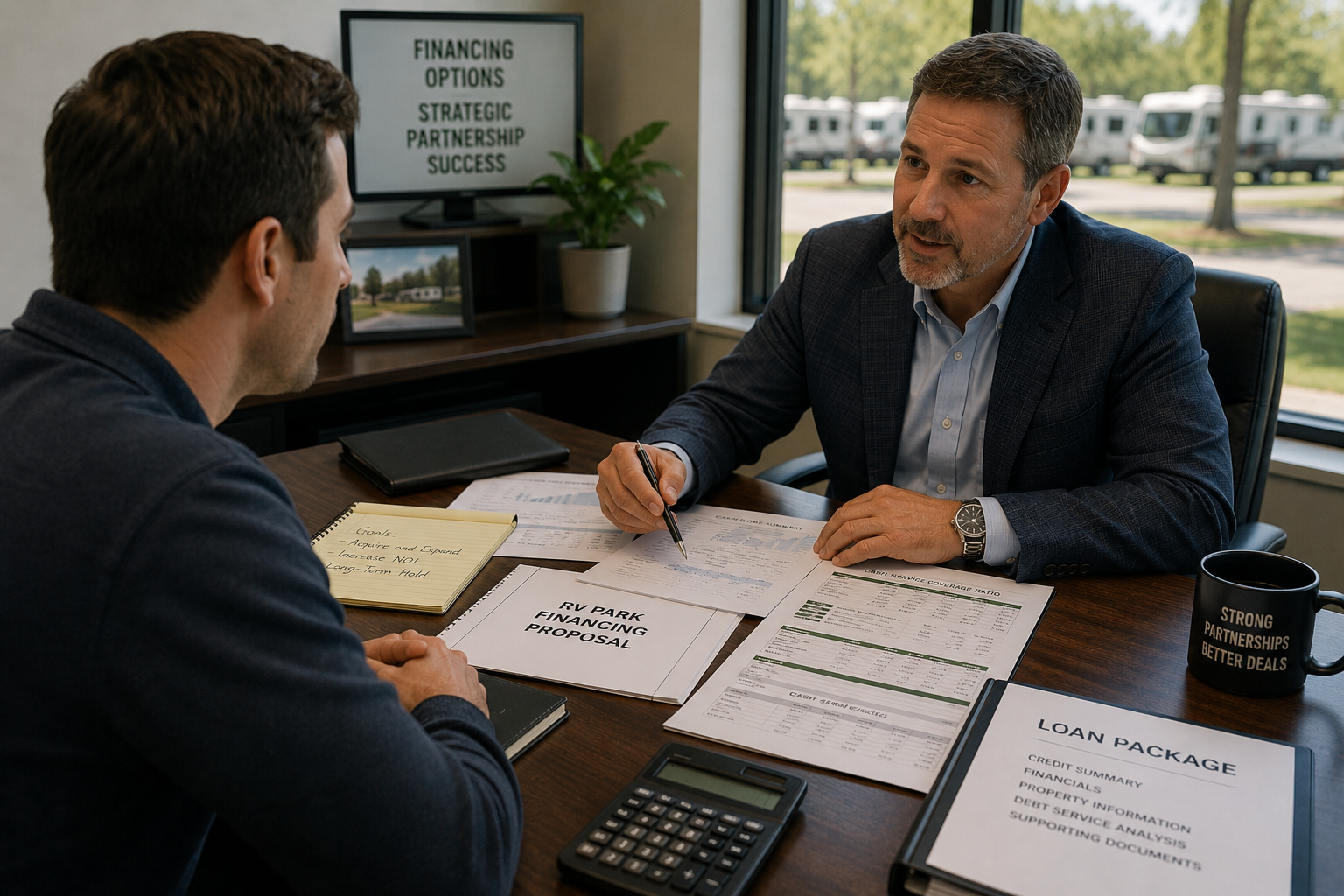
Knowing how to finance an RV park before you start making offers is one of the biggest advantages you can have in a competitive market. Most buyers do it backwards. They find a park they love, get under contract, and then start scrambling to figure out the money. That approach costs time, costs deals, and sometimes costs buyers their earnest money when financing falls through at the last minute.
Understanding how to finance an RV park gives you clarity on your budget, your down payment requirements, and your debt service before you ever submit an LOI. Knowing how to finance an RV park also tells a seller that you are a serious, prepared buyer who can actually close.
Here are the five financing options every serious RV park buyer needs to understand:
1. SBA 7(a) loans
The SBA 7(a) loan is one of the most popular options for buyers figuring out how to finance an RV park, and for good reason. It offers loan amounts up to $5 million, repayment terms up to 25 years for real estate, and interest rates that are capped and generally competitive with conventional options.
For first time RV park buyers, the SBA 7(a) typically requires 10% down, which makes it one of the most accessible entry points into the asset class. For buyers who already own at least one operating RV park, some lenders will finance up to 100% of the acquisition cost under the right circumstances.
There are a few important things to know. The park must generate more than 50% of its revenue from short term stays of 30 days or less to qualify as SBA eligible. Monthly or seasonal tenants may or may not count toward that threshold depending on how your lender interprets the guidelines. And not all SBA lenders are created equal. Some have deep experience in outdoor hospitality and understand how to underwrite a seasonal business. Others do not, and working with the wrong lender can derail a deal that should have closed easily.
For more on what lenders look at when evaluating a deal, read What a Lender Actually Looks at Before Approving an RV Park Loan.
Knowing how to finance an RV park through the SBA 7a program is one of the most accessible paths into outdoor hospitality ownership.
2. SBA 504 loans
The SBA 504 loan is specifically designed for fixed asset purchases including real property. It is structured differently from the 7(a) and works best for buyers purchasing land or an existing campground facility rather than a business acquisition with significant goodwill.
The 504 program typically requires 15% to 20% down depending on whether it is an expansion of an existing business or a new acquisition. It offers long term fixed rate financing on the real estate portion of the deal, which can be attractive in a higher interest rate environment where locking in a fixed rate provides payment certainty.
The 504 is less flexible than the 7(a) for business acquisitions but can be a strong option for the right deal structure. Your lender can help you determine which program fits your specific transaction. The 504 is less commonly discussed when buyers research how to finance an RV park but for the right deal structure it can be the most cost effective option.
3. Conventional commercial loans
Conventional commercial financing from banks and credit unions is another option for how to finance an RV park, particularly for buyers with strong financials, significant equity, or an existing relationship with a lender. Conventional loans typically require 20% to 30% down and have shorter amortization periods than SBA loans, which means higher monthly payments but sometimes lower overall cost depending on the rate and terms.
The advantage of conventional financing is speed and flexibility. There is less paperwork than SBA, fewer restrictions on how the loan proceeds can be used, and in some cases faster closing timelines. The disadvantage is the larger down payment requirement and the fact that most conventional lenders do not specialize in outdoor hospitality, which means they may not understand the seasonal nature of the business or how to properly underwrite it.
4. Seller financing
Seller financing is one of the most powerful and underutilized tools in how to finance an RV park, especially in the current market. When a seller agrees to carry a portion of the purchase price as a note, it reduces the amount you need to borrow from a traditional lender, lowers your down payment requirement, and can often be structured with more flexible terms than a bank will offer.
Seller financing works particularly well for mom and pop operators who own their parks free and clear or with minimal debt, want to spread the tax liability of the sale over several years, and are motivated by income rather than a lump sum. Not every seller is open to it but it is always worth asking, especially if the park has been on the market for a while or if the seller is motivated by something other than maximizing the sale price.
For a detailed walkthrough of how to analyze a seller carry deal, read How to Analyze a Seller Carry Deal and Whether the Terms Actually Work for You.
Seller financing is one of the most powerful and underutilized tools in how to finance an RV park especially in the current market.
5. Specialized outdoor hospitality lenders
This is the option most buyers do not know about when they start researching how to finance an RV park, and it is often the best one. There are lenders who specialize exclusively or primarily in outdoor hospitality financing, meaning they understand the asset class, know how to underwrite seasonal revenue, and have loan products designed specifically for RV parks and campgrounds.
Working with a specialized lender rather than a generalist bank can make a significant difference in how smoothly your transaction goes. They understand that revenue drops in January and does not mean the business is struggling. They know what cap rates look like in the outdoor hospitality space. They are not going to ask you to explain why occupancy is low in February.
Live Oak Bank is one of the most well known specialized outdoor hospitality lenders in the country and a good starting point for any buyer exploring how to finance an RV park.
I also have a direct contact at a lender who finances over 100 RV park loans every single year. If you want an introduction to someone who knows this asset class inside and out and can tell you quickly whether your deal is financeable and at what terms, reach out to me at PVIFinancial.com and I will make the connection.
Getting your financing organized before you need it
The single most important thing to understand about how to finance an RV park is that the time to figure this out is before you find a deal, not after. Know your down payment. Know your target loan amount. Have a lender conversation before you are under contract so you know your parameters going in.
Buyers who show up to a deal already knowing how they are going to finance it close faster, negotiate stronger, and win more deals. Sellers with multiple offers on the table will almost always favor the buyer who has already done the work to get their financing organized.
If you need help with the financial side of your acquisition, from underwriting the deal to understanding your financing options to connecting with the right lender, that is exactly what I do. Reach out at PVIFinancial.com and let’s get your next deal financed the right way.
The Small Business Administration also has detailed information on both the 7(a) and 504 loan programs including current rates, eligibility requirements, and how to find an approved lender in your area.
~Wendi | Fractional CFO | PVIFinancial.com
Leave a Reply