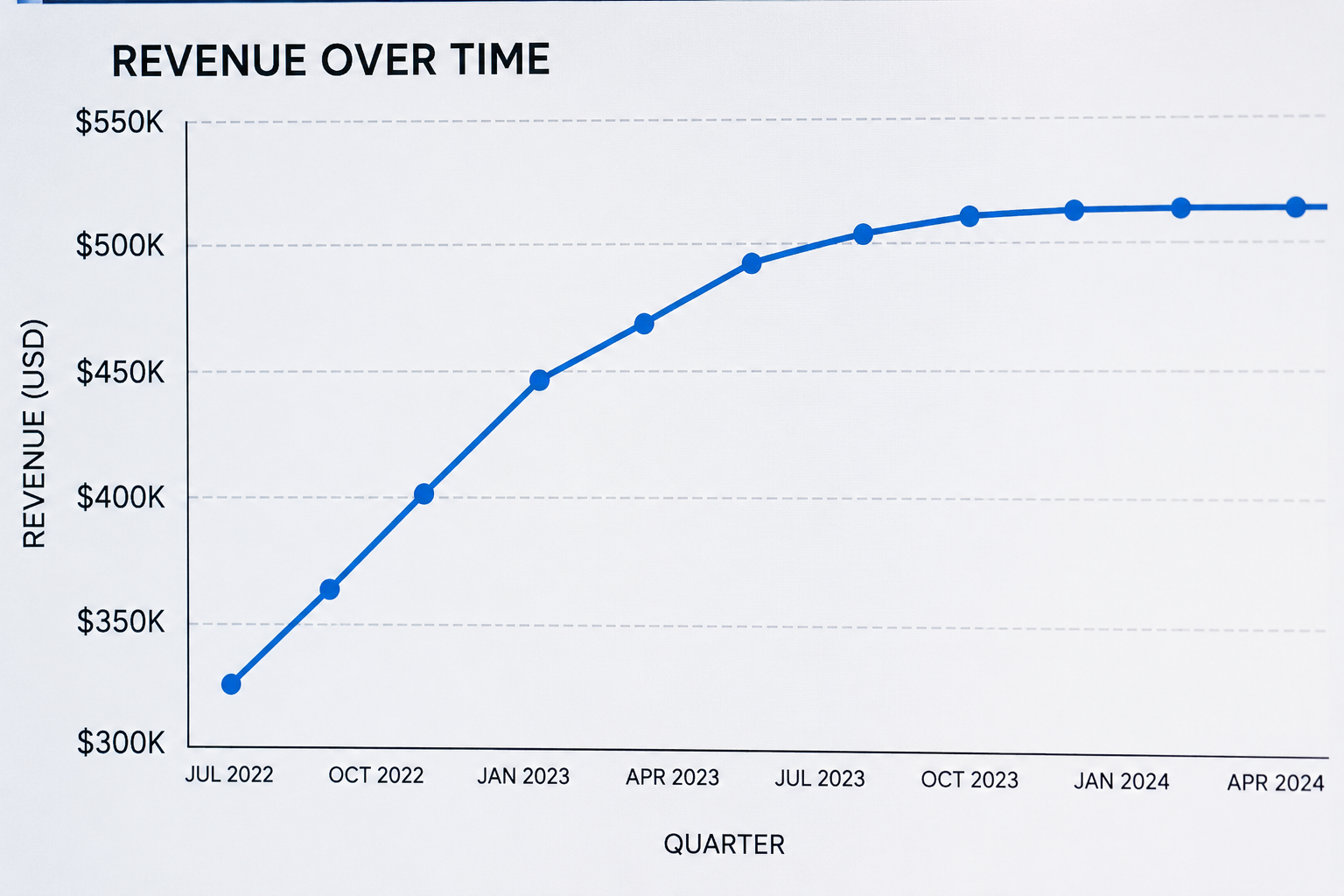
The RV park market slowdown was not on anyone’s radar during the boom years. If you got into parks between 2020 and 2025 you probably heard some version of this pitch: the industry is exploding, demand is up, new campers are flooding in, this is the best time to buy. And that was true. The industry grew at over 8% annually during that stretch. Occupancy was strong, rates were rising, and parks that were barely functional were still generating solid returns because the tide was lifting everything
That tide has leveled off. Industry projections now point to near-zero growth through 2030, with some forecasts showing a slight revenue decline over that period. That does not mean RV parks are a bad investment. It means the era where a mediocre operation could hide behind a rising market is over. If your park is going to perform well in a flat market, it has to be built to perform, not just to exist.
This post is about what that actually means for your financials, and the specific things I look at when I am evaluating whether a park is positioned to hold its ground or slowly erode in a maturing market. Here is what we are going to be looking at:
What a RV Park Market Slowdown Actually Means for Your NOI
In a growth market, you can count on some level of natural rate and occupancy increase year over year even if you do nothing. Demand is outrunning supply, so guests come to you. In a flat market, that tailwind disappears. Your NOI does not grow unless you make it grow, and your expenses will almost certainly keep climbing regardless of what revenue does.
Utilities, insurance, labor, property taxes, and maintenance costs do not plateau just because the market does. If your revenue is flat and your expenses are rising 3 to 5 percent per year, your NOI is shrinking. A shrinking NOI means a shrinking valuation. This can happen slowly enough that you do not notice it until you are sitting across from a buyer or a lender and wondering why the number is lower than you expected.
The parks that hold their value in a flat market are the ones where the operator is actively managing the spread between revenue and expenses, not just running the park and hoping the numbers work out at year end.
The Metrics That Matter More Now Than They Did in 2021
When the market was growing, occupancy was the headline number. If your park was full, you were fine. In a maturing market, occupancy is still important but it is not sufficient on its own. Here are the metrics I focus on with clients when we are trying to understand whether a park is truly healthy or just appears healthy.
Revenue per available site, or RevPAS, tells you how much income you are generating from each site on average across the entire season, including empty nights. A park with 70% occupancy and a strong RevPAS is in a different position than a park with 70% occupancy and a weak one, usually because of rate, ancillary income, or both. If you are not tracking RevPAS you are missing a key layer of the story.
Expense ratio is your total operating expenses divided by total revenue. In a well-run park this typically runs between 50 and 65 percent. If you are above 70 percent, your margins are thin and any revenue softness hits you hard. If you do not know your expense ratio off the top of your head, that is the first thing to calculate.
Operating cash flow, separate from your accounting profit, tells you how much actual cash the business is generating after all operating expenses and debt service. Parks can look profitable on a P&L and still be cash-flow negative because of debt structure, deferred maintenance that is now hitting, or working capital gaps. In a flat market, cash flow discipline is everything.
Where Operators Lose Ground Without Realizing It
The most common pattern I see in a slowing market is what I call the quiet squeeze. Revenue holds roughly flat. The operator feels okay because nothing is obviously wrong. But expenses creep up, deferred maintenance starts accumulating, a rate increase gets skipped because it feels risky, and three years later the NOI is meaningfully lower than it was even though the park looks the same from the outside.
The quiet squeeze is dangerous because it is gradual. You do not feel it the way you would feel a sudden drop in occupancy. You feel it when you go to refinance and the appraisal comes in lower than you expected. You feel it when a buyer makes an offer based on your actual current NOI and it is not the number you had in your head.
The antidote is a monthly financial review that actually looks at trends, not just snapshots. I want to see revenue month over month, expense categories month over month, and NOI quarter over quarter for at least the last two years. Trends tell you things that a single month never will.
The Operational Moves That Protect You in a Flat Market
Surviving a plateau is not about dramatic reinvention. It is about getting very intentional about the levers you control. Here is where I focus with clients who are trying to protect their position in a maturing market.
Rate discipline matters more than it ever did. If you have not raised rates in two years, your real revenue is declining when you factor in inflation. Even a 5 to 8 percent annual increase on new reservations keeps you moving in the right direction without shocking your regulars.
Ancillary revenue becomes a meaningful line item. In a boom market you did not need it. In a flat market, income from storage, laundry, firewood, propane, on-site activities, or cabin rentals can be the difference between an NOI that grows and one that stagnates. These revenue streams also tend to carry high margins because your fixed costs are already covered by site revenue.
Expense management has to be active, not passive. I review every major expense category with my clients quarterly, looking specifically for costs that have crept up without a corresponding increase in value. Insurance is a frequent culprit. So are utility costs that could be partially billed back to guests. So is software that was added during the busy years and never evaluated for ROI.
Capital expenditure planning becomes critical. Deferred maintenance is the silent killer of NOI in a flat market. Every year you skip a repair or replacement that needs to happen, you are borrowing from your future self. When it finally comes due, it hits the P&L all at once, and it is never at a convenient time. I help clients build a rolling 3-year capital expenditure forecast so they can see what is coming and plan for it rather than react to it.
What This Means for Your Financial Reporting
If your books are currently set up to track revenue and expenses at a basic level and spit out a P&L once a month, that was probably sufficient when the market was doing the heavy lifting. It is not sufficient now.
In a flat market, you need financial reporting that shows you trends over time, breaks out revenue by type and site category, tracks your key metrics monthly, and gives you enough visibility to make decisions before problems become emergencies. That is not complicated to build, but it does require intentional setup. If you are not sure whether your current reporting is giving you what you need, that is worth finding out sooner rather than later.
The parks that will do well through this plateau are not necessarily the ones with the best locations or the newest amenities. They are the ones with operators who are paying attention and managing with intention. That starts with your numbers.
Read this next: The Monthly Financial Review Every RV Park Owner Should Be Doing (But Almost Nobody Does)
I cover what healthy RV park financials look like at every stage of ownership in 𝗙𝗿𝗼𝗺 𝗢𝗳𝗳𝗲𝗿 𝘁𝗼 𝗢𝗽𝗲𝗿𝗮𝘁𝗶𝗼𝗻: 𝗧𝗵𝗲 𝗖𝗼𝗺𝗽𝗹𝗲𝘁𝗲 𝗥𝗩 𝗣𝗮𝗿𝗸 𝗜𝗻𝘃𝗲𝘀𝘁𝗼𝗿’𝘀 𝗚𝘂𝗶𝗱𝗲 ($49). Available at wendipvifinancial.gumroad.com/l/kqmyb and on Amazon under my name, Wendi Rook.
Leave a Reply