Category: Real Estate Investing

  • Your Park Is Worth Less Than You Think, and Your Nightly Rate Is Why.

    Your Park Is Worth Less Than You Think, and Your Nightly Rate Is Why.

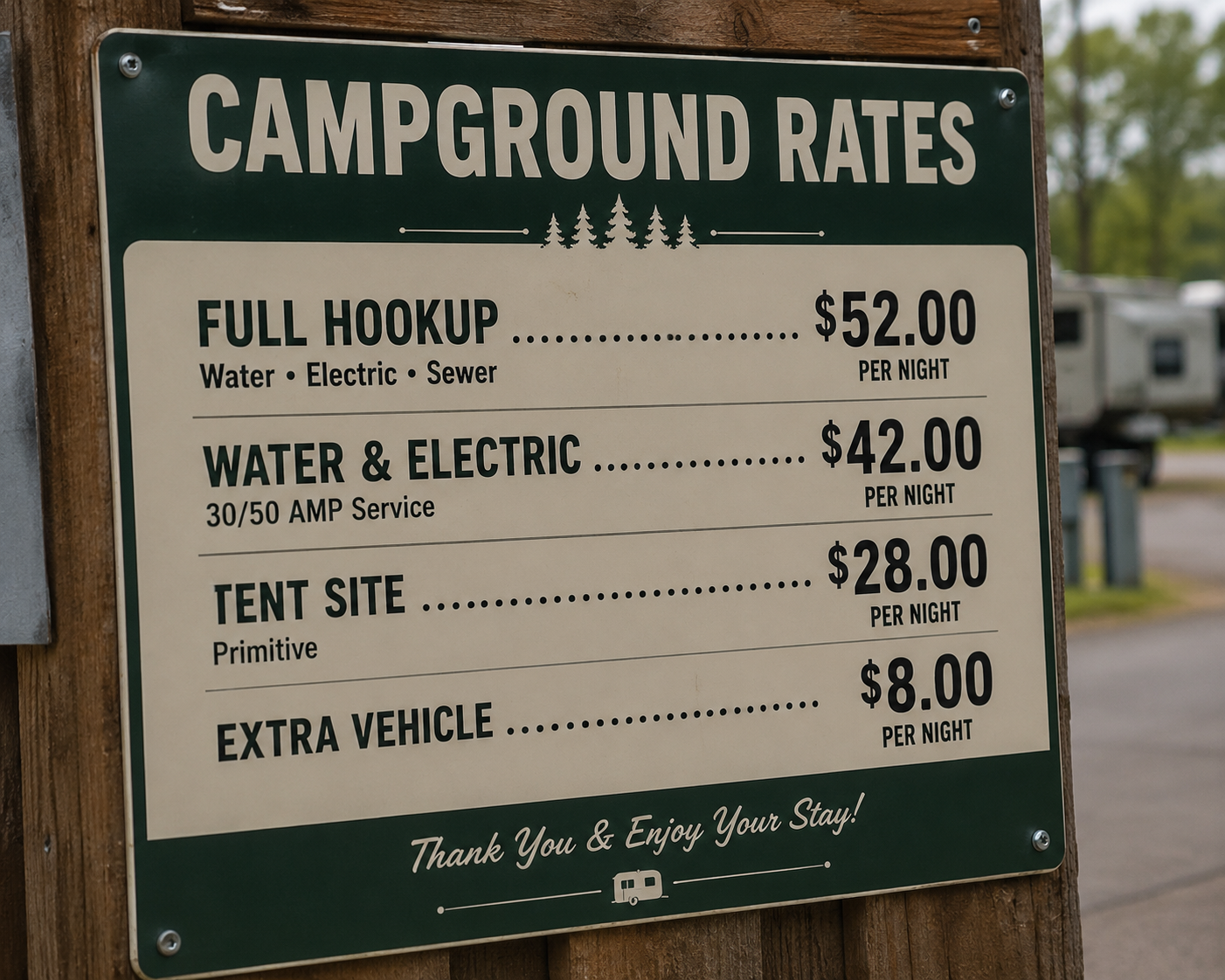
    I am going to say something that is going to sting a little. If you are charging $25 or $30 a night when the market around you supports $50 or $55, you are not just leaving money on the table every single night. You are also actively lowering the appraised value of your park. Not because anything is wrong with it, not because your occupancy is bad, not because your guests are unhappy. Simply because your nightly rate is the engine that drives your NOI, and your NOI is what determines what your park is worth to a buyer or a lender.

    Most park owners do not realize this connection until they are already in a transaction. I want you to understand it now, while you still have time to do something about it.

    How RV Park Valuation Actually Works

    Unlike residential real estate, which is valued based on comparable sales, commercial properties like RV parks are valued on income. Specifically, on a metric called net operating income, or NOI. NOI is your total revenue minus your operating expenses, before debt service and depreciation. A buyer or appraiser takes that number and divides it by a cap rate, which is a market-derived percentage that reflects the risk and return profile of the asset, to arrive at value.

    The formula looks like this: Value = NOI divided by Cap Rate.

    So if your park generates $120,000 in NOI and the market cap rate for parks like yours is 10%, your park is worth $1.2 million. That is the math. Simple, direct, and completely tied to your income.

    Now here is where your nightly rate comes in. Every dollar you add to your average daily rate, across every occupied site, every night of the season, flows almost entirely to the bottom line. Your fixed costs do not change. Your mortgage does not change. Your labor does not change much. So rate increases have an outsized impact on NOI, which means they have an outsized impact on value.

    What Below-Market Rates Are Actually Costing You

    Let me show you a real example of how this plays out. Say you have a 50-site park running at 70% occupancy for 200 nights a year. That is 7,000 occupied site nights per season. If you are charging $30 a night, your gross site revenue is $210,000. If the market around you supports $50 a night, your gross site revenue should be $350,000. That is a $140,000 difference in revenue, most of which becomes NOI.

    At a 10% cap rate, that $140,000 difference in NOI translates to $1.4 million in lost value. Same park. Same sites. Same guests. Just a different number on your rate board.

    I see this constantly with mom-and-pop parks that have been owned by the same family for years. The owner knows every guest by name, has not raised rates in a decade because it feels wrong, and genuinely has no idea that they have been shrinking their own net worth year after year. I am not criticizing that loyalty. I am saying the financial consequence of it is something every owner deserves to understand.

    How to Find Your Gap

    Pull your average nightly rate right now. If you do not know it off the top of your head, that is the first problem, and I will come back to that. Go to Google and look up three to five comparable parks within 30 to 50 miles of you. Check their websites, check their Campspot or Hipcamp listings, check their Google profile. Write down what they are charging for a standard RV site on a weeknight and on a weekend.

    Now compare that to what you are charging. If there is a $10 gap, that is meaningful. If there is a $20 or $25 gap, you have a valuation problem sitting right there in plain sight.

    The parks you are comparing yourself to are not necessarily better than yours. They may just have an owner who did the math.

    What Your Books Should Be Tracking

    This is where the financial management piece comes in, and it is where I spend a lot of time with clients. Your average daily rate, or ADR, should be a line item on your monthly financial dashboard. Not just total revenue. Not just occupancy percentage. ADR specifically, broken out by site type if you have multiple categories.

    When you track ADR monthly, you can see trends. You can see if you are actually capturing rate increases you have implemented or if discounting and last-minute deals are eroding them. You can compare your ADR month over month and year over year. And when you sit down with a lender or a buyer, you can show them a park that is managed with intention, not just one that happens to generate income.

    If your bookkeeping is not giving you this number every month, that is a gap worth closing.

    A Word on Raising Rates

    You do not have to do this overnight, and I would not recommend it. Guests who have been coming to your park for years deserve some consideration. But there is a middle path between staying flat forever and shocking your regulars with a 40% jump.

    Many operators raise rates 8 to 12 percent annually on new reservations while grandfathering existing long-term guests on a slower schedule. Some parks introduce a new site category, upgraded electric, better location, improved pad, at a higher rate point, which lets the market absorb the increase without it feeling like a blanket hit to everyone.

    The strategy matters less than the intention. Start tracking your rate. Know your gap. Make a plan. Your future self, and your future sale price, will thank you.

    Read this next: What happens to your cap rate when you raise rates the wrong way


    I cover cap rates, NOI, and how park valuation actually works in ๐—™๐—ฟ๐—ผ๐—บ ๐—ข๐—ณ๐—ณ๐—ฒ๐—ฟ ๐˜๐—ผ ๐—ข๐—ฝ๐—ฒ๐—ฟ๐—ฎ๐˜๐—ถ๐—ผ๐—ป: ๐—ง๐—ต๐—ฒ ๐—–๐—ผ๐—บ๐—ฝ๐—น๐—ฒ๐˜๐—ฒ ๐—ฅ๐—ฉ ๐—ฃ๐—ฎ๐—ฟ๐—ธ ๐—œ๐—ป๐˜ƒ๐—ฒ๐˜€๐˜๐—ผ๐—ฟ’๐˜€ ๐—š๐˜‚๐—ถ๐—ฑ๐—ฒ ($49). Available at wendipvifinancial.gumroad.com/l/kqmyb and on Amazon under my name, Wendi Rook.


  • You Bought at the Peak. Here Is What Your Financials Need to Show Right Now.

    You Bought at the Peak. Here Is What Your Financials Need to Show Right Now.

    If you bought an RV park between 2020 and 2022, you paid peak prices. That is just the reality. Occupancy was record high, interest rates were low, and sellers knew exactly what they had. You probably paid a multiple that made sense at the time, and maybe it still does. But the market has shifted. Debt costs are higher, operating expenses have climbed, and the post-pandemic camping surge has normalized. If your financials are not telling a clear, accurate story right now, you are sitting on a risk you may not fully see yet.

    This is not doom and gloom. It is a call to get eyes on your numbers before someone else does it for you, whether that is a lender, a partner, or a buyer.

    Here is what I look for when I work with park owners who acquired during the boom years.

    Your NOI needs to be real, not optimistic.

    A lot of operators track revenue well but get loose on the expense side. They forget to include a management fee even if they self-manage, they skip reserves for capital expenditures, and they leave out one-time costs that are actually recurring. If your NOI looks healthy on paper but you are always scrambling for cash, those two things are telling you something. Clean it up. Real NOI protects you.

    Your debt service coverage ratio needs room.

    If you financed at peak prices with rates that have since risen, your DSCR may be tighter than it looks on the surface. Lenders want to see at least 1.25, and most prefer closer to 1.35 or higher. If you are sitting at 1.10 or below, you need to know that now and have a plan before your next refinance conversation.

    Your revenue mix matters more than it used to.

    During the boom, parks could run on transient weekend traffic and still hit their numbers. That window is narrowing. I look at what percentage of revenue is coming from long-term stays, from shoulder season, and from ancillary income. If you are still 90% dependent on peak-season transient guests, your income is more fragile than your P&L suggests.

    Your books need to be audit-ready, not catch-up ready.

    If you had to hand your financials to a lender or buyer today, would they hold up? Commingled accounts, missing receipts, cash transactions that were never recorded, these are the things that kill deals and tank valuations. The time to clean them up is not when you need something. It is now, while you have runway.

    Buying at the peak was not a mistake. Not knowing where you stand right now is the actual risk. Get your financials in front of someone who understands this asset class and can tell you the truth.

    If you want a second set of eyes on your numbers, that is exactly what I do.

    Read this next: What a Lender Actually Looks at Before Approving an RV Park Loan


    I cover the financial side of RV park ownership in depth in my book, ๐—™๐—ฟ๐—ผ๐—บ ๐—ข๐—ณ๐—ณ๐—ฒ๐—ฟ ๐˜๐—ผ ๐—ข๐—ฝ๐—ฒ๐—ฟ๐—ฎ๐˜๐—ถ๐—ผ๐—ป: ๐—ง๐—ต๐—ฒ ๐—–๐—ผ๐—บ๐—ฝ๐—น๐—ฒ๐˜๐—ฒ ๐—ฅ๐—ฉ ๐—ฃ๐—ฎ๐—ฟ๐—ธ ๐—œ๐—ป๐˜ƒ๐—ฒ๐˜€๐˜๐—ผ๐—ฟ’๐˜€ ๐—š๐˜‚๐—ถ๐—ฑ๐—ฒ ($49), including how to read your own financials the way a lender does. Available at wendipvifinancial.gumroad.com/l/kqmyb and on Amazon under my name, Wendi Rook.
  • The Month Your Books Will Lie to You the Most (And Why Every RV Park Owner Needs to Know It)

    The Month Your Books Will Lie to You the Most (And Why Every RV Park Owner Needs to Know It)

    There is one month on the calendar that trips up more RV park owners than any other. It is not the slowest month. It is not the busiest month. It is the month right after your peak season ends, when your bank account still looks healthy from the summer, your books are showing strong revenue, and everything feels like it is working.

    That feeling is the lie.

    What your books are not showing you in that moment is what is coming. The slow months ahead. The fixed costs that continue regardless of occupancy. The capital contributions you may have skipped during the rush of peak season. The reserve account that looks adequate right now and will not look adequate in February.

    The month your books lie to you the most is the first month after your best month. And if you do not know how to read what is actually there, you will make decisions based on a financial picture that is already out of date.

    Why peak season creates a false sense of security

    During peak season, cash comes in fast. Reservations are full, sites are occupied, the camp store is moving product, and the bank balance climbs in a way that feels like confirmation that everything is working. For most RV park owners, this is the best the business looks all year.

    The problem is that peak season revenue has to do more than cover peak season expenses. It has to carry the entire operation through the months when revenue drops but costs do not. Insurance does not pause in November. Loan payments do not skip January. Utilities do not stop because the sites are empty. Any year-round staff you have does not work for free in the off-season.

    If you spent peak season looking at a healthy bank balance and making decisions based on that number without modeling what the next six months actually require, you have set yourself up for a cash flow problem that will feel sudden but was entirely predictable.

    What your books are not telling you in October

    Your October P&L will show strong revenue if your peak season ran through September. It may show your best month of the year. On paper everything looks fine.

    What it will not show you is that November through March will generate a fraction of that revenue while carrying most of the same fixed costs. It will not show you the gap between what you have in the bank today and what you need in the bank to get through the slow season comfortably. It will not show you whether your reserve account is adequately funded for the capital event that always seems to happen at the worst possible time.

    A P&L is a rearview mirror. It tells you what happened. It does not tell you what is coming. And in a seasonal business, what is coming matters more than what just happened.

    The number your books should be showing you but probably are not

    The financial metric that matters most at the end of peak season is not your revenue. It is your forward cash position. Specifically, what does your cash balance need to be right now to cover every fixed expense, every debt obligation, every planned capital contribution, and a reasonable buffer for the unexpected through the end of your slow season?

    That number is not on your P&L. It is not on your balance sheet in a form most owners look at. It lives in a forward cash flow projection that most RV park owners have never built, which means most RV park owners are making post-peak-season decisions without knowing whether they can actually afford to make them.

    This is how owners end up dipping into reserve accounts to cover operating expenses in January. It is how capital projects that should have been funded from peak season revenue get deferred again. It is how a business that had a great summer ends up in a cash squeeze by spring that nobody saw coming, even though it was visible six months earlier to anyone who was looking at the right numbers.

    The seasonal cash flow trap

    Here is the pattern I see repeatedly. Owner has a strong peak season. Bank balance looks good in October. Owner makes a discretionary purchase, takes a distribution, or simply stops making reserve contributions because the account already looks healthy. November arrives. Revenue drops by 60 to 70 percent. Fixed costs continue. The bank balance starts declining faster than expected. By February the owner is managing cash flow week to week instead of month to month.

    The summer was not the problem. The October decision made without a forward cash flow model was the problem.

    Peak season revenue is not profit until you have confirmed it covers everything the slow season requires. Before that confirmation, it is a float.

    What to do differently

    Before peak season ends, build a month by month cash flow projection through the end of your slow season. Use your actual fixed cost structure. Use conservative revenue estimates for the slow months based on prior year performance, not hope. Calculate the cash reserve you need to carry the operation through comfortably and compare it to what you actually have.

    If the number works, great. Make informed decisions from that position. If the number does not work, you need to know that in October, not in February when the options are limited and the pressure is real.

    Your books will tell you what happened last month. Your job is to use that information to understand what is coming next. In a seasonal business those are two completely different conversations, and only one of them actually protects you.

    The month your books lie to you the most is the one where everything looks fine. That is the month to look harder.


    Read this next: The Monthly Financial Review Every RV Park Owner Should Be Doing But Almost Nobody Does


    If you want the full framework for buying, managing, and understanding the financials on an RV park acquisition, I wrote ๐—™๐—ฟ๐—ผ๐—บ ๐—ข๐—ณ๐—ณ๐—ฒ๐—ฟ ๐˜๐—ผ ๐—ข๐—ฝ๐—ฒ๐—ฟ๐—ฎ๐˜๐—ถ๐—ผ๐—ป: ๐—ง๐—ต๐—ฒ ๐—–๐—ผ๐—บ๐—ฝ๐—น๐—ฒ๐˜๐—ฒ ๐—ฅ๐—ฉ ๐—ฃ๐—ฎ๐—ฟ๐—ธ ๐—œ๐—ป๐˜ƒ๐—ฒ๐˜€๐˜๐—ผ๐—ฟ’๐˜€ ๐—š๐˜‚๐—ถ๐—ฑ๐—ฒ ($49) specifically for investors who want to get this right. You can get it direct here: https://wendipvifinancial.gumroad.com/l/kqmyb, or Amazon has it too, just search author Wendi Rook.

  • The Maintenance Schedule Nobody Gave You When You Closed (And What It’s Costing You)

    The Maintenance Schedule Nobody Gave You When You Closed (And What It’s Costing You)

    When you closed on your RV park, you got a lot of documents. The deed. The title commitment. The closing statement. Maybe an equipment list. Maybe a vendor contact sheet if the seller was organized and generous with their time.

    What you almost certainly did not get was a maintenance schedule. Not a real one. Not a document that told you when the septic was last pumped, when the electrical pedestals were last inspected, when the roof on the bathhouse was last replaced, or when the water lines were last pressure tested.

    And if nobody gave it to you, there is a good chance nobody had it. Which means right now you are operating infrastructure you cannot fully see, on a timeline you do not know, with capital exposure you have not quantified.

    That gap is costing you money. It may be about to cost you a lot more.

    The problem with inherited infrastructure

    Every physical system in your park has a lifespan. Septic systems. Electrical distribution. Water lines. Roofs. Roads. HVAC in any structures. Pump stations. Every one of them is somewhere on a curve between brand new and end of life, and when you closed you inherited whatever point on that curve each system happened to be at.

    The previous owner knew where those systems were, at least roughly, because they had been living with them for years. They knew the septic had been giving them trouble. They knew the main electrical panel needed attention. They knew the bathhouse roof had been patched twice and was probably good for one more season. They knew all of that and almost none of it made it into the seller disclosure or the deal package.

    You are now the owner of systems you did not build, cannot fully see, and have no documented history on. And the clock on all of them is running whether you are tracking it or not.

    What deferred maintenance actually looks like from the inside

    It does not usually announce itself. It accumulates quietly while you are focused on occupancy, reservations, guest experience, and the hundred other things that demand attention in the first year of ownership.

    A pedestal that trips occasionally. A water pressure issue in the back loop that guests mention in reviews but has not caused a real problem yet. A bathhouse drain that runs slow. A road section that gets soft after heavy rain. None of these feel urgent. Each one is telling you something.

    What they are telling you is that the system behind them is closer to failure than it was when you bought the park. And because you have no maintenance history, you do not know how close.

    The failure, when it comes, is never at a convenient time. It is peak season weekend. It is a holiday Friday. It is the morning your highest-rated guest of the year is checking in. And instead of running your park you are managing an emergency repair at emergency pricing, writing apology notes, and watching your review score take a hit that will outlast the repair by two years.

    The cost nobody puts in the pro forma

    Emergency repairs cost more than scheduled maintenance. That is not an opinion, it is a procurement reality. A contractor called on a Saturday morning during peak season charges differently than one scheduled six weeks in advance on a Tuesday. Parts sourced overnight cost more than parts ordered on a normal timeline. And the revenue lost while a system is down, sites that cannot be occupied, amenities that cannot be used, is a cost that never shows up anywhere but your bank account.

    Owners who run preventive maintenance schedules spend less over time than owners who run reactively. The systems last longer. The repairs are smaller. The emergencies are fewer. And the capital reserve contributions that fund planned replacements are predictable rather than catastrophic.

    The math on preventive maintenance is not complicated. The reason more owners do not do it is that building the schedule requires work that nobody handed you at closing.

    What a real maintenance schedule actually covers

    A functional preventive maintenance program for an RV park is not complicated but it has to be comprehensive. It covers every major system on a documented inspection and service interval.

    Septic systems should be inspected and pumped on a schedule appropriate to capacity and usage, not when they start showing signs of distress. Electrical systems, including individual site pedestals and receptacles, should be inspected annually by a qualified electrician. Water lines and pressure systems need regular testing. Roofs on all structures need annual inspection and documented repair history. Roads need seasonal assessment and grading before problems develop into guest complaints.

    Beyond the major systems, the smaller items add up. Playground equipment inspections. Laundry machine service. HVAC filter schedules. Fire extinguisher certifications. Generator testing if you have backup power. Each of these is minor in isolation. Together they represent the operational foundation that keeps a park running smoothly and keeps guests writing the kinds of reviews that fill sites.

    Building the schedule you should have received at closing

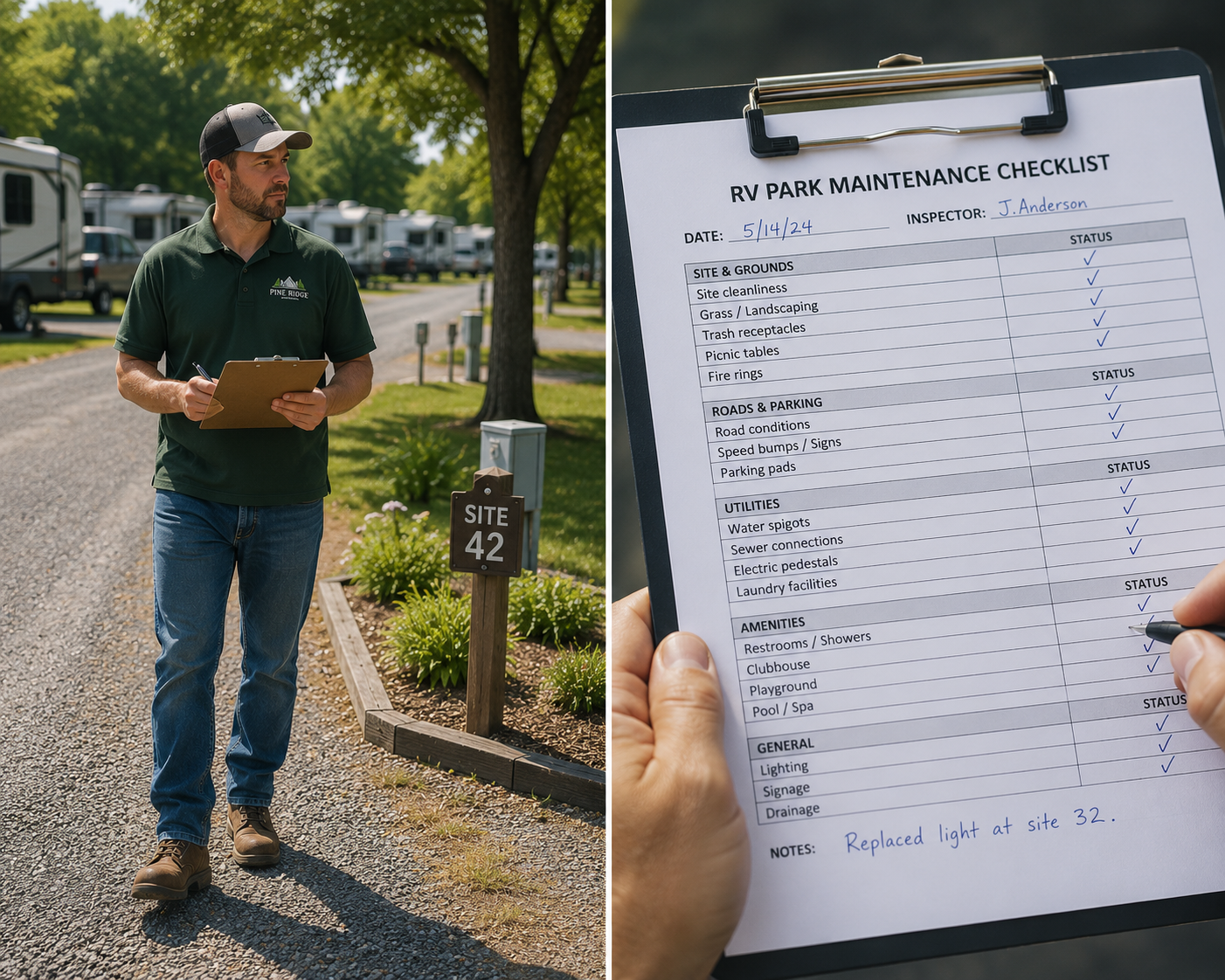
    If you do not have a maintenance schedule, build one now. Start with a physical walkthrough of every system on the property and document what you find. Age, condition, last known service date if you can determine it, and your best estimate of remaining useful life. That inventory is your starting point.

    From that inventory, build a twelve-month maintenance calendar with specific tasks, assigned responsibility, and estimated cost. Put it in a format someone other than you can follow, because eventually someone other than you will need to.

    Then fund it. Maintenance tasks that are on a schedule and budgeted for get done. Maintenance tasks that depend on available cash when the time comes get deferred. Deferred maintenance is how you end up in the same position as the seller you bought from, operating infrastructure on borrowed time and hoping nothing fails before you can get to it.

    The seller did not give you a maintenance schedule at closing. That is not an excuse to operate without one. It is the first problem you need to solve.


    Read this next: The Expense Category Most RV Park Owners Forget to Budget For Until It Wrecks Their First Year


    If you want the full framework for buying, managing, and understanding the financials on an RV park acquisition, I wrote ๐—™๐—ฟ๐—ผ๐—บ ๐—ข๐—ณ๐—ณ๐—ฒ๐—ฟ ๐˜๐—ผ ๐—ข๐—ฝ๐—ฒ๐—ฟ๐—ฎ๐˜๐—ถ๐—ผ๐—ป: ๐—ง๐—ต๐—ฒ ๐—–๐—ผ๐—บ๐—ฝ๐—น๐—ฒ๐˜๐—ฒ ๐—ฅ๐—ฉ ๐—ฃ๐—ฎ๐—ฟ๐—ธ ๐—œ๐—ป๐˜ƒ๐—ฒ๐˜€๐˜๐—ผ๐—ฟ’๐˜€ ๐—š๐˜‚๐—ถ๐—ฑ๐—ฒ ($49) specifically for investors who want to get this right. You can get it direct here: https://wendipvifinancial.gumroad.com/l/kqmyb, or Amazon has it too, just search author Wendi Rook.

  • I Reviewed a Deal Yesterday. Here Is Exactly Why I Walked Away.

    I Reviewed a Deal Yesterday. Here Is Exactly Why I Walked Away.

    Yesterday I sat down with a deal package on a 23-site RV park asking $1.6 million. I am not going to name the park or the location. What I am going to do is walk you through exactly what I saw, because if you are actively looking at deals right now there is a reasonable chance something with the same fingerprints is sitting in your inbox.

    I walked away. Here is why.

    The financials told two different stories

    The package came with what I can only describe as a handmade P&L. Not a formal financial statement. Not something pulled from accounting software. A document that someone built themselves, by hand, to present the park in the best possible light.

    The numbers showed roughly $85,000 in NOI across each of the prior four years, then a jump to $199,000 this year. The seller presented that $199,000 as the number to underwrite to.

    When NOI more than doubles in a single year after four years of flat performance, that is not a trend. That is a question. And it is a question that needs a verifiable answer before you go any further.

    When I adjusted the numbers, the story changed immediately

    I rebuilt the NOI from what they gave me. Before I even got to management fees or real estate taxes, I had already adjusted the presented $199,000 down to $152,000. That $47,000 gap came from the numbers themselves, before accounting for the expenses that were missing entirely from the P&L.

    Then I added back a market-rate management fee. It was not in the expenses anywhere, because the current owner self-manages. On a park this size that is a real cost that belongs in any honest underwriting.

    Then I looked for real estate taxes. They were not there either. On a $1.6 million asking price asset. That is not an oversight. That is a choice someone made when they built the P&L, and it is the kind of choice that inflates NOI in exactly the way that benefits a seller and misleads a buyer.

    By the time I added both of those back, the number I was actually underwriting to looked very different from $199,000.

    November and December were estimated

    For the last two months of the year, the P&L showed revenue listed as estimated based on an average of the previous ten months.

    That is not how financials work. You do not average your way to a year-end number and present it as performance data in a deal package. November and December for most RV parks are slow months. Averaging them against peak season revenue inflates the annual figure in exactly the way that benefits a seller and misleads a buyer.

    If the actual numbers were not available, the right answer is to say so. Substituting an estimate that produces a better annual total is not a financial statement. It is a guess dressed up as one.

    The operations were, generously speaking, informal

    This park took reservations by phone only. No online booking. No property management software. No digital payment processing.

    Rent collection happened when people paid by cash or check. Sometimes the maintenance guy collected it. I say sometimes because the maintenance guy was also living in the one cabin on the property for free in exchange for his services, and his involvement in collections appeared to be, based on what was presented to me, somewhat optional.

    There was no formal rent collection system. There were no documented processes. There was no way to verify that the revenue reported on the handmade P&L bore any reliable relationship to the cash that actually changed hands at this park over the past year.

    When you cannot trace revenue to a reservation system, a payment processor, or a bank deposit pattern that holds up to scrutiny, you do not have verified financials. You have a number someone wrote down.

    The occupancy told a different story than the revenue

    Last month, six of the park’s 23 sites were unoccupied. That is a 26 percent vacancy rate on a small park that is supposedly generating dramatically higher NOI than it has in any of the prior four years. And that vacancy was not the outlier. The occupancy at this park swings wildly, which means the presented number is not a stabilized figure. It is a peak number being presented as if it were normal.

    When I see occupancy swings that dramatic on a small site count with no formal reservation or payment infrastructure, I want to know what is actually driving the revenue spike this year. I did not get a satisfying answer.

    The upside pitch did not hold up either

    The seller’s position on the $1.6 million asking price leaned heavily on an adjacent acre with ten lots already laid out for expansion. The implication was that the development potential justified the premium over what the current financials would support.

    I understand the logic. I do not agree with the math.

    Undeveloped lots are not revenue. They are a capital project with an unknown timeline, unknown permitting risk, unknown infrastructure cost, and zero guarantee of the occupancy needed to justify the investment once built. You do not pay for lots that do not yet exist as if they were producing income. You price the asset on what it actually generates today and negotiate separately for any legitimate upside that can be quantified.

    At $1.6 million, with a presented NOI that I adjusted down significantly before even accounting for missing expenses, with no formal reservation or payment system, with estimated months in the annual financials, and with a maintenance situation I cannot adequately describe with professional language, this deal was not priced on reality. It was priced on a story.

    Why I am telling you this

    Because someone is going to look at this deal. Maybe they already have. And if they have not done this kind of line-by-line analysis on the financials, they might see a park with a big NOI number, an expansion opportunity, and a motivated seller and think they found something.

    They did not find something. They found a deal that needs to be priced correctly before it becomes a good investment, and right now it is not priced correctly.

    This is the work. Not just reviewing the numbers the seller gave you, but pressure testing every line, identifying what is missing, understanding what the operations actually look like behind the headline number, and being willing to walk away when the story does not hold up.

    I walked away yesterday. I will look at the next one tomorrow.


    Read this next: The Seller’s Pro Forma Is Not Your Pro Forma


    If you want the full framework for buying, managing, and understanding the financials on an RV park acquisition, I wrote ๐—™๐—ฟ๐—ผ๐—บ ๐—ข๐—ณ๐—ณ๐—ฒ๐—ฟ ๐˜๐—ผ ๐—ข๐—ฝ๐—ฒ๐—ฟ๐—ฎ๐˜๐—ถ๐—ผ๐—ป: ๐—ง๐—ต๐—ฒ ๐—–๐—ผ๐—บ๐—ฝ๐—น๐—ฒ๐˜๐—ฒ ๐—ฅ๐—ฉ ๐—ฃ๐—ฎ๐—ฟ๐—ธ ๐—œ๐—ป๐˜ƒ๐—ฒ๐˜€๐˜๐—ผ๐—ฟ’๐˜€ ๐—š๐˜‚๐—ถ๐—ฑ๐—ฒ ($49) specifically for investors who want to get this right. You can get it direct here: https://wendipvifinancial.gumroad.com/l/kqmyb, or Amazon has it too, just search author Wendi Rook.

  • What Happens to Your Cap Rate When You Raise Rates the Wrong Way

    What Happens to Your Cap Rate When You Raise Rates the Wrong Way

    Rate increases are one of the most powerful levers available to an RV park owner. Done correctly, a well-executed rate strategy can add hundreds of thousands of dollars in asset value without a single capital improvement. Done incorrectly, it can erode occupancy, damage your review profile, and quietly destroy the NOI you were trying to build.

    Most of the conversation in RV park investing circles focuses on the upside of raising rates. What gets less attention is how raising rates the wrong way can hurt you, and how the damage often does not show up where you expect it to.

    First, understand what your cap rate actually reflects

    Your cap rate is a function of your NOI and your asset value. When NOI goes up, asset value goes up at the same multiple. When NOI goes down, so does your value. This is the math that makes rate increases so compelling on paper.

    A $10 per night rate increase across 60 sites at 150 occupied nights per year is $90,000 in additional gross revenue. At a 40 percent expense ratio that flows to roughly $54,000 in additional NOI. At an 8 cap that represents approximately $675,000 in added asset value. The math is real and it is why rate discipline gets talked about so much.

    What the math does not capture is what happens to occupancy when you raise rates faster than your market, your product, or your guest base can absorb.

    The occupancy leak nobody models

    When you raise rates aggressively, some guests leave. That is not always a bad thing. If you are replacing budget-conscious guests with higher-rate guests who book more consistently and leave better reviews, the trade is often worth making.

    The problem is when the guests who leave are not replaced. When you raise rates 30 percent in year one at a park that has not had a capital improvement in a decade, you are asking guests to pay premium rates for a product that does not yet support them. Some will pay it once. Most will not come back. And the reviews they leave on their way out will affect your ability to fill those sites at the new rate for longer than you expect.

    Occupancy loss at higher rates can easily produce lower total revenue than the original rate at full occupancy. A 20 percent occupancy drop on a rate increase that was supposed to add $90,000 in revenue can turn into a net revenue loss before you have processed what happened.

    The review problem compounds the math problem

    Here is where it gets worse. Occupancy loss from a rate increase that outpaced your product shows up in your financials within a season. The review damage shows up on Google and Campendium immediately and stays there for years.

    Guests who feel they overpaid for an experience do not write neutral reviews. They write detailed ones. And a pattern of reviews citing value concerns at a park with recently increased rates is one of the most difficult reputational holes to climb out of, because every future guest reading those reviews is doing the math before they book.

    Recovering review scores after a mispriced rate increase typically takes two to three years of consistent operational improvement and deliberate review management. During that window you are competing for bookings at a disadvantage against parks with cleaner profiles, which puts downward pressure on the occupancy you need to justify the rate.

    What the right rate strategy actually looks like

    Rate increases should be tied to something. A capital improvement that genuinely upgrades the guest experience. A market analysis showing your rates are materially below comparable parks in your trade area. A site-type differentiation strategy that prices premium pull-throughs and waterfront sites differently from standard back-ins.

    Incremental increases that the market can absorb are almost always more effective than large single-year jumps. A five to eight percent annual increase compounded over three years gets you to roughly the same place as a 25 percent increase in year one, with a fraction of the occupancy risk and none of the review exposure.

    Segment before you increase. Not every site in your park supports the same rate. Raising rates uniformly across all site types leaves money on the table at your best sites and creates value objections at your weakest ones. Know what each site type is worth and price accordingly.

    And time it right. Rate increases implemented mid-season on existing reservations create guest friction that is disproportionate to the revenue gained. Increase rates at the start of a new booking season when guests are making fresh decisions, not in the middle of a stay they already budgeted for.

    The cap rate conversation buyers need to have

    If you are buying a park where the pitch includes significant rate upside, pressure test that assumption before you underwrite to it. Ask what comparable parks in the trade area are actually charging. Ask what the current guest mix looks like and whether that mix will support a rate increase or simply leave when one happens. Ask what capital improvements are planned and on what timeline, because rate increases without product improvement are a short-term revenue strategy with long-term consequences.

    The upside is real. The risk is real too. The buyers who execute rate strategies well are the ones who tied the increase to something the guest could see, feel, and justify paying for.

    Rate increases that outpace the product do not build asset value. They borrow against it.


    Read this next: Should You Raise Rates After Acquiring an RV Park? How to Know When the Numbers Support It


    If you want the full framework for buying, managing, and understanding the financials on an RV park acquisition, I wrote ๐—™๐—ฟ๐—ผ๐—บ ๐—ข๐—ณ๐—ณ๐—ฒ๐—ฟ ๐˜๐—ผ ๐—ข๐—ฝ๐—ฒ๐—ฟ๐—ฎ๐˜๐—ถ๐—ผ๐—ป: ๐—ง๐—ต๐—ฒ ๐—–๐—ผ๐—บ๐—ฝ๐—น๐—ฒ๐˜๐—ฒ ๐—ฅ๐—ฉ ๐—ฃ๐—ฎ๐—ฟ๐—ธ ๐—œ๐—ป๐˜ƒ๐—ฒ๐˜€๐˜๐—ผ๐—ฟ’๐˜€ ๐—š๐˜‚๐—ถ๐—ฑ๐—ฒ ($49) specifically for investors who want to get this right. You can get it direct here: https://wendipvifinancial.gumroad.com/l/kqmyb, or Amazon has it too, just search author Wendi Rook.

  • The Thing That Kills Cash Flow After You Close (That Has Nothing to Do With Revenue)

    The Thing That Kills Cash Flow After You Close (That Has Nothing to Do With Revenue)

    Most RV park buyers spend the majority of their pre-close energy focused on revenue. What is the park generating. What could it generate. What does occupancy look like at different rate scenarios. What is the upside if you reposition the tenant mix or add a few glamping units.

    That focus is not wrong. Revenue matters. But it is incomplete in a way that costs people real money in the first year of ownership, because the thing that most often kills cash flow after you close has nothing to do with revenue at all.

    It is the expense side. Specifically, the expenses that did not exist under the previous owner and appear for the first time under yours.

    The seller’s expense structure is not your expense structure

    This is the part of the underwriting conversation that does not get enough attention. When you review a seller’s T12 and rebuild the expense side, the standard advice is to add back a management fee if the owner self-manages and normalize owner compensation if it is understated. That is correct and important.

    But there is a broader issue underneath it. The seller’s entire cost structure reflects how they ran the park, not how you are going to run it. And in many cases, especially in mom-and-pop acquisitions, those two things look very different.

    A seller who has owned the park for twenty years has vendor relationships, insurance rates, and operational routines that took two decades to build. Their maintenance costs are low because they know every system in the park and fix most things themselves. Their insurance premium reflects a long claims-free history with a carrier who knows them. Their accounting costs are minimal because their nephew does the books. Their marketing spend is zero because they filled the park on word of mouth and a Good Sam listing they set up in 2009.

    None of that transfers to you at closing.

    What the new expense lines actually look like

    When you take ownership, the cost structure resets in ways that most pro formas do not fully capture.

    Professional management, if you are not self-managing, adds 8 to 12 percent of gross revenue. On a park generating $400,000 a year that is $32,000 to $48,000 in annual expenses that may not exist anywhere in the seller’s numbers.

    Insurance will reprice at renewal under new ownership. If the previous owner had a long claims-free history and a multi-decade relationship with their carrier, your first-year premium may be meaningfully higher than what the T12 reflects.

    Bookkeeping and accounting at a professional level costs money. So does a property management software upgrade if the previous owner was running on a spreadsheet and a handshake reservation system. So does a new website if theirs was last updated during the Obama administration.

    Staffing often changes. If the seller handled maintenance themselves or had a family member doing it informally, you are adding a real labor cost that did not show up in payroll records.

    And then there are the vendor contracts. The landscaper who gave the previous owner a longtime-customer rate. The propane supplier with the legacy pricing agreement. The pest control company the seller’s brother-in-law owns. Those relationships do not come with the park. The rates you negotiate as a new owner may be different, and not in your favor.

    The cash flow impact in year one

    Individually, each of these items feels manageable. Collectively, they can add $40,000 to $80,000 or more in annual expenses to a park that the T12 made look leaner than it actually is under new ownership.

    If your pro forma was built on the seller’s expense structure with a management fee added back and nothing else adjusted, you are likely looking at a year-one cash flow that is materially worse than you projected. Not because the revenue disappointed. Because the expense side was never really your expense structure to begin with.

    I see this consistently when I underwrite acquisitions for buyers. The revenue holds. The occupancy holds. The cash flow does not, because nobody rebuilt the expense side from the buyer’s cost structure rather than the seller’s.

    How to protect yourself before you close

    The fix is not complicated but it requires intentionality. When you are building your pro forma, do not just normalize the seller’s expenses. Rebuild them from scratch using your actual cost structure.

    Get insurance quotes before you close, not after. Talk to property management companies if you are not planning to self-manage and get real numbers. Price out bookkeeping, accounting, and software at professional rates. Talk to vendors in the area and understand what new-owner pricing looks like. Model staffing based on what you will actually need, not what the seller needed.

    Then compare that rebuilt expense structure to the seller’s T12 line by line. The gap between those two numbers is the conversation you need to have about purchase price before you sign, not the cash flow surprise you absorb in month four.

    Revenue gets the attention. Expenses win the year.


    Read this next: Why Your RV Park’s Best Season Can Also Be Its Biggest Financial Risk


    If you want the full framework for buying, managing, and understanding the financials on an RV park acquisition, I wrote ๐—™๐—ฟ๐—ผ๐—บ ๐—ข๐—ณ๐—ณ๐—ฒ๐—ฟ ๐˜๐—ผ ๐—ข๐—ฝ๐—ฒ๐—ฟ๐—ฎ๐˜๐—ถ๐—ผ๐—ป: ๐—ง๐—ต๐—ฒ ๐—–๐—ผ๐—บ๐—ฝ๐—น๐—ฒ๐˜๐—ฒ ๐—ฅ๐—ฉ ๐—ฃ๐—ฎ๐—ฟ๐—ธ ๐—œ๐—ป๐˜ƒ๐—ฒ๐˜€๐˜๐—ผ๐—ฟ’๐˜€ ๐—š๐˜‚๐—ถ๐—ฑ๐—ฒ ($49) specifically for investors who want to get this right. You can get it direct here: https://wendipvifinancial.gumroad.com/l/kqmyb, or Amazon has it too, just search author Wendi Rook.

  • Why Your Occupancy Number Is Lying to You

    Why Your Occupancy Number Is Lying to You

    If you ask most RV park owners how their park is performing, the first number they give you is occupancy. We were at 85 percent last summer. We ran 70 percent for the season. Occupancy was strong.

    And maybe it was. But occupancy as a standalone number tells you less than you think it does, and in some cases it actively misleads you about the financial health of your park.

    Here is why.

    Occupancy does not tell you what you charged

    A park running at 90 percent occupancy at $35 per night is generating less revenue than a park running at 70 percent occupancy at $60 per night. The math is not complicated, but the implication gets missed constantly.

    Owners who track occupancy without tracking average daily rate alongside it are looking at half the picture. You can have a full park and still be leaving significant money on the table if your rates are below market. You can have a park that looks less full than your competitor and be outperforming them on revenue per available site because your rate discipline is better.

    Occupancy is a volume metric. It tells you how many sites were sold. It does not tell you anything about what those sites were worth.

    Occupancy does not tell you what kind of guests filled those sites

    Not all occupied sites are equal. A transient nightly guest at full rate generates very different revenue from a long-term monthly tenant at a flat rate that has not been adjusted in three years. A seasonal camper who booked a package deal at a discount fills a site on paper but may be contributing significantly less to your bottom line than the occupancy number suggests.

    When you blend all of those guest types into a single occupancy figure, you lose the ability to see what is actually driving your revenue. A park that is 80 percent occupied with a heavy mix of below-market long-term tenants looks identical to a park that is 80 percent occupied with transient guests at premium rates. They are not the same park. The financial reality is completely different.

    Occupancy does not account for seasonality

    An annual occupancy figure smooths over the peaks and valleys that actually determine whether your cash flow is manageable. A park that runs 95 percent occupancy in July and 15 percent in January has a very different operational and financial reality than a park with steady 55 percent occupancy year-round, even if the annual average works out similarly on paper.

    The number that matters is not your average occupancy. It is your occupancy by month, tracked against the revenue each of those months actually produced, so you can see clearly where your cash flow is being generated and where it is not. That monthly picture is what tells you whether your reserves are adequate, whether your slow season strategy is working, and whether your peak season pricing is capturing the revenue available to you.

    The number you should be tracking instead

    Revenue per available site night, sometimes called RevPAS, is the metric that actually tells you how your park is performing. It combines occupancy and rate into a single number that reflects real financial output rather than just volume.

    If your RevPAS is growing, your park is improving. If your occupancy is growing but your RevPAS is flat or declining, you are filling more sites but not getting paid more for them, which usually means your rates are not keeping up with your actual demand. That is a revenue management problem, not a success story.

    Track RevPAS monthly. Compare it to the same month in the prior year. Watch the trend. That number will tell you things about your park’s performance that occupancy alone never will.

    What this means if you are buying a park

    If you are evaluating an acquisition and the seller leads with occupancy as the primary performance metric, slow down. Ask for the monthly revenue breakdown. Ask for the average daily rate by site type and guest category. Ask for the revenue mix between transient, seasonal, and long-term tenants.

    A seller who can give you those numbers has a park that is being run with financial discipline. A seller who can only tell you occupancy is either not tracking the right metrics or does not want you looking too closely at the ones that would tell a more complicated story.

    Occupancy is not a vanity metric exactly, but it is an incomplete one. The park that wins is not the one with the most sites filled. It is the one generating the most revenue per available site with a cost structure that lets that revenue flow to the bottom line.

    Those are two very different parks. Make sure you know which one you are buying, or building.


    Read this next: The Three Numbers That Expose Every Problem in Your RV Park Before It Costs You Money


    If you want the full framework for buying, managing, and understanding the financials on an RV park acquisition, I wrote ๐—™๐—ฟ๐—ผ๐—บ ๐—ข๐—ณ๐—ณ๐—ฒ๐—ฟ ๐˜๐—ผ ๐—ข๐—ฝ๐—ฒ๐—ฟ๐—ฎ๐˜๐—ถ๐—ผ๐—ป: ๐—ง๐—ต๐—ฒ ๐—–๐—ผ๐—บ๐—ฝ๐—น๐—ฒ๐˜๐—ฒ ๐—ฅ๐—ฉ ๐—ฃ๐—ฎ๐—ฟ๐—ธ ๐—œ๐—ป๐˜ƒ๐—ฒ๐˜€๐˜๐—ผ๐—ฟ’๐˜€ ๐—š๐˜‚๐—ถ๐—ฑ๐—ฒ ($49) specifically for investors who want to get this right. You can get it direct here: https://wendipvifinancial.gumroad.com/l/kqmyb, or Amazon has it too, just search author Wendi Rook.

  • The Reserve Fund Mistake That Turns a Good RV Park Deal Into a Nightmare

    The Reserve Fund Mistake That Turns a Good RV Park Deal Into a Nightmare

    There is a version of this story that plays out more often than most people in the RV park investing space want to admit.

    A buyer finds a solid park. The numbers work. The due diligence gets done. The deal closes. And then, somewhere in the first twelve to eighteen months, something goes wrong. Not catastrophically. Not all at once. But the cash position starts tightening in ways that were not in the projections, and suddenly every decision is being made from a position of financial pressure instead of financial confidence.

    In most of those situations, the deal was not bad. The reserve fund was.

    What a reserve fund actually is

    A reserve fund is not a savings account you contribute to when things are going well. It is a dedicated, non-negotiable capital account funded from day one of ownership, sized to absorb the normal variability of running an operating business on a seasonal cash flow cycle.

    Most buyers understand the concept in theory. The problem is in the execution. The reserve gets underfunded at close because the down payment stretched capital further than planned. Or it gets raided in month three because a piece of equipment failed and the operating account was already running thin. Or it never gets funded at all because the buyer assumed the first season’s revenue would build it up organically.

    None of those approaches survive contact with reality.

    The three things your reserve fund has to cover

    When you are sizing your reserve, you are not just planning for one type of risk. You are planning for three that can hit simultaneously.

    The first is capital expenditure. Equipment fails. Infrastructure ages. The septic pump that was fine during due diligence develops a problem in month six. A reserve fund that is not sized for capital events is not a reserve fund. It is a checking account with a different name.

    The second is operating cash flow gaps. RV parks are seasonal businesses. If your park generates most of its revenue between May and September, your reserve fund is what carries you through October, November, February, and March. The fixed costs do not stop because the guests do. Insurance, loan payments, utilities, any year-round staffing, and basic maintenance continue regardless of occupancy. If you do not have reserves sized to cover that gap comfortably, you will be making decisions under pressure during every slow season you own the park.

    The third is the unexpected. Not the dramatic unexpected, just the normal unexpected that every operating business experiences. A key employee leaves. A major OTA platform changes its algorithm and your bookings drop for sixty days while you adjust. A regional weather event cancels a peak weekend. These are not disasters. They are the cost of operating a hospitality business. Your reserve fund is what keeps them from becoming crises.

    What underfunded reserves actually look like in practice

    When a buyer closes without adequate reserves, the signs show up fast. Deferred maintenance starts accumulating almost immediately because every dollar of operating cash is needed for operations. Capital projects get pushed to next season, and then the season after that. Reviews start to reflect it before the financials do.

    The pressure compounds. A slow month creates a cash shortfall. The shortfall gets covered by skipping the reserve contribution. The next unexpected expense hits a reserve account that is already depleted. The buyer is now making every financial decision reactively instead of proactively, which is exactly the operating posture the previous owner was in when they decided to sell.

    I have seen buyers in this position within six months of closing on deals that were genuinely good acquisitions. The park was fine. The capital structure was not.

    What an adequate reserve actually looks like

    There is no universal number, but there are reasonable benchmarks. At minimum, you should close with three to six months of total operating expenses in reserve, separate from your down payment and closing costs. On top of that, any identified CapEx from due diligence should be fully funded before you close, not planned to be funded from operating cash flow after the fact.

    If your park has meaningful seasonality, size the reserve to cover your worst-case slow season cash flow gap with margin to spare. Model that number at the monthly level before you finalize your offer, not after you close.

    A good rule of thumb for ongoing reserve contributions is a minimum of five percent of gross revenue deposited monthly into a dedicated capital reserve account, treated as a non-negotiable operating expense rather than discretionary savings. That account does not get touched for operating expenses. It exists for capital events and genuine emergencies only.

    The conversation most buyers do not have before they close

    The reserve fund conversation almost never happens with the broker. It rarely happens with the lender, whose job is to get the loan closed, not to stress test your post-close capital position. It sometimes happens with a CPA, if the buyer has one engaged early enough.

    What it requires is someone looking at the full capital picture before you commit: down payment, closing costs, identified CapEx, operating reserves, and slow season cash flow requirements, all on one page, sized against the actual cash you have available to deploy.

    If that number does not work, the deal does not work, regardless of what the pro forma says.

    The buyers who close well-capitalized make decisions from a position of strength for the first two years of ownership. The buyers who close thin spend those same two years managing cash flow anxiety instead of building a business.

    The park is the same either way. The experience is not.


    Read this next: The One Financial System Every RV Park Owner Needs Before They Close


    If you want the full framework for buying, managing, and understanding the financials on an RV park acquisition, I wrote ๐—™๐—ฟ๐—ผ๐—บ ๐—ข๐—ณ๐—ณ๐—ฒ๐—ฟ ๐˜๐—ผ ๐—ข๐—ฝ๐—ฒ๐—ฟ๐—ฎ๐˜๐—ถ๐—ผ๐—ป: ๐—ง๐—ต๐—ฒ ๐—–๐—ผ๐—บ๐—ฝ๐—น๐—ฒ๐˜๐—ฒ ๐—ฅ๐—ฉ ๐—ฃ๐—ฎ๐—ฟ๐—ธ ๐—œ๐—ป๐˜ƒ๐—ฒ๐˜€๐˜๐—ผ๐—ฟ’๐˜€ ๐—š๐˜‚๐—ถ๐—ฑ๐—ฒ ($49) specifically for investors who want to get this right. You can get it direct here: https://wendipvifinancial.gumroad.com/l/kqmyb, or Amazon has it too, just search author Wendi Rook.

  • The Expense Category Most RV Park Owners Forget to Budget For (Until It Wrecks Their First Year)

    The Expense Category Most RV Park Owners Forget to Budget For (Until It Wrecks Their First Year)

    You did the math before you closed. You looked at the T12, built your pro forma, stress-tested your occupancy, and felt confident in the numbers.

    Then you got into year one and something started eating your cash flow. Not dramatically. Not all at once. Just a slow, steady bleed that your pro forma never accounted for.

    For a lot of new RV park owners, that bleed comes from the same place: deferred maintenance and capital expenditure they did not budget for because the seller never flagged it and the broker package never mentioned it.

    This is not a due diligence failure. It is a budgeting failure. And it happens to smart, prepared buyers all the time.

    Here is what tends to get missed.

    The stuff that was already aging when you bought it

    Every RV park comes with infrastructure that has a lifespan. Utility pedestals. Septic systems. Water lines. Roofs on any structures. Gravel roads. The electrical panel in the laundry building nobody has touched in fifteen years.

    None of that shows up as a line item on the T12 because the previous owner was not replacing it. They were patching it, deferring it, or ignoring it entirely. That is often why the park was for sale.

    When you close, you inherit every deferred decision they made. The clock does not reset. The pedestal that was already ten years old on closing day is still ten years old. And when it fails, it is your cash flow that covers it.

    What a realistic CapEx reserve actually looks like

    Most buyers who do include a CapEx line in their pro forma use a number that feels reasonable. Somewhere between one and three percent of revenue. Sometimes a flat number like $10,000 or $15,000 a year.

    That is almost always not enough.

    A realistic CapEx reserve for an RV park depends on the age and condition of the infrastructure, the number of sites, and what is due for replacement in the next three to five years. If the park has aging pedestals across 80 sites and each one costs $400 to $600 to replace, that is a $32,000 to $48,000 project sitting in your future. That is not a pro forma line item. That is a capital event.

    The way to budget for this correctly is to do a capital needs assessment before you close, or immediately after, and build a realistic replacement schedule. Not a guess. An actual inventory of what exists, how old it is, and what it will cost to replace.

    The operational expenses that only appear after you own it

    Beyond capital items, there is a category of operating expenses that simply does not exist in the seller’s numbers because the seller was not running the park the way you are going to run it.

    If you are adding a manager where the previous owner self-managed, that is a new expense line. If you are upgrading your booking software, adding a website, switching to a professional payroll service, or actually budgeting for liability insurance at a realistic level, those are new expenses that your pro forma inherited from a business that did not have them.

    This is especially common in mom-and-pop acquisitions. The seller ran lean because they lived on the property, handled everything themselves, and had relationships with vendors going back twenty years. You do not have any of that. Your cost structure is different and your pro forma needs to reflect yours, not theirs.

    What this costs you if you get it wrong

    If you underbudget CapEx and operational expenses by $30,000 to $50,000 in year one, and your projected cash flow was already modest, you are not just short on cash. You are making decisions under pressure. Deferring maintenance you should be addressing. Skipping the reserve contribution because you need the cash for operations. Starting a cycle that looks exactly like the one the previous owner was already in when they sold to you.

    I recently talked to a client who made this exact mistake. He is now selling a park he very recently purchased because he does not have the budget for the needed CapEx and the income will not come close to covering it. I cover this scenario in detail in my book, including it as one of the mistakes that cost people everything, because it is not a rare story. It is one I keep hearing.

    The park is the same. The problem is the same. The only thing that changed is whose name is on the loan.

    The fix

    Before you close, ask for a capital needs assessment or hire someone to do one. Build a CapEx reserve into your pro forma that reflects actual replacement costs on a realistic timeline, not a percentage guess. And when you are reviewing the T12, ask yourself not just what the seller was spending, but what they were not spending that you will have to.

    The expense categories that wreck year one are not usually surprises. They are just the things nobody put in the spreadsheet.


    Read this next:ย Ignore This Number and Your RV Park Will Cost You Money Every Single Month


    If you want the full framework for buying, managing, and understanding the financials on an RV park acquisition, I wrote ๐—™๐—ฟ๐—ผ๐—บ ๐—ข๐—ณ๐—ณ๐—ฒ๐—ฟ ๐˜๐—ผ ๐—ข๐—ฝ๐—ฒ๐—ฟ๐—ฎ๐˜๐—ถ๐—ผ๐—ป: ๐—ง๐—ต๐—ฒ ๐—–๐—ผ๐—บ๐—ฝ๐—น๐—ฒ๐˜๐—ฒ ๐—ฅ๐—ฉ ๐—ฃ๐—ฎ๐—ฟ๐—ธ ๐—œ๐—ป๐˜ƒ๐—ฒ๐˜€๐˜๐—ผ๐—ฟ’๐˜€ ๐—š๐˜‚๐—ถ๐—ฑ๐—ฒ ($49) specifically for investors who want to get this right. You can get it direct here: https://wendipvifinancial.gumroad.com/l/kqmyb, or Amazon has it too, just search author Wendi Rook.


  • The Market Took My Retirement Once. Here Is What I Built Instead.

    The Market Took My Retirement Once. Here Is What I Built Instead.

    In 2008 I watched my 401K shrink in real time like a lot of people did. The market did what it did and there was not much to do about it except sit with the reality that the retirement I had been counting on was significantly smaller than it used to be.

    I decided I was not going to let that happen again.

    Not out of anger, just out of clarity. If I was going to have financial security in retirement, I was going to have to build it myself. I was starting over from scratch this time. There was no 401K left.

    So I started a business. With an idea, a goal, and about $500.

    The Part Nobody Talks About

    I did not quit my job and leap. I am not that person. I stayed in my medical field career for two full years while I built the business on the side, because I was scared and because I was practical and because I knew that burning the boats sounds romantic until you have bills due.

    When I finally did go full time it was because the business had earned it, not because I was feeling brave. That distinction matters. Courage is not the absence of fear. It is making the next right move anyway, carefully, with your eyes open.

    For a while it worked. I got focused, I got traction, and the business grew.

    And then the market shifted and someone else’s decisions nearly destroyed everything I had built.

    When Outside Forces Burn It Down

    The first time it happened I watched competition flood the online space and commoditize what I had spent years building. The model that had been working stopped working almost overnight. I had to pivot, rebuild, and find a new angle fast.

    I did. And it worked again.

    Then it happened a second time. Bigger money entered my space, the wholesale model I had built dried up, and I was staring at another moment of having to decide whether to walk away or go all in on something different.

    I went all in. This time on a full retail strategy.

    What I know now is that watching your business get undercut by forces completely outside your control is one of the most clarifying experiences an entrepreneur can have. You find out very quickly what you are actually made of. And you find out that starting over is not the same as failing. Starting over with the knowledge you have accumulated is actually a significant advantage if you are willing to use it.

    The Decision That Changed Everything

    Somewhere in the middle of all of that, after watching two near-destructions and knowing it could happen again at any time, I made a decision that turned out to be one of the smartest things I have ever done.

    I started spreading my risk.

    I became a private money lender. First trust deeds secured by real estate, earning consistent returns on capital I had worked hard to accumulate, backed by an asset I could evaluate and understand. It was not glamorous. It was intentional. I was not going to have all of my financial security sitting in one place ever again.

    That lending business has now been running for over eight years. I have deployed more than four million dollars. And it generates legacy income that does not depend on me showing up and grinding every day.

    How It Ended and What Came Next

    The retail business I rebuilt after that second near-destruction became the strongest version of what I had been building all along. I exited with over 500 accounts and a multi-million dollar outcome.

    I am not telling you that to impress you. I am telling you because in 2008 I was sitting with a depleted retirement account, and I knew the only person I could rely on to get it back was myself. And I chose myself. Scared, practical, deliberate, one move at a time

    What I do now is help other entrepreneurs build the financial clarity and discipline that makes outcomes like that possible. The Fractional CFO work, the underwriting, the bookkeeping, all of it comes from having lived the version of business ownership where the stakes were real and the margin for error was thin.

    I know what it feels like to not have visibility into your numbers and to be making decisions anyway. I know what it costs. And I know what changes when you finally have a clear picture of where you actually stand.

    That is what PVI Financial is built on. Not theory. Not a credential on a wall. Thirty years of real decisions with real money on the line.

    If you are building something and you want a financial partner who has actually been where you are, I would love to talk. The free financial health check at pvifinancial.com is the best place to start.

    And if you have not grabbed a copy of my book yet, ๐—™๐—ฟ๐—ผ๐—บ ๐—ข๐—ณ๐—ณ๐—ฒ๐—ฟ ๐˜๐—ผ ๐—ข๐—ฝ๐—ฒ๐—ฟ๐—ฎ๐˜๐—ถ๐—ผ๐—ป: ๐—ง๐—ต๐—ฒ ๐—–๐—ผ๐—บ๐—ฝ๐—น๐—ฒ๐˜๐—ฒ ๐—ฅ๐—ฉ ๐—ฃ๐—ฎ๐—ฟ๐—ธ ๐—œ๐—ป๐˜ƒ๐—ฒ๐˜€๐˜๐—ผ๐—ฟ’๐˜€ ๐—š๐˜‚๐—ถ๐—ฑ๐—ฒ ($49), it covers the full financial and operational management framework for running your park with the discipline it deserves. You can get it direct here: wendipvifinancial.gumroad.com/l/kqmyb, or Amazon has it too, just search author Wendi Rook.

    Read this next: “What is a Fractional CFO and Does Your Small Business Need One”

  • Why I Work With Entrepreneurs and Not Corporations

    Why I Work With Entrepreneurs and Not Corporations

    I have been asked more than once why I do not go after corporate clients. The contracts are bigger, the engagements are longer, and the budgets are not a conversation. On paper it makes sense.

    But I have never been drawn to it and I have finally stopped pretending I might be.

    I work with entrepreneurs. Specifically, I work with experienced entrepreneurs, people who have already built something real, who know what they are doing, and who mostly just need clarity and a nudge in the right direction. That is my sweet spot and I am not apologetic about it.

    The Corporate World Moves Too Slow for Me

    I have nothing against large organizations. But the reality of working inside or alongside them is that decisions require committees, changes require approvals, and by the time everyone has weighed in the moment has often passed. There are too many rules, too many layers, and too much energy spent managing the process instead of solving the problem.

    Entrepreneurs do not work that way. When an entrepreneur sees something clearly they move. When you show them a number that changes the picture they act on it. That responsiveness is not just more efficient, it is more satisfying. I can see the impact of the work in real time because the person I am working with is actually using it.

    I Am a Cheerleader, But Only for People Who Are Already Running

    I genuinely love cheering people on. I believe in what my clients are building and I bring real energy to that. But I am not a coach for someone who is still deciding whether to start. I am not the right fit for someone who needs to be convinced to take action.

    The people I do my best work with are already in motion. They have built something, they are running it, and they have hit a point where the financial side of the business needs to catch up with everything else. They are not looking for someone to hold their hand. They are looking for someone to look at the numbers with them, tell them the truth, and help them figure out the next right move.

    That person I can help enormously. And that work energizes me in a way that nothing else does.

    Why Experience Changes Everything

    There is a particular kind of conversation I love. It happens when I am working with someone who has been in business long enough to know what they do not know. They are not defensive about the gaps. They are not pretending the problems are not there. They just want clarity, and they are ready to do something with it once they have it.

    That is a very different conversation than the one where someone needs to be convinced that their financials matter or that the number they think they have is not the number they actually have. I am not the right person for that convincing. I would rather spend that energy going deep with someone who is already a believer and just needs the right information to make their next move confidently.

    What That Looks Like in Practice

    The clients I work with best are the ones who come to me with real businesses, real decisions, and real stakes. Maybe they are about to acquire something and they need the numbers underwritten before they commit. Maybe cash flow has gotten tight in a way they cannot fully explain and they need someone to find it. Maybe they have been running on instinct for years and they are finally ready to have a real financial dashboard that tells them what is actually happening every month.

    In every one of those situations what I am really doing is giving someone who is already capable the visibility they need to perform at the level they are already capable of. That is the work. And honestly it never gets old.

    If you are an experienced business owner who is ready for that kind of clarity, the free financial health check at pvifinancial.com is the best place to start. Fill out the form and let’s talk.

    And if you have not grabbed a copy of my book yet, ๐—™๐—ฟ๐—ผ๐—บ ๐—ข๐—ณ๐—ณ๐—ฒ๐—ฟ ๐˜๐—ผ ๐—ข๐—ฝ๐—ฒ๐—ฟ๐—ฎ๐˜๐—ถ๐—ผ๐—ป: ๐—ง๐—ต๐—ฒ ๐—–๐—ผ๐—บ๐—ฝ๐—น๐—ฒ๐˜๐—ฒ ๐—ฅ๐—ฉ ๐—ฃ๐—ฎ๐—ฟ๐—ธ ๐—œ๐—ป๐˜ƒ๐—ฒ๐˜€๐˜๐—ผ๐—ฟ’๐˜€ ๐—š๐˜‚๐—ถ๐—ฑ๐—ฒ ($49), it covers the full financial and operational management framework for running your park with the discipline it deserves. You can get it direct here: wendipvifinancial.gumroad.com/l/kqmyb, or Amazon has it too, just search author Wendi Rook.

    Read this next: “What is a Fractional CFO and Does Your Small Business Need One”

  • CFO Help Without the CFO Price Tag.

    CFO Help Without the CFO Price Tag.

    One of the most common things I hear from business owners is some version of this: “I know I need more financial help but I’m not ready for a big monthly commitment.” And I get it. Not every business is at the stage where a full retainer makes sense, and not every financial problem requires ongoing support to solve.

    That is exactly why I built out a full menu of project-based and ร  la carte CFO work. You can get high-level financial expertise for a specific problem, a specific decision, or a specific moment in your business, without signing up for anything ongoing.

    Here is what that actually looks like.

    Business Financial Audit ($1,000 to $2,000)

    This is where a lot of owners start. If you have a nagging sense that something is off in your financials but you cannot put your finger on it, an audit gives you a clear picture of where you actually stand. What is working, what is not, where money is leaking, and what needs to be fixed. It is a diagnosis before a prescription.

    Cash Flow Rescue Plan ($1,000 to $1,500)

    If cash flow is tight right now and you need a clear path forward, this is the engagement. I look at your current cash position, your upcoming obligations, and your revenue timeline, and I build you a concrete plan for stabilizing and improving your cash flow. Not theory. An actual plan with specific actions.

    KPI Dashboard Build-Out ($2,000 to $3,000)

    If you are making decisions without real-time visibility into your numbers, a custom KPI dashboard changes that. I build it around your specific business, your specific revenue drivers, and the metrics that actually matter for how you operate. Once it is built, you have a tool you use every month.

    Financial Model Build ($1,500 to $15,000)

    For businesses planning a significant move, whether that is expansion, a new revenue stream, a construction project, or a major operational change, a financial model lets you stress-test the decision before you commit to it. The range reflects the complexity of what you are modeling.

    New Construction ROI Model ($1,500 to $15,000)

    Specific to owners considering adding cabins, glamping units, amenity buildings, or other capital improvements. Before you spend the money, you need to know what the return looks like, how long the payback period is, and whether the project actually pencils at realistic occupancy and rate assumptions. I can answer those questions for you.

    Deal Screening / Deal Review ($500 to $750)

    If you are looking at an acquisition and you want a fast, experienced read on whether the numbers make sense before you go deeper, this is a one-time review. I look at the financials, flag the issues, and tell you what I see. Fast, focused, and actionable.

    Acquisition Underwrite ($750 to $1,500)

    A full underwriting goes deeper than a screening. I build out the adjusted NOI, model the debt structure scenarios, identify the red flags, and give you a clear picture of what the deal actually looks like before you make an offer. This is the work that keeps you from overpaying or closing on a deal that looks better on paper than it performs in real life.

    Strategic Expense Recovery (Free Audit)

    This one surprises people. Most businesses are paying for things they do not need, have duplicate subscriptions, vendor relationships that have not been renegotiated in years, or expense categories that have crept up without anyone noticing. I find it. The audit is free because the savings speak for themselves.

    Hourly Advisory ($175 to $225/hour)

    Sometimes you just need an hour with someone who knows their numbers and can help you think through a decision clearly. No project scope, no deliverable. Just a focused conversation with a Fractional CFO who has actually built, run, and exited a business and deployed millions in real estate capital.

    And If You Are Ready for Ongoing Support

    If any of these conversations turns into something bigger, or if you realize what you actually need is consistent monthly visibility and strategy, that is what my Essential, Growth, and Strategic retainer tiers are built for. Starting at $1,500 a month, you get a real financial partner, not just a report.

    The right level of support is whatever solves your actual problem.

    If you are not sure what that is, the free financial health check is the best place to start. Fill out the form at pvifinancial.com and let’s figure it out together.

    And if you have not grabbed a copy of my book yet, ๐—™๐—ฟ๐—ผ๐—บ ๐—ข๐—ณ๐—ณ๐—ฒ๐—ฟ ๐˜๐—ผ ๐—ข๐—ฝ๐—ฒ๐—ฟ๐—ฎ๐˜๐—ถ๐—ผ๐—ป: ๐—ง๐—ต๐—ฒ ๐—–๐—ผ๐—บ๐—ฝ๐—น๐—ฒ๐˜๐—ฒ ๐—ฅ๐—ฉ ๐—ฃ๐—ฎ๐—ฟ๐—ธ ๐—œ๐—ป๐˜ƒ๐—ฒ๐˜€๐˜๐—ผ๐—ฟ’๐˜€ ๐—š๐˜‚๐—ถ๐—ฑ๐—ฒ ($49), it covers the full financial and operational management framework for running your park with the discipline it deserves. You can get it direct here: wendipvifinancial.gumroad.com/l/kqmyb, or Amazon has it too, just search author Wendi Rook.

    Read this next: “What is a Fractional CFO and Does Your Small Business Need One”

  • What a Lender Actually Looks at Before Approving an RV Park Loan

    What a Lender Actually Looks at Before Approving an RV Park Loan

    If you have ever tried to get a loan on an RV park and felt like the process was opaque, you are not imagining it. Commercial lending on outdoor hospitality assets is more specialized than a residential mortgage, and lenders are evaluating factors that are not always obvious from the outside. Understanding what they are actually looking for changes how you prepare, and how you show up to that conversation.

    The Property Has to Make Sense on Its Own

    The first thing a commercial lender evaluates is the property’s ability to service the debt from its own income. They are not primarily interested in your personal income or your net worth as a primary repayment source. They want to see that the park itself generates enough NOI to cover the debt payment with a reasonable cushion.

    That cushion is measured by the Debt Service Coverage Ratio, or DSCR. Most conventional commercial lenders want to see a DSCR of at least 1.25, meaning the property generates $1.25 in NOI for every $1.00 of annual debt service. Some SBA lenders will go to 1.15. Below that, the deal typically does not work regardless of how strong everything else looks.

    This is why NOI accuracy matters so much before you walk into a lending conversation. If your books are not clean, the lender cannot confidently calculate your DSCR, and an uncertain DSCR almost always gets discounted in your favor, not the lender’s.

    Your Financials Need to Be Verifiable

    Lenders do not take your word for income. They want to see at least two to three years of tax returns for the business, trailing twelve month profit and loss statements, bank statements that reconcile to your books, and in many cases a rent roll or occupancy history.

    If your books have been kept inconsistently, if you have been running personal expenses through the business, or if there are revenue streams that show up in your bank account but not in your P&L, those discrepancies become problems. The lender’s underwriter will find them, and when they do, it raises questions about the integrity of everything else in the file.

    Clean, consistent, well-organized financials do not just make you look professional. They reduce the friction in underwriting, shorten the timeline, and give the lender confidence that the income they are underwriting is real.

    The Property Itself Gets Scrutinized

    Beyond the financials, lenders look hard at the physical asset. Infrastructure condition matters because a lender does not want to finance a park that has a $200,000 utility replacement sitting in the near future. Environmental considerations matter, particularly for properties with on-site fuel storage, older septic systems, or adjacent land uses that create contamination risk.

    Market position matters too. A lender wants to understand who your guests are, how competitive your market is, and whether your occupancy is driven by genuine demand or by unsustainably low rates. A park with strong occupancy at market rates in an underserved area looks very different to a lender than a park with strong occupancy because it is the cheapest option in a crowded market.

    Your Personal Financial Profile Still Matters

    Commercial lending on a small park is not purely asset-based. The lender is also evaluating you as the operator. They want to see a personal financial statement, a reasonable personal credit profile, and evidence that you have the liquidity to support the business through lean periods.

    For SBA loans specifically, they will also look at your management experience. If you have never operated a hospitality business before, being able to show a management plan, an advisory team, or relevant transferable experience strengthens the file considerably.

    How to Prepare Before You Apply

    The best thing you can do before approaching a lender is build a clean, current financial package. That means up-to-date books, a trailing twelve month P&L, a current balance sheet, bank statements, and a clear narrative of the business that explains the numbers in plain language. If there are anomalies in your financials, a one-page explanation attached to your package is far better than letting the underwriter discover them without context.

    The owners who move through commercial lending the fastest are the ones who show up prepared. Not just with the numbers, but with the story the numbers tell. That is where having a Fractional CFO in your corner before you apply makes a real difference. I have relationships with RV Park lenders, and help get you pointed in the right direction.

    And if you have not grabbed a copy of my book yet, ๐—™๐—ฟ๐—ผ๐—บ ๐—ข๐—ณ๐—ณ๐—ฒ๐—ฟ ๐˜๐—ผ ๐—ข๐—ฝ๐—ฒ๐—ฟ๐—ฎ๐˜๐—ถ๐—ผ๐—ป: ๐—ง๐—ต๐—ฒ ๐—–๐—ผ๐—บ๐—ฝ๐—น๐—ฒ๐˜๐—ฒ ๐—ฅ๐—ฉ ๐—ฃ๐—ฎ๐—ฟ๐—ธ ๐—œ๐—ป๐˜ƒ๐—ฒ๐˜€๐˜๐—ผ๐—ฟ’๐˜€ ๐—š๐˜‚๐—ถ๐—ฑ๐—ฒ ($49), it covers the full financial and operational management framework for running your park with the discipline it deserves. You can get it direct here: wendipvifinancial.gumroad.com/l/kqmyb, or Amazon has it too, just search author Wendi Rook.

  • The Hidden Tax on Messy Books: What Disorganized Financials Are Costing Your RV Park

    The Hidden Tax on Messy Books: What Disorganized Financials Are Costing Your RV Park

    If you ever plan to sell your RV park, refinance it, bring in a partner, or take out a business line of credit, your books are not just a back-office function. They are a core component of your asset value. And most owners do not realize how directly the quality of their financial records affects the number they walk away with.

    This is not about having perfect books for some hypothetical future event. It is about understanding that messy financials cost you real money, and that the cost is not small.

    How Parks Are Valued

    RV parks are valued primarily on Net Operating Income. A buyer, a lender, or an appraiser takes your NOI and applies a cap rate to arrive at a value. The formula is straightforward: NOI divided by cap rate equals value.

    That means two things matter above everything else. The NOI number itself, and the confidence a buyer or lender has in that number. Clean books produce both. Messy books undermine both.

    What Messy Books Actually Do to a Deal

    When a buyer or their due diligence team opens your financials and finds inconsistent categorization, missing records, commingled personal and business expenses, or revenue that cannot be traced and verified, a few things happen in sequence.

    First, they discount the income. If they cannot verify that a revenue number is real and repeatable, they will not pay full price for it. They will apply a haircut to the NOI they are willing to underwrite, which flows directly into a lower offer.

    Second, they extend the timeline. Every question your books raise adds time to due diligence. Time kills deals. Buyers get cold feet. Financing terms change. The longer a deal sits in due diligence, the more likely it is to fall apart or reprice.

    Third, they renegotiate. Issues found during due diligence become leverage. A buyer who finds $30,000 in unexplained expenses or inconsistent revenue does not usually walk away. They come back with a lower number and a take-it-or-leave-it posture, and you are negotiating from a weak position because the problems are in your own records.

    A recent report from North Star Brokerage noted that clean, organized, verifiable financials are one of the most consistent factors separating properties that close at or near asking price from those that reprice or fall apart in due diligence. That tracks exactly with what I see working with park owners.

    What Lenders See

    Even if you are not selling, your books matter every time you need capital. A bank evaluating a refinance or a line of credit is doing the same analysis a buyer does. They want to see that the income is real, that the expenses are reasonable, and that the business is being run with financial discipline.

    Lenders have gotten more conservative in 2025 and 2026. Clean financials are not just nice to have in this environment. They are often the difference between getting the loan and not getting it.

    What Clean Books Actually Look Like

    Clean books mean your income and expenses are categorized consistently every month. They mean personal and business expenses are completely separated. They mean your bank statements reconcile to your books. They mean you have a profit and loss statement, a balance sheet, and a cash flow statement that are current and accurate. And they mean you can hand your financials to a stranger and they can understand your business without needing you to explain it.

    If you are not there yet, the best time to fix it was the day you closed. The second best time is today. Because the longer messy books compound, the more expensive the cleanup becomes, and the more it costs you when it matters most.

    And if you have not grabbed a copy of my book yet, ๐—™๐—ฟ๐—ผ๐—บ ๐—ข๐—ณ๐—ณ๐—ฒ๐—ฟ ๐˜๐—ผ ๐—ข๐—ฝ๐—ฒ๐—ฟ๐—ฎ๐˜๐—ถ๐—ผ๐—ป: ๐—ง๐—ต๐—ฒ ๐—–๐—ผ๐—บ๐—ฝ๐—น๐—ฒ๐˜๐—ฒ ๐—ฅ๐—ฉ ๐—ฃ๐—ฎ๐—ฟ๐—ธ ๐—œ๐—ป๐˜ƒ๐—ฒ๐˜€๐˜๐—ผ๐—ฟ’๐˜€ ๐—š๐˜‚๐—ถ๐—ฑ๐—ฒ ($49), it covers the full financial and operational management framework for running your park with the discipline it deserves. You can get it direct here: wendipvifinancial.gumroad.com/l/kqmyb, or Amazon has it too, just search author Wendi Rook.

    Read this next: “What is NOI and How to Find the Real Number”

  • The Real Cost of Online Travel Agent (OTA) Dependency

    The Real Cost of Online Travel Agent (OTA) Dependency

    If your RV park fills up every summer, you might think your booking strategy is working. And maybe it is. But if most of those bookings are coming through Hipcamp, Campspot, Outdoorsy, or any other online travel agency, you are paying for that occupancy in ways that do not always show up where you expect them to.

    This is the real cost of OTA dependency, and it is something every park owner needs to understand before they look at their revenue numbers and feel good about what they see.

    What OTAs Actually Cost You

    The commission structure on most OTA platforms runs between 8% and 15% per booking. On a $50 nightly site that does not sound catastrophic. But run it across a full season on 40 sites and you are handing over tens of thousands of dollars in revenue that never hits your bank account. It shows up in your gross revenue line but disappears before it ever becomes cash you can use.

    That is the first problem. Gross revenue looks strong. Net revenue tells a different story.

    The second problem is data. When a guest books through an OTA, the platform owns that relationship. You get a name and a date. You do not get an email address you can market to, a phone number to follow up with, or any real ability to build a direct relationship with that guest. You filled the site. The OTA built their list.

    The third problem is pricing control. Many OTA agreements include rate parity clauses, meaning you cannot offer a lower price on your own website than you list on their platform. So even if you build a beautiful direct booking system, you are not allowed to incentivize it with a better rate. You are competing with a platform that has a bigger marketing budget than you and your hands are partially tied.

    What It Does to Your NOI

    Net Operating Income is the number that determines what your park is worth. Every dollar you lose to OTA commissions is a dollar that does not flow through to NOI. And because parks are valued on a cap rate multiple, losing $20,000 a year in commissions does not just cost you $20,000. At a 7% cap rate, it costs you nearly $285,000 in property value.

    That is not a rounding error. That is real money that disappears because of how your bookings are structured.

    What a Healthy Booking Mix Looks Like

    This is not an argument against using OTAs. They have a place, especially for filling shoulder season gaps, reaching new guests who have never heard of your park, and maintaining visibility on platforms where your competitors are listed. The goal is not zero OTA bookings. The goal is not being dependent on them.

    A healthy booking mix for a stabilized park trends toward 60 to 70 percent direct bookings over time. That means your own website is converting, your repeat guest rate is strong, and you have an email list you actually use. OTAs become a tool you deploy strategically, not a lifeline your revenue depends on.

    Getting there takes time and intentional effort. It means building a direct booking engine, capturing guest emails at check-in, creating a reason for guests to come back and book directly next time, and tracking your booking source every single month so you know whether your mix is improving.

    How to Track This in Your Books

    If you cannot see OTA commissions as a separate line item in your financials right now, that is the first thing to fix. Gross booking revenue and net revenue after platform fees need to live in different places so you always know what you are actually keeping.

    From there, track direct bookings as a percentage of total bookings monthly. Watch that number. It is one of the most important operational KPIs your park has, and most owners are not tracking it at all.

    The parks that build long-term financial strength are the ones that treat their booking channel mix as a financial strategy, not just a marketing decision. Those two things are the same thing, and the sooner you run them together, the better your numbers will look.

    And if you have not grabbed a copy of my book yet, ๐—™๐—ฟ๐—ผ๐—บ ๐—ข๐—ณ๐—ณ๐—ฒ๐—ฟ ๐˜๐—ผ ๐—ข๐—ฝ๐—ฒ๐—ฟ๐—ฎ๐˜๐—ถ๐—ผ๐—ป: ๐—ง๐—ต๐—ฒ ๐—–๐—ผ๐—บ๐—ฝ๐—น๐—ฒ๐˜๐—ฒ ๐—ฅ๐—ฉ ๐—ฃ๐—ฎ๐—ฟ๐—ธ ๐—œ๐—ป๐˜ƒ๐—ฒ๐˜€๐˜๐—ผ๐—ฟ’๐˜€ ๐—š๐˜‚๐—ถ๐—ฑ๐—ฒ ($49), it covers the full financial and operational management framework for running your park with the discipline it deserves. You can get it direct here: wendipvifinancial.gumroad.com/l/kqmyb, or Amazon has it too, just search author Wendi Rook.

    Read this next “What Financial Reports Should You Review Every Month”

  • Ignore This Number and Your RV Park Will Cost You Money Every Single Month

    Ignore This Number and Your RV Park Will Cost You Money Every Single Month

    Here is a scenario that plays out more often than it should in RV park acquisitions.

    A buyer finds a park they love. Good location, solid occupancy, clean financials, a motivated seller, and a cap rate that looks attractive for the market. They make an offer, negotiate a price, get financing, and close. And then somewhere in the first few months of ownership they sit down and actually look at the monthly numbers and realize the park is not producing the cash flow they expected. In some cases it is barely breaking even. In a few cases it is costing them money every month.

    Nothing went wrong with the park. The revenue is performing roughly as projected. The expenses are in line. The problem is that the loan payment is consuming most of what is left after expenses and there is almost nothing flowing through to the owner.

    This is a financing structure problem, not an operational problem. And it is almost always detectable before closing if the buyer runs the debt coverage math before they fall in love with the deal rather than after.

    What Debt Service Coverage Ratio Actually Means

    Debt Service Coverage Ratio, or DSCR, is the relationship between what a property earns and what it costs to service the debt on it. It is calculated by dividing the net operating income by the annual debt service, which is the total of all principal and interest payments on the loan.

    A DSCR of 1.0 means the property earns exactly enough to cover the loan payment. Nothing more. A DSCR of 1.25 means the property earns 25 percent more than the loan payment, which is the minimum most commercial lenders require before they will approve financing. A DSCR of 0.90 means the property does not earn enough to cover the loan payment and the owner is subsidizing the shortfall out of pocket every month.

    The formula is simple. Take your rebuilt NOI, the one you calculated from verified data with all missing expenses added back, not the seller’s version, and divide it by your projected annual loan payment. That ratio tells you whether the deal cash flows at the financing terms you are likely to obtain.

    Why Buyers Skip This Step

    The most common reason buyers do not run this calculation before making an offer is that they do not have their financing terms nailed down yet. They are still in the early stages of evaluating the deal and they have not talked to a lender about specific rates and terms for this property.

    That is understandable but it is not a reason to skip the math. You do not need exact financing terms to model DSCR. You need reasonable assumptions. If you know you are likely to put down 25 percent on a commercial loan at roughly current market rates with a 25-year amortization, you can model your approximate annual debt service before you make an offer. That model may shift slightly when you get actual lender terms but it will be close enough to tell you whether the deal is likely to cash flow or not.

    Running the DSCR model on the front end also helps you negotiate. If you know that the deal only achieves a 1.10 DSCR at the asking price with the financing terms you can obtain, you know exactly how much price reduction you need to get to a comfortable 1.25. That is a much stronger negotiating position than making an offer and hoping the financing works out.

    Walking Through the Math

    Let me show you how this works with a straightforward example.

    A park has a rebuilt NOI of $180,000. The asking price is $2,000,000. You plan to put 25 percent down, which means a loan of $1,500,000. At a current commercial rate of 7.5 percent on a 25-year amortization, your approximate annual debt service is around $133,000.

    DSCR equals $180,000 divided by $133,000, which is 1.35. That clears the lender’s minimum of 1.25 comfortably and produces positive cash flow of about $47,000 per year after debt service. That is a deal that works financially.

    Now change one variable. The seller will not come down on price and you pay $2,400,000. Your down payment is now $600,000 and your loan is $1,800,000. At the same rate and term your annual debt service is approximately $160,000.

    DSCR equals $180,000 divided by $160,000, which is 1.125. That is below most lender minimums and it means the park produces only $20,000 per year in cash flow after debt service. One slow month, one unexpected repair, one staffing disruption and you are subsidizing the park out of pocket.

    Same park. Same NOI. Same financing terms. The only variable that changed was the purchase price, and the difference between paying $2,000,000 and $2,400,000 is the difference between a park that works and one that is a financial stress every single month.

    The Lender’s Perspective and Why It Matters to You

    Your lender calculates DSCR too and their calculation determines whether you get the loan. Most commercial lenders require a minimum DSCR of 1.20 to 1.25 at the loan amount you are requesting. If your deal does not clear that threshold, the lender will either decline the loan, reduce the loan amount, or require a larger down payment.

    Understanding this before you make an offer means you are never surprised by a lender telling you the deal does not pencil at your financing assumptions. You have already run the math and you know exactly what DSCR looks like at different price points and loan amounts.

    It also means you can have a more intelligent conversation with your lender. Instead of presenting a deal and hoping it qualifies, you can walk in and say here is the NOI, here is the purchase price, here is the down payment, and here is the DSCR at those terms. Lenders respond very differently to borrowers who know their numbers going in.

    What to Do When the DSCR Does Not Work

    If you run the DSCR calculation and the deal does not cash flow at the asking price with realistic financing terms, you have several options.

    The first is to negotiate a lower price. Every dollar you take off the purchase price reduces your loan amount, reduces your debt service, and improves your DSCR. Use the DSCR math to calculate exactly how much price reduction you need to reach your target coverage ratio and make that the basis of your negotiation.

    The second option is a larger down payment. Putting 30 or 35 percent down instead of 25 reduces your loan amount and improves your debt coverage. This only works if you have the additional capital available and if the improved cash flow justifies tying up more equity in the deal.

    The third option is to walk away. If the seller will not negotiate to a price that makes the financing work and you do not have the capital for a larger down payment, the deal does not work for you at this time. That is not a failure. That is the discipline that protects you from owning an asset that costs you money every month.

    The Bigger Point

    DSCR is not a complicated concept and the math is not difficult. But it requires you to model the financing before you make an offer rather than after, which means you need to have a reasonably clear picture of the financing terms you are likely to obtain before you get too deep into any deal.

    Talk to your lender early. Not after you have a signed purchase agreement, but before you make an offer on any park you are seriously considering. Understand what rate and terms you are likely to get on a commercial RV park loan at your current financial profile. Then run the DSCR on every deal you evaluate before you get emotionally attached to any of them.

    The buyers who build real wealth in this asset class are the ones who run the numbers before they fall in love, not the ones who fall in love and then hope the numbers work out.

    If you want help modeling the debt coverage on a specific deal you are evaluating, reach out at pvifinancial.com. That is exactly the kind of analysis I do before my clients make an offer.

    And if you have not grabbed a copy of my book yet, ๐—™๐—ฟ๐—ผ๐—บ ๐—ข๐—ณ๐—ณ๐—ฒ๐—ฟ ๐˜๐—ผ ๐—ข๐—ฝ๐—ฒ๐—ฟ๐—ฎ๐˜๐—ถ๐—ผ๐—ป: ๐—ง๐—ต๐—ฒ ๐—–๐—ผ๐—บ๐—ฝ๐—น๐—ฒ๐˜๐—ฒ ๐—ฅ๐—ฉ ๐—ฃ๐—ฎ๐—ฟ๐—ธ ๐—œ๐—ป๐˜ƒ๐—ฒ๐˜€๐˜๐—ผ๐—ฟ’๐˜€ ๐—š๐˜‚๐—ถ๐—ฑ๐—ฒ ($49), it covers DSCR and every other financial metric you need to evaluate an RV park deal with confidence. You can get it direct here: wendipvifinancial.gumroad.com/l/kqmyb, or Amazon has it too, just search author Wendi Rook.


    You might want to read this next: “Before You Fall in Love With That RV Park, Do This First”

  • Don’t Overlook The Vendor Relationships That Can Make or Break Your First Year of RV Park Ownership

    Don’t Overlook The Vendor Relationships That Can Make or Break Your First Year of RV Park Ownership

    There is a moment that happens to almost every new RV park owner somewhere in the first 90 days of ownership. Something breaks, or a service needs to be scheduled, or a vendor shows up expecting payment on terms you did not know existed, and you realize that the previous owner had a web of relationships, agreements, and informal arrangements that nobody thought to document and nobody transferred to you at closing.

    The pool chemical supplier who has been coming every Tuesday for eight years and bills net 30 does not know you exist. The electrician who knows the quirks of the aging distribution system and shows up same day when something fails has never heard your name. The waste hauler who has a verbal arrangement with the previous owner about pickup scheduling just keeps showing up on whatever schedule they agreed to two years ago.

    Some of those relationships will transfer smoothly. Others will not. And the ones that do not tend to reveal themselves at the worst possible moment, during peak season, on a holiday weekend, when you are already managing a full park and cannot afford an operational disruption.

    Here is how to think about vendor relationships from pre-close through your first year so you are not the new owner piecing it together after the fact.

    Before You Close: Know What You Are Inheriting

    The due diligence phase is your opportunity to understand every vendor relationship the park has and what the terms of each one are. Most buyers focus on the financial and legal documents and treat vendor contracts as a secondary concern. That is a mistake.

    Request a complete list of all current vendors and service providers as part of your due diligence document request. For each one you want to know the nature of the service, the contract terms if there is a written agreement, the payment terms, the renewal or termination provisions, and how long the relationship has been in place.

    Pay particular attention to any vendor with a contract that has a remaining term. A laundry equipment lease with 24 months left at $450 per month is a $10,800 obligation you are inheriting. A pest control contract with an auto-renewal clause that triggered last month means you are locked in for another year whether you wanted that vendor or not. A propane supply agreement with a price lock expiring in three months means you are about to face a cost increase that was not in anyone’s financial projections.

    Also ask specifically about any verbal or informal arrangements. Long-term owner-operated parks frequently have handshake deals that have never been written down. The seller may not even think to mention them because they are so embedded in how the park operates that they feel like just the way things work. Ask directly: are there any vendor relationships or service arrangements that are not covered by a written contract?

    For any vendor with a significant contract, confirm whether the agreement transfers automatically to a new owner or requires the vendor’s consent to assign. Some contracts have anti-assignment clauses that require the vendor to agree to the transfer. If the vendor decides they do not want to work with the new owner, or if they use the transition as an opportunity to renegotiate terms, you need to know that before closing, not after.

    At Closing: The Transition That Most Buyers Skip

    One of the most valuable things you can negotiate in your purchase agreement is a structured vendor transition period. This means the seller agrees to introduce you to key vendors, facilitate the transfer of accounts and relationships, and remain available for a defined period after closing to answer questions and help smooth the handoff.

    Most sellers are willing to do this. Most buyers do not think to ask for it specifically enough to make it happen.

    The vendors worth prioritizing in the transition are the ones where the relationship is personal and the institutional knowledge is significant. The electrician who knows your distribution system. The plumber who has dealt with your well and septic infrastructure. The maintenance contractor who knows which sites have drainage issues and which equipment is approaching end of life. These are not interchangeable service providers you can replace with a Google search. They carry knowledge that took years to accumulate and that knowledge has real operational value.

    Ask the seller to make personal introductions. Not a list of phone numbers but an actual introduction, even if it is just a phone call or an email that says this is the new owner, please work with them the way you have worked with me. That introduction changes the dynamic significantly in the first few months when you are still learning the property and need vendors who will show up and give you the benefit of the doubt.

    Your First 90 Days: Building the Relationships That Will Sustain You

    Once you own the park, the vendor relationship work shifts from inheriting what exists to actively building what you need.

    Start by meeting every significant vendor in person within the first 30 days. Show up when they are on site. Introduce yourself. Ask questions about the property, not just about the service they provide. A good vendor who has been working with a park for years knows things about the physical condition and history of the property that never made it into any document. That knowledge is worth cultivating.

    Pay your vendors on time, every time, from day one. This sounds obvious but new owners who are managing cash flow carefully sometimes slow-walk vendor payments when money is tight. Nothing damages a new vendor relationship faster or more permanently than a pattern of late payment in the first few months. Your vendors talk to each other, and a reputation for paying slowly follows you in ways that are difficult to recover from.

    Be honest about what you do not know. Vendors who have been working with a property for years are often the best source of operational intelligence you have in the first 90 days. Ask them what they have observed about the property. Ask them what they think you should know. Most vendors appreciate being treated as partners rather than just service providers and they will tell you things that would otherwise take you years to learn on your own.

    Building New Vendor Relationships When the Old Ones Do Not Transfer

    Sometimes the seller’s vendor relationships do not transfer. The longtime handyman retires. The pool service company is bought out and the new owners raise rates significantly. The electrician who knew your system moves away. These transitions happen and they are disruptive, but they are manageable if you approach them proactively rather than reactively.

    Do not wait until something breaks to find a new electrician. In the first 30 days of ownership, identify the critical service categories where you do not have a reliable vendor relationship and start building those relationships before you need them urgently. Get quotes. Meet contractors. Find out who other park owners in your area use and trust.

    Your local RV park and campground association is one of the best resources for vendor referrals. Other park owners in your region have already done the work of finding reliable service providers and most of them are willing to share that knowledge. Join the association, go to the meetings, and ask the questions. The vendor network you build through those relationships will serve you for as long as you own the park.

    The Bigger Picture

    Vendor relationships are not a glamorous part of RV park ownership. They do not show up in the pro forma and they do not get discussed at acquisition conferences. But they are one of the most reliable predictors of how smooth or how chaotic your first year of ownership will be.

    The parks that transition well are the ones where the new owner knew what they were inheriting, asked the right questions during due diligence, negotiated a proper transition period, and invested time in building relationships with the people who keep the property running. The parks that struggle in year one are often the ones where the new owner discovered the vendor situation the hard way, one broken piece of equipment or one missed service call at a time.

    Do the work before you close. Build the relationships after you close. And treat every vendor who shows up at your park as a partner in making the asset perform the way you need it to.

    If you want help thinking through the vendor and operational transition for a park you are acquiring, or want a fractional CFO in your corner as you navigate the first year of ownership, reach out at pvifinancial.com.

    And if you have not grabbed a copy of my book yet, ๐—™๐—ฟ๐—ผ๐—บ ๐—ข๐—ณ๐—ณ๐—ฒ๐—ฟ ๐˜๐—ผ ๐—ข๐—ฝ๐—ฒ๐—ฟ๐—ฎ๐˜๐—ถ๐—ผ๐—ป: ๐—ง๐—ต๐—ฒ ๐—–๐—ผ๐—บ๐—ฝ๐—น๐—ฒ๐˜๐—ฒ ๐—ฅ๐—ฉ ๐—ฃ๐—ฎ๐—ฟ๐—ธ ๐—œ๐—ป๐˜ƒ๐—ฒ๐˜€๐˜๐—ผ๐—ฟ’๐˜€ ๐—š๐˜‚๐—ถ๐—ฑ๐—ฒ ($49), it covers the full operational transition framework for new RV park owners. You can get it direct here: wendipvifinancial.gumroad.com/l/kqmyb, or Amazon has it too, just search author Wendi Rook.


    Read this next: “Before You Fall in Love With That RV Park, Do This First”

  • Before You Fall in Love With That RV Park, Do This First

    Before You Fall in Love With That RV Park, Do This First

    I looked at a deal yesterday. Someone brought it to me excited, good location, decent revenue, motivated seller, and a price that was at least a starting point worth the conversation. And sitting right there in the property description was a detail that changed the entire conversation.

    The park had its own wastewater treatment plant.

    Not a septic system. Not a municipal sewer connection. A full commercial wastewater treatment facility on the property that the owner was responsible for operating, maintaining, and keeping in compliance with state and federal environmental regulations.

    That single detail did not kill the deal. But it changed everything about how you have to look at it. The capital exposure, the regulatory risk, the operational complexity, the insurance implications, the cost to remediate if something goes wrong. A wastewater plant that fails or falls out of compliance is not a $50,000 problem. It can be a $500,000 to $1,000,000 problem and it can shut your park down while you fix it.

    The buyer who walked into that deal without knowing what to look for would have seen a park with good bones and a motivated seller. The buyer who knows what questions to ask sees a completely different asset.

    Here is how to put eyes on a deal before you fall in love with it.

    Step 1: Run the Red Flag Pass First

    Before you rebuild a single number, before you model the debt coverage, before you think about what you are going to offer, run a red flag pass on the deal. This is a quick but deliberate scan of the property, the financials, and the operational setup specifically looking for the issues that can make a deal uninvestable or require significant price adjustment.

    The red flags fall into five categories and you need to check all five before you go any deeper.

    Financial red flags are the ones hiding in the numbers. Is the NOI missing a management fee because the owner self-manages? Is the owner working full time in the business without drawing a market rate salary? Are the utility costs suspiciously low? Is maintenance running below 4 percent of gross revenue, which almost always means deferred capital is building up? Does the revenue show a declining trend over the last three years? Any one of these changes the value of the deal.

    Operational red flags tell you whether the business actually runs without the current owner. Is there a manager in place or does the owner handle everything personally? Are there documented systems and processes or does the institutional knowledge live entirely in one person’s head? What do the online reviews look like over the last two years? A park with declining review scores is showing you the early signs of a revenue problem that has not shown up in the financials yet.

    Infrastructure red flags are the ones that cost you the most money and give you the least warning. When was the septic or wastewater system last inspected? What is the age and capacity of the electrical distribution system? Are the roads maintained or are there signs of deferred grading and drainage issues? What is the condition of the bathhouses? Every major system has a finite lifespan and a replacement cost. Know where each one sits in that lifespan before you make an offer.

    And then there is the wastewater plant situation. A private wastewater treatment facility is a category of infrastructure risk that goes beyond a standard septic inspection. You are looking at regulatory compliance requirements, operator licensing, ongoing testing and reporting obligations, and capital exposure that is difficult to estimate without an environmental engineer on site. If a deal has one, it needs a specialist assessment before you can price it accurately. Do not guess on this one.

    Legal and compliance red flags include zoning that has not been confirmed in writing, permits that may not transfer to a new owner, open code violations, environmental concerns including flood plain designation and wetlands, and any pending or threatened legal claims. Zoning nonconformity in particular is one of the most dangerous and least visible risks in any RV park acquisition. A park that has been operating for years without anyone ever confirming the use is legally conforming can face serious exposure if the municipality ever decides to enforce.

    Structural red flags are about the deal itself rather than the property. Is this an asset purchase or a stock purchase and do you fully understand the liability implications? Has the revenue mix been verified and does it create financing challenges with your lender? Are there advance reservation deposits that are not properly accounted for? Are there OTA contracts with auto-renewal clauses or rate parity requirements that limit how you can run the park after closing?

    If the red flag pass surfaces more than two or three significant issues, that does not automatically mean you walk away. It means you need to understand the cost and complexity of each issue before you go any further. A red flag with a quantifiable cost is a negotiating point. A red flag with an unknown cost is a reason to slow down.

    Step 2: If It Passes, Underwrite It

    If the red flag pass comes back clean or with issues you understand and can price, now you underwrite the deal.

    Start by rebuilding the NOI from the source documents. Not from the broker package. Not from the seller’s summary. From the actual bank statements and tax returns. Three years of each.

    Pull the gross revenue from the bank deposits and confirm it matches what the financials show. Then rebuild the expense side from scratch. Add back every missing expense, the management fee if the owner self-manages, market rate compensation for any owner labor not reflected in the books, normalized maintenance to at minimum 4 percent of gross, a capital reserve contribution of 5 percent of gross, and any utility costs that have been understated or absorbed.

    What you are left with after that rebuild is the real NOI. Divide that by the cap rate appropriate for the market and the asset quality and you have your supportable value. Compare that to the asking price and you know whether you have a deal worth pursuing or a price negotiation to have.

    Then model the debt coverage at the financing terms you can realistically obtain. Does the rebuilt NOI support your loan payment with a DSCR of at least 1.20 to 1.25? What does your cash-on-cash return look like on your total capital deployment including down payment, closing costs, reserves, and any identified CapEx?

    If the numbers hold up after that analysis you have a deal worth making an offer on. If they do not, you have the information you need to either renegotiate or move on.

    The Most Expensive Mistake in RV Park Investing

    The most expensive mistake buyers make is doing these two steps in the wrong order. They underwrite the deal first, fall in love with the numbers, start imagining what the park could be, and then run the red flag pass as a formality rather than a genuine investigation. By that point they are emotionally committed and the red flags become obstacles to rationalize rather than signals to respect.

    Run the red flag pass first. Every time. On every deal. Before you model a single number.

    The wastewater plant deal I mentioned at the top? The buyer is still evaluating it. It may still be a good deal at the right price with the right environmental assessment and the right capital budget. But they are going into that assessment with clear eyes because they ran the flags first, not after they had already decided they wanted the park.

    That is the difference between a buyer who knows what they are buying and one who finds out after they close.

    If you want a second set of eyes on a deal you are evaluating, reach out at pvifinancial.com. Acquisition underwriting and red flag review is exactly what I do.

    And if you have not grabbed a copy of my book yet, ๐—™๐—ฟ๐—ผ๐—บ ๐—ข๐—ณ๐—ณ๐—ฒ๐—ฟ ๐˜๐—ผ ๐—ข๐—ฝ๐—ฒ๐—ฟ๐—ฎ๐˜๐—ถ๐—ผ๐—ป: ๐—ง๐—ต๐—ฒ ๐—–๐—ผ๐—บ๐—ฝ๐—น๐—ฒ๐˜๐—ฒ ๐—ฅ๐—ฉ ๐—ฃ๐—ฎ๐—ฟ๐—ธ ๐—œ๐—ป๐˜ƒ๐—ฒ๐˜€๐˜๐—ผ๐—ฟ’๐˜€ ๐—š๐˜‚๐—ถ๐—ฑ๐—ฒ ($49), it covers the full red flag framework and underwriting process in detail, plus a bonus report with 34 specific red flags to verify before you close. You can get it direct here: wendipvifinancial.gumroad.com/l/kqmyb, or Amazon has it too, just search author Wendi Rook.


    Read this next: “The $312,000 Mistake: What Happens When a Buyer Accepts the Seller’s NOI Without Rebuilding It”


  • The Due Diligence Items Nobody Talks About (That Could Cost You More Than the Septic)

    The Due Diligence Items Nobody Talks About (That Could Cost You More Than the Septic)

    Everyone who has spent time in the RV park acquisition space knows to inspect the septic. They know to pull the financials and verify the revenue. They know to walk the property and assess deferred maintenance.

    What most buyers, including experienced ones, do not think to dig into are the operational and technology commitments that come with the park. The contracts, platforms, software subscriptions, and commission arrangements that are quietly running in the background and that transfer to you at closing whether you knew about them or not.

    These are not the sexiest due diligence items. They are not the ones that show up in the inspection report or the title commitment. But they are the ones that quietly erode your NOI in year one while you are busy trying to figure out everything else.

    Here are the ones that matter most and what to ask about each one.

    OTA Contracts and What They Are Actually Costing

    Most buyers look at the revenue a park generates through online travel agencies like Hipcamp, Campspot, Booking.com, and Good Sam and see it as a positive. Online bookings mean occupancy. Occupancy means revenue. Revenue is good.

    What they do not look at carefully enough is what that revenue actually costs to generate.

    OTA commissions in the outdoor hospitality space typically run between 8 and 25 percent of the booking value depending on the platform and the agreement. On a park generating $200,000 in OTA-sourced revenue at an average commission of 15 percent, that is $30,000 per year in commission expense. If that $30,000 is not clearly broken out as a line item in the seller’s financials, which it often is not because it gets netted out of revenue rather than shown as an expense, the NOI looks better than it actually is.

    Beyond the commission cost, OTA contracts can contain terms that significantly affect how you run the park after closing. Rate parity clauses require you to offer the same rate on the OTA platform as on your own website, which prevents you from incentivizing direct bookings. Auto-renewal clauses lock you into a platform for another year if you do not give notice within a specific window. Termination provisions can require 30 to 90 days notice and sometimes carry penalties.

    What to ask: Request copies of all active OTA contracts before you remove contingencies. What are the commission rates on each platform? Are there rate parity requirements? What is the termination notice period and are there any penalties? What percentage of total bookings came through each OTA versus direct channels in the last 12 months?

    What to do: Model the true net revenue from OTA bookings after commissions. Assess whether the park has a direct booking strategy and what it would cost in time and marketing spend to shift the mix toward direct over time. Factor the transition period into your first year revenue projections.

    The Property Management Software Situation

    Every operating RV park runs on some kind of reservation and property management system. It might be a sophisticated platform like Campspot, RMS Cloud, or ResNexus. It might be a basic system that was set up ten years ago and has never been updated. It might be a combination of a spreadsheet and a phone.

    The software the park runs on matters for three reasons.

    First, it holds all the historical data. Reservation history, guest contact information, occupancy records, rate history. That data is one of your most valuable operational assets going into year one and you need to confirm it transfers to you at closing. Some platforms make data export straightforward. Others make it difficult or expensive. And if the reservation system login credentials are tied to the seller’s personal account rather than a business account, you could find yourself locked out of your own booking history after closing.

    Second, the software has costs that may not be visible in the financials. Subscription fees, per-booking fees, processing fees. These are often small individually but they add up and they belong in your expense model.

    Third, the software determines what you can and cannot do operationally. A park on an outdated system with no online booking capability is a value-add opportunity but also an immediate operational project in year one. Budget for it, plan for the transition period, and factor the potential occupancy disruption into your projections.

    What to ask: What reservation and property management software does the park currently use? Is the account tied to the seller personally or to the business? Can all historical reservation and guest data be exported and transferred at closing? What are the monthly costs? Is the contract month-to-month or does it have a remaining term?

    What to do: Log into the system with the seller during due diligence and confirm you can see the data. Understand the transfer process before closing day, not after. If the system is outdated or inadequate, get quotes on replacement and include the cost and transition timeline in your planning.

    Wi-Fi Infrastructure and the Contracts Behind It

    Wi-Fi has gone from a nice-to-have amenity to a basic guest expectation in almost every market. Guests arrive with multiple devices and they expect to stream, work, and stay connected. A park with inadequate Wi-Fi coverage or speed gets penalized in reviews in ways that directly affect future bookings.

    What most buyers do not look at carefully enough is what the park’s Wi-Fi infrastructure actually consists of and what contracts support it. Is it a consumer-grade router plugged into a cable modem or a purpose-built outdoor Wi-Fi system with access points distributed across the property? Is there a managed service provider handling the network or is it the seller’s personal internet account?

    Managed Wi-Fi service contracts for RV parks, companies like Tengo Internet or RV Park Wi-Fi, are common and they often have multi-year terms with early termination fees. If the park is locked into a contract for another 18 months at $800 per month and the service is inadequate, you are paying for something that is generating negative reviews until the contract expires.

    What to ask: Who provides the Wi-Fi service and what are the contract terms? Is there a managed service provider or is the internet service tied to the seller’s personal account? What is the monthly cost? Are there any minimum term commitments or early termination fees? What does the coverage look like across the full property including the back sites?

    What to do: Walk the property with your phone and test the Wi-Fi signal in multiple locations including the sites furthest from the office. If coverage is spotty or the system is inadequate, get quotes on upgrade or replacement before closing and include the cost in your acquisition budget.

    Vendor Contracts With Remaining Terms

    Beyond the technology-specific contracts, parks often have vendor relationships with remaining contractual terms that are not immediately visible in a review of the financials. Laundry equipment leases. Propane supply agreements. Pest control contracts. Vending machine arrangements. Pool chemical service agreements. Landscaping contracts.

    Each of these individually is small. Collectively they can represent a meaningful set of commitments that transfer to you at closing. A laundry equipment lease with 30 months remaining at $400 per month is a $12,000 obligation you are inheriting. A propane supply agreement with a price lock that expires next year may mean you are about to face a significant cost increase.

    What to ask: What vendor contracts does the park currently have and what are the remaining terms on each? Are any of these contracts personally guaranteed by the seller? Which of these transfer automatically to a new owner and which require the vendor to consent to the assignment?

    What to do: Request copies of all vendor contracts as part of your due diligence document request. Review the remaining terms and calculate the total committed obligation across all of them. Confirm which require consent to assign and start that process early enough that it does not delay your closing.

    The Guest Database and What It Is Worth

    This one almost nobody thinks about until after they close and realize the previous owner took the guest list with them.

    A park with three or four years of operation has a guest database that represents real value. Past guests are your highest probability future guests. They have stayed at the park, they liked it enough to complete their stay, and if you can reach them directly you can market to them for essentially zero cost.

    The guest database lives in the reservation system. If the reservation system account transfers cleanly to you at closing, the database transfers with it. If the account is tied to the seller personally, they may have the ability to export the guest data and you may end up with nothing.

    This is not hypothetical. It happens in acquisitions when nobody thinks to address it specifically in the purchase agreement.

    What to ask: Where does the guest database live and who controls it? Can you confirm at closing that the full guest history and contact database will transfer to the new owner? Is there any data that is stored outside the reservation system?

    What to do: Address the guest data transfer specifically in the purchase agreement. Require that the full guest database be exported and delivered to the buyer at closing as a condition of the sale. This costs the seller nothing and protects you from losing an asset that has real marketing value.

    Why This All Matters

    None of the items above are individually deal-breakers. But collectively they represent a category of due diligence that most buyers, including experienced ones, give minimal attention to because they are focused on the bigger ticket items like infrastructure, financials, and legal.

    The pattern is this: buyers close on a park, spend the first few weeks getting oriented, and then start discovering commitments they did not know they had, platforms they cannot access, contracts they cannot exit, and a guest database that the seller took with them.

    Every one of those discoveries is avoidable with the right questions asked at the right time in the due diligence process.

    If you want help building a complete due diligence framework for a specific deal you are evaluating, reach out at pvifinancial.com. And if you have not grabbed a copy of my book yet, ๐—™๐—ฟ๐—ผ๐—บ ๐—ข๐—ณ๐—ณ๐—ฒ๐—ฟ ๐˜๐—ผ ๐—ข๐—ฝ๐—ฒ๐—ฟ๐—ฎ๐˜๐—ถ๐—ผ๐—ป: ๐—ง๐—ต๐—ฒ ๐—–๐—ผ๐—บ๐—ฝ๐—น๐—ฒ๐˜๐—ฒ ๐—ฅ๐—ฉ ๐—ฃ๐—ฎ๐—ฟ๐—ธ ๐—œ๐—ป๐˜ƒ๐—ฒ๐˜€๐˜๐—ผ๐—ฟ’๐˜€ ๐—š๐˜‚๐—ถ๐—ฑ๐—ฒ ($49), it covers the full due diligence framework in great detail.

    You can get it direct here: wendipvifinancial.gumroad.com/l/kqmyb, or Amazon has it too, just search author Wendi Rook.


    Click here to read “The $312,000 Mistake: What Happens When a Buyer Accepts the Seller’s NOI Without Rebuilding It” (psst, it includes a FREE calculator)

  • The $312,000 Mistake: What Happens When a Buyer Accepts the Seller’s NOI Without Rebuilding It

    The $312,000 Mistake: What Happens When a Buyer Accepts the Seller’s NOI Without Rebuilding It

    This is not a story about one specific deal. It is a pattern that shows up in RV park acquisitions over and over again, different parks, different markets, different sellers, same mistake. A buyer does little investigation, accepts the seller’s NOI nearly at face value, makes an offer based on that number, and closes on a park that is worth significantly less than what they paid.

    Here is what that pattern typically looks like, and more importantly, what to do about it before you make your next offer.

    The Deal That Looks Clean

    Picture a mixed use park, call it Cedar Creek RV and Mobile Home Resort. Sixty-two sites, sitting on twelve acres about twenty minutes outside a mid-size recreational market. Decent reviews, a mix of long-term monthly tenants and transient nightly guests, a motivated seller, and a broker package that looks clean.

    The financials presented look like this:

    Gross Revenue: $524,000 Operating Expenses: $274,000 Net Operating Income: $250,000 Asking Price: $1,875,000 Implied Cap Rate: 7.5%

    On the surface that looks reasonable. A 7.5 cap in a decent market, expenses running at about 52 percent of gross. Nothing obviously wrong.

    But when you rebuild NOI for a real acquisition you do not accept the surface. You go line by line.

    Line by Line: Where the Numbers Change

    Management Fee The seller has owned and operated this park for eleven years. He lives on the property, handles guest check-ins personally, manages all vendor relationships, and coordinates maintenance. There is no management fee in the expenses because he never paid one. He just worked.

    Owner Labor Beyond Management Beyond the management function the seller is also performing the role of maintenance coordinator and handling all bookkeeping internally. To replace those two functions with hired help would cost approximately $28,000 per year combined. Also not in the expenses.

    Utility Costs Pulling the actual utility bills and comparing them to what is in the financials reveals that the seller has been absorbing electrical costs for the long-term tenant sites without passing any of it through to tenants. The actual utility cost when you include the tenant site electrical is $18,400 higher than what is presented in the financials.

    Maintenance The park has not had a significant capital expenditure in four years. The maintenance expense in the financials is running unusually low at $14,200 per year for a sixty-two site property with aging road infrastructure and bathhouses that were last renovated years ago. A normalized maintenance budget for a park this size and age runs closer to $28,000 per year. That is another $13,800 in understated expenses that will land on the new owner whether they budgeted for it or not.

    Insurance The seller’s current policy is significantly underinsured for a hospitality property of this type. An independent quote at appropriate coverage levels comes in $9,600 higher than what is reflected in the financials.

    The Rebuilt Numbers

    Here is what the NOI actually looks like once every missing and understated expense is added back:


    Seller PresentedRebuilt
    Gross Revenue$524,000$524,000
    Management Fee$0$47,160
    Owner Labor$0$28,000
    Utility ExpenseUnderstated by $18,400Corrected
    Maintenance$14,200$28,000
    InsuranceUnderstated by $9,600Corrected
    Total Additional Expenses$0$116,960
    Net Operating Income$250,000$133,040

    Want to run these numbers on your own deal? Use the free NOI Calculator here.

    The seller presented an NOI of $250,000. The real NOI is $133,040. Not because the seller is being dishonest. Because an owner-operator presenting their own financials shows the business the way they experience it, not the way a buyer needs to evaluate it. They absorbed their own labor, let deferred costs accumulate, and presented the numbers the way they actually look from the inside.

    That is not fraud. It is just the natural gap between owner financials and acquisition financials. And closing that gap is the buyer’s responsibility, not the seller’s.

    What That Means for the Price

    At the seller’s presented NOI of $250,000 and a 7.5 cap, the asking price of $1,875,000 is internally consistent.

    At the real NOI of $133,040 and the same 7.5 cap, the supportable value drops to $1,773,867.

    But there is more to it than just recalculating at the same cap rate. A park with this many normalization adjustments required carries more execution risk than a clean stabilized asset. Sophisticated buyers in this market apply a 7.5 cap to well-run stabilized parks. A park with missing management infrastructure, deferred maintenance, and understated utilities warrants a higher cap rate to reflect that risk. At an 8.5 cap the supportable value based on the real NOI is $1,565,176.

    The asking price is $1,875,000. The supportable value based on verified numbers and an appropriate cap rate is approximately $1,563,000. That is a $312,000 gap between what the seller is asking and what the park is actually worth.

    A buyer who catches this before making an offer has a very different negotiating conversation than a buyer who catches it after closing.

    This Is Not a Rare Deal. This Is a Typical Deal.

    The pattern in Cedar Creek shows up in the overwhelming majority of RV park acquisitions that get reviewed carefully. Missing management fees, understated owner labor, deferred maintenance masquerading as a lean expense structure, utility costs that do not reflect actual consumption.

    The specific numbers vary. The pattern does not.

    The buyers who avoid overpaying are the ones who rebuild the NOI from source documents before they make an offer. They pull three years of bank statements and tax returns. They add back what is missing. They normalize what is understated. They apply a cap rate that reflects the real risk profile of the asset. And they make their offer based on that number, not the seller’s version.

    The buyers who overpay are the ones who trusted the broker package.

    Do the Work Before You Make the Offer

    If you are evaluating a park right now, go through the Cedar Creek checklist on your own deal before you make an offer. Is there a management fee in the expenses? Is there market-rate owner compensation reflected? Have you pulled the actual utility bills and compared them to the financials? Have you normalized the maintenance budget based on the age and condition of the property? Have you gotten an independent insurance quote?

    Every one of those questions has a dollar value attached to it. And every dollar of missing expense translates directly into overstated NOI and an inflated asking price.

    To make this easier, there is a free NOI calculator at PVIFinancial.com that walks through this same rebuilding process line by line. Plug in your numbers and see what the real NOI looks like on the deal you are evaluating before you commit to anything.

    And if you want professional eyes on a specific deal before you make an offer, acquisition underwriting is available at PVIFinancial.com. No retainer required.

    If you have not grabbed a copy of my book yet, ๐—™๐—ฟ๐—ผ๐—บ ๐—ข๐—ณ๐—ณ๐—ฒ๐—ฟ ๐˜๐—ผ ๐—ข๐—ฝ๐—ฒ๐—ฟ๐—ฎ๐˜๐—ถ๐—ผ๐—ป: ๐—ง๐—ต๐—ฒ ๐—–๐—ผ๐—บ๐—ฝ๐—น๐—ฒ๐˜๐—ฒ ๐—ฅ๐—ฉ ๐—ฃ๐—ฎ๐—ฟ๐—ธ ๐—œ๐—ป๐˜ƒ๐—ฒ๐˜€๐˜๐—ผ๐—ฟ’๐˜€ ๐—š๐˜‚๐—ถ๐—ฑ๐—ฒ ($49), it covers the full underwriting framework including everything you need to know about rebuilding NOI, evaluating cap rates, and structuring your offer.

    You can get it direct here: https://wendipvifinancial.gumroad.com/l/kqmyb, or Amazon has it too, just search author Wendi Rook.


    Click here to use my FREE RV Park NOI Calculator to rebuild the NOI before you make an offer.

    You might want to read this next: “The Seller’s Pro Forma Is Not Your Pro Forma”

  • Not All RV Parks Are Created Equal: What Every Investor Needs to Know Before They Buy

    Not All RV Parks Are Created Equal: What Every Investor Needs to Know Before They Buy

    One of the most common mistakes I see buyers make before they ever look at a single financial statement is assuming that an RV park is an RV park. They find a listing, they like the location, they request the financials, and they start running numbers without ever stopping to ask a more fundamental question.

    What kind of park is this, and does that match what I am trying to buy?

    It sounds basic. It is not. The type of park you are buying determines your revenue model, your financing options, your operational complexity, your guest profile, your risk exposure, and ultimately your returns. Getting clear on park type before you underwrite a deal is not a detail. It is the foundation.

    There are five distinct types of RV parks, and each one operates as a fundamentally different business.

    1. Roadside RV Parks

    These are the highway corridor stops, the parks that exist because a traveler needs to sleep somewhere between Point A and Point B. Guests stay one to two nights and move on. There is no loyalty, no repeat booking relationship, and no reason for the guest to choose your park specifically over the one three exits down except convenience and availability.

    From an investor standpoint, roadside parks are the most traffic-dependent and the most volatile. A new highway bypass, a competing park with better online reviews, or a slow travel season can all hit occupancy hard and fast. They can work as investments but they require the right price, the right location, and a clear-eyed view of the demand drivers before you commit.

    2. RV Park Campgrounds

    Typically located one to two hours outside a metro area, these parks benefit from tourism demand, nearby outdoor recreation, lakes, trails, state parks, and the kind of destination that draws weekend and week-long travelers. Guests are not just passing through. They chose this area.

    These parks tend to have stronger repeat guest potential than roadside parks and benefit from the growing demand for outdoor recreation experiences. They are also more sensitive to seasonal patterns, so monthly cash flow modeling matters significantly when you are underwriting one of these.

    3. RV Park Communities

    Long-term stay communities where residents live on-site full time or for extended periods. The revenue profile looks more like a mobile home park than a hospitality business, predictable monthly income from a stable tenant base with low turnover.

    The tradeoff is rate. Long-term tenants pay significantly less per night than transient guests, and as I have written about before, a heavy concentration of long-term tenant revenue can create real financing challenges with SBA and conventional lenders who classify that income as residential rather than commercial. If you are buying a community-style park, understand the financing implications before you go under contract.

    4. RV Park Resorts

    The premium tier. These parks compete on amenities and experience, pools, water slides, clubhouses, entertainment, the full resort package. Guests come specifically because of what the park offers, not just where it is located. Premium nightly rates are possible and repeat guest loyalty can be very strong.

    The operational overhead is higher, the amenity capital requirements are real, and the management complexity is greater than any other park type. These are not beginner acquisitions. But for an experienced operator with the capital and the team to run them well, the return profile can be exceptional.

    5. Hybrid RV Parks

    The newest and most complex category. Hybrid parks combine multiple revenue models, sometimes including fractional ownership or timeshare-style interests alongside traditional site rentals. The revenue diversification can be attractive but the legal and operational complexity is genuinely significant.

    If you are evaluating a hybrid park, make sure you have both a real estate attorney and a CFO in your corner before you go far down the road. The structures vary widely and the due diligence required goes well beyond what a standard park acquisition demands.

    Why This Matters for Your Underwriting

    Every number in a park’s financials means something different depending on the park type. A 70 percent occupancy rate at a roadside park tells a very different story than a 70 percent occupancy rate at a destination campground. A strong T12 at a resort park built on amenity-driven demand is a different asset than a strong T12 at a community park built on long-term tenant stability.

    When I underwrite a park deal for a client, the first thing I want to understand is not the revenue number. It is the revenue model. What type of park is this, who is the guest, why do they come, and what happens to occupancy if one of those drivers changes?

    The type determines the risk. The risk determines the price.

    The Bottom Line

    Before you request financials on your next deal, ask yourself what type of park you are actually looking at. Each model has different risks, different rewards, and a different operational reality once you own it. Knowing the difference before you make an offer is not optional. It is the starting point for every other analysis you are going to do.

    If you want help figuring out what type of park you are evaluating and whether the numbers support the price being asked, that is exactly what I do at pvifinancial.com.

    And if you have not grabbed a copy of my book yet, From Offer to Operation: The Complete RV Park Investor’s Guide ($49), it covers the full acquisition and operations framework including a bonus report with 34 red flags to verify before you close. I am very confident you will learn something you had not thought of.

    You can get it direct here: https://wendipvifinancial.gumroad.com/l/kqmyb

    Or if you prefer Amazon has it too, just search author Wendi Rook.

    ~Wendi | Fractional CFO | PVIFinancial.com

    Click here to read “The Sellers Proforma is Not Your Proforma” next

  • I Have Never Owned an RV Park. Here Is Why I Am the Person You Want Looking at Your Deal.

    I Have Never Owned an RV Park. Here Is Why I Am the Person You Want Looking at Your Deal.


    I get this question more than you might think. Sometimes it is asked directly. Sometimes I can just feel it hanging in the air when I am talking to a buyer or an owner for the first time.

    You have never owned an RV park. So why should I listen to you? Just the other day someone commented on one of my Facebook posts “why should we listen to you? What makes you special over all the other mentors out there teaching about RV parks?”

    It is a fair question and I want to answer it honestly, because I think the honest answer is actually more useful to you than the polished version.

    I am a real estate investor who has built and sold a seven figure real estate portfolio over the last 30 years. I am a private money lender who has put over $4 million into first trust deeds secured by real estate over the last 8 years. I bootstrapped a seven figure business from $500 and built it into something worth selling. And I am a Fractional CFO and bookkeeper who lives in business financials every single day. That combination of skills is exactly what you need when you are evaluating an RV park deal, and it is not a combination you find very often in one person

    Here is what I mean by that.

    The Investor Lens

    When I look at an RV park deal, I am not looking at it as a consultant who has read about investing. I am looking at it as someone who has personally been through the acquisition process, understands what it feels like to have real money on the line, and knows the difference between a deal that looks good on paper and a deal that actually holds up when you start pulling on the threads.

    I have walked away from deals that did not pencil. I have pushed through deals that had problems because the problems were quantifiable and the price reflected them. I have been the person sitting at the closing table wondering if I did enough diligence. That experience does not come from a textbook and it changes how you look at everything.

    The Lender Lens

    Eight years of lending on real estate has taught me something that most people on the buyer side never fully appreciate. The lender sees everything. Every deal that came across my desk as a private money lender came with a story the borrower was telling me about why it was a good investment. My job was to look past the story and evaluate the collateral, the numbers, and the risk.

    When you have spent years on the lender side of the table, you develop a very specific kind of skepticism about financial presentations. You learn to ask where a number came from before you accept it. You learn that the most important information in any deal package is often what is missing, not what is there. That skepticism is exactly what a buyer needs when they are evaluating a seller’s financials.

    I did not have to take somebody’s word for what a property was worth. I had to verify it independently, every single time, because my own money was on the line if I got it wrong. That discipline is built into how I approach every underwriting engagement I take on for a client.

    The CFO and Bookkeeper Lens

    This is the one people underestimate the most.

    I spend my professional life inside the financials of small businesses. I know what clean books look like and I know what messy books look like. I know the difference between a P&L that was prepared to accurately reflect the business and one that was prepared to tell a specific story to a specific audience. I know where expenses get buried, how revenue gets overstated, and which line items are the first places a seller cleans up before putting a park on the market.

    I also know what it takes to build the financial infrastructure to run a business properly after you close. Not just the acquisition, but the day-to-day systems, the reporting, the cash flow management, the bank account structure, the chart of accounts that actually gives you visibility into how the business is performing. Most buyers close on a park and then figure this part out as they go. The ones who have it in place from day one make better decisions faster and avoid the expensive lessons that come from flying blind in the first year of ownership.

    So Why Not Just Hire Someone Who Owns Parks?

    You can. There are operators out there with direct park ownership experience who offer consulting services. That experience is genuinely valuable, particularly on the operational side.

    But ownership experience alone does not make someone qualified to pressure test your financial assumptions, rebuild a seller’s NOI from the source documents, identify what is missing from a set of financials, or set up the bookkeeping infrastructure that turns your new acquisition into a manageable business. That work requires a specific financial skill set, and it is the skill set I have been building for over a decade across real estate, lending, and CFO work.

    I bring three lenses to every RV park deal I look at. The investor who understands what is at stake. The lender who has been trained to verify everything. And the CFO who knows what the numbers are supposed to look like and what to do when they do not.

    That combination is what I offer. And I think it is exactly what most buyers in this space are missing.

    If you are evaluating a park right now and want that combination working for you before you commit, reach out at pvifinancial.com.

    And if you have not already grabbed a copy of my book, From Offer to Operation: The Complete RV Park Investor’s Guide ($49), it is everything you want to know about how to evaluate, acquire, and run an RV park, plus a bonus report with 34 red flags to verify before you close so you are not buying someone else’s problem.

    You can get it direct here: https://wendipvifinancial.gumroad.com/l/kqmyb

    Or if you prefer Amazon has it too, just search author Wendi Rook.

    ~Wendi | Fractional CFO | PVIFinancial.com

    Read this next “The Two Line Items That Will Wreck Your First RV Park Deal”

  • The Two Line Items That Will Wreck Your First RV Park Deal (And Why They Never Show Up in the Broker Package)

    The Two Line Items That Will Wreck Your First RV Park Deal (And Why They Never Show Up in the Broker Package)

    I have reviewed a lot of RV park deals. Rebuilt the NOI from scratch, stress tested the assumptions, gone line by line through the financials looking for what the seller was not saying out loud.

    And over and over again, the same two things show up after closing that nobody budgeted for. Not because the buyer was careless. Not because they skipped the financials. But because these two items do not live in the financials at all.

    They live in the ground. And in the walls. And by the time you find out they are a problem, you already own the park.

    I am talking about septic and electrical.

    If you are evaluating an RV park right now, or planning to, read this before you make an offer.

    The Septic Problem

    A private septic system does not show up on a profit and loss statement. It does not appear in the T12. It will not come up in a conversation with the seller unless you specifically ask for inspection records, and even then, many sellers have not had the system professionally inspected in years.

    Here is why this matters. A commercial septic system serving an RV park is not the same animal as the system behind a single family home. It is handling waste from dozens or hundreds of connections simultaneously, often for extended periods during peak season. These systems have a capacity rating and a lifespan, and when they are at or near the end of both, the indicators are not always visible. The grass looks fine. The system seems to be draining. And then on your busiest weekend in July, it fails.

    Remediation costs for a failed commercial septic system start around $50,000 on the low end. Parks with larger systems, difficult soil conditions, or local regulatory requirements can be looking at $200,000 to $500,000 or more. I have seen it. The number is real.

    What makes this particularly dangerous in an acquisition is that the seller may genuinely not know the system is approaching failure. They have been running the park successfully for years. The system has always worked. They have no reason to disclose a problem they are not aware of.

    Your job as a buyer is not to assume good faith covers the risk. Your job is to require a professional inspection with a written capacity assessment before you remove contingencies. Not after. Before.

    What you want from that inspection is not just confirmation that the system is currently functioning. You want to know the rated capacity relative to the number of sites, the estimated remaining useful life, and whether the system has ever been pumped, repaired, or expanded. If the seller cannot provide documentation and will not allow an independent inspection, that is your answer.

    The Electrical Problem

    The electrical distribution system at an RV park is infrastructure most buyers never think to interrogate because it is invisible. You cannot see it during a walkthrough the way you can see a deteriorating road or a bathhouse that needs renovation. The pedestals look fine. The lights are on. Guests are plugging in without complaint.

    But here is the reality. The average RV on the road today draws significantly more power than the average RV from 15 or 20 years ago. Modern rigs with residential refrigerators, washer-dryer combos, multiple air conditioning units, and entertainment systems routinely require 50-amp service. Many parks, especially those built or last upgraded in the 1990s or early 2000s, were wired for a world of 30-amp service that no longer reflects the market.

    An aging electrical distribution system creates three problems. First, it limits the guest segment you can serve. Larger, newer rigs will either avoid your park or generate complaints when they cannot get the power they need. Second, it creates reliability issues. Older wiring and pedestals fail more frequently, and a power outage during peak occupancy is a guest experience and revenue problem on top of a maintenance problem. Third, upgrading the system is one of the most expensive capital projects you will face as a park owner. Running new service, replacing pedestals, upgrading panel capacity, and bringing a dated system to current standards can run well into six figures on a mid-sized park.

    Like the septic issue, none of this appears in the financials. The seller is not hiding it. It just is not a line item. It is a future capital requirement that the current owner has been deferring, intentionally or not, and that you will inherit at closing.

    The fix here is straightforward. Hire an independent licensed electrician to assess the distribution system before you close. Not the electrician the seller recommends. An independent one. Ask specifically for the amperage capacity at each site type, the age and condition of the distribution panels, and a written estimate on what it would cost to bring the system to current standards. Get that number before you finalize your offer, because it belongs in your total acquisition cost calculation, not as a surprise in year one.

    Why These Two Items Are Different From Everything Else

    When you find a problem in the financials, you can quantify it and negotiate it into the price. A seller who left out a management fee, a revenue figure that does not reconcile with the bank statements, an expense that looks inflated, these are all things you can put a number on and address at the negotiating table.

    Infrastructure surprises do not work that way. You cannot negotiate a septic replacement after you close. You cannot renegotiate the purchase price because the electrical system you did not inspect turned out to be inadequate. The risk transfers at closing, fully and completely, to you.

    This is why the physical inspection of the utility infrastructure is not a nice-to-have in your due diligence process. It is a requirement. The cost of the inspection is a rounding error compared to the cost of discovering the problem after you own the park.

    What This Means for Your Offer

    If you complete independent inspections of both systems and they come back clean, great. You have eliminated two of the most significant sources of post-close capital surprise and you can price the deal with confidence.

    If the inspections surface problems, you have options. You can negotiate a price reduction that reflects the remediation cost. You can require the seller to address the issue before closing. You can use the findings to renegotiate other terms. Or you can walk away from a deal that does not work at a price that accounts for what you found.

    None of those options are available to you if you skip the inspection.

    A Practical Checklist Before You Remove Contingencies

    Before you finalize any RV park acquisition, make sure you have checked off both of these:

    Septic: Written professional inspection with capacity assessment relative to number of sites, documentation of pumping and maintenance history, and an independent estimate on remaining useful life and any recommended repairs.

    Electrical: Independent licensed electrician assessment of the full distribution system, site-level amperage capacity documentation, age and condition of all panels and pedestals, and a written estimate on what upgrade to current standards would cost.

    If either of those is missing when you are heading into the final stretch of due diligence, get them before you remove your contingencies. Not after.

    The Bottom Line

    The broker package shows you what the park looks like on paper. The physical infrastructure shows you what the park will cost you to operate. Those are two different conversations, and the second one only happens if you go looking for it.

    I help buyers pressure test RV park deals before they commit, including identifying the capital requirements that do not show up in the financials.

    If you are evaluating a park right now and want a second set of eyes on the numbers, reach out at pvifinancial.com, and before you make your next offer, request a copy of my book, From Offer to Operation: The Complete RV Park Investor’s Guide ($49). It covers everything from underwriting the deal to running the asset, and includes a bonus report with 34 red flags to verify before you close so you are not buying someone else’s problem.

    You can get it direct here: https://wendipvifinancial.gumroad.com/l/kqmyb

    Or if you prefer Amazon has it too, just search author Wendi Rook.

    ~Wendi | Fractional CFO | PVIFinancial.com

    Click here to read “The Seller’s Proforma is Not Your Proforma”

    Click here to Download my free guide, “The 5 Numbers Every RV Park Buyer Must Know Before Making an Offer”

  • What Your P&L Is Trying to Tell You Before You Buy

    What Your P&L Is Trying to Tell You Before You Buy

    Every seller hands you a P&L. Most buyers glance at the revenue number, nod, and move on. That’s a mistake that can cost you everything.

    A P&L is not just a scorecard of what a business earned. It’s a story. And if you know how to read it, that story will tell you whether the deal in front of you is as good as it looks, better than it looks, or a disaster waiting to happen.

    Here’s what to look for before you make an offer.

    Revenue Trends Matter More Than Revenue Totals

    A business that did $800,000 last year sounds great. But was that up from $600,000 the year before or down from $1.2 million? Direction matters as much as the number itself. Always ask for two to three years of P&Ls so you can see the trend, not just a snapshot. A business in decline can still show impressive trailing numbers while the foundation is quietly crumbling underneath.

    Expense Lines Tell You How the Business Was Really Run

    Look at every expense category and ask whether it makes sense for the size and type of business. Payroll as a percentage of revenue, cost of goods as a percentage of revenue, marketing spend, maintenance, utilities. If any category looks unusually low compared to industry norms ask why. Sometimes expenses are being deferred, maintenance skipped, staff underpaid, or costs run through a different entity entirely. Low expenses on paper can mean a capital problem waiting for you on day one of ownership.

    One Time Items Can Inflate the Picture

    Sellers love to show you their best year. What they don’t always volunteer is that their best year included a one time contract, an insurance payout, a PPP loan that hit as income, or a related party transaction that won’t repeat. Always ask what was unusual about any year that looks significantly better than the others. Normalized earnings, what the business actually produces in a typical year, is what you’re buying.

    Owner Compensation is Almost Never What It Appears

    In a small owner operated business the owner’s salary, or lack of one, dramatically affects what the P&L shows. Some owners pay themselves very little and run personal expenses through the business. Some pay themselves above market to reduce taxable income. You need to recast the financials with a fair market owner salary to understand what the business actually earns after replacing the owner’s labor. This is called a recasted or adjusted P&L and it’s the number that should drive your valuation.

    Gross Margin is Your Early Warning System

    Gross margin is revenue minus the direct cost of delivering that revenue. It tells you how efficiently the business converts sales into profit before overhead. If gross margin is shrinking year over year it means either prices aren’t keeping up with costs or the cost of delivery is rising. Either way it’s a problem that gets worse after you own it, not better.

    What the P&L Can’t Tell You

    Here’s the part most buyers miss. A P&L only shows you what was recorded. If bank accounts weren’t connected, if expenses were paid in cash, if revenue was deposited without being invoiced, none of that shows up. A clean looking P&L on a poorly kept set of books is not a clean business. It’s a clean looking document sitting on top of an unknown mess.

    This is why underwriting a deal means going beyond the P&L. Bank statements, tax returns, reconciliation history, and a proper review of the books behind the numbers will tell you far more than the summary document the seller hands you at the first meeting.

    The P&L is where the conversation starts. Not where it ends.

    If you’re looking at a deal right now and want a second set of eyes on the numbers, that’s exactly what I do. I offer a free initial review. Let’s talk.

    ~Wendi | Fractional CFO | PVIFinancial.com

    Click here to read: “The Hidden Financial Risk of Buying a Mom-and-Pop Operation”

    Click here to Download my free guide, The 5 Numbers Every RV Park Buyer Must Know Before Making an Offer

  • How to Analyze a Seller Carry Deal and Whether the Terms Actually Work for You

    How to Analyze a Seller Carry Deal and Whether the Terms Actually Work for You

    Because seller financing sounds great until you run the actual numbers

    If you spend any time in the creative real estate space you hear about seller carry deals constantly. And for good reason, when they’re structured well they can be genuinely transformative. Lower barriers to entry, flexible terms, no bank approval required, and a motivated seller who wants the deal to work as much as you do.

    But here’s what doesn’t get talked about enough. Seller carry deals can also be structured in ways that look attractive on the surface and quietly destroy your returns underneath. The terms matter enormously and not all seller financing is created equal.

    I’ve analyzed a lot of these deals. Here’s how I think through them and what I look for before I ever say yes.

    What is a seller carry deal?

    For anyone newer to the concept, a seller carry deal, also called seller financing or an owner carry, is when the seller of a property acts as the lender instead of a bank. Rather than you going to a bank to borrow the purchase price the seller carries a note and you make payments directly to them over time.

    The appeal is obvious. No bank qualification process, potentially lower interest rates than conventional financing, more flexible terms, and a seller who is often motivated to make the deal work because they’re receiving monthly payments rather than a lump sum.

    The risk is equally obvious once you understand it. The terms are entirely negotiable which means they can be structured in your favor or against you depending on how well you understand what you’re agreeing to.

    The four numbers that determine whether a seller carry deal actually works

    Before I get excited about any seller carry deal I run four numbers. All four have to make sense together or I keep negotiating or I walk.

    1. The interest rate

    Seller carry deals typically come with interest rates somewhere between 5% and 8% in today’s market though this varies widely. The rate matters because it directly determines your monthly payment and therefore your cash flow.

    A $3,000,000 seller carry note at 5% interest only for 10 years costs you $12,500 per month. The same note at 7% costs you $17,500 per month. That $5,000 monthly difference is $60,000 per year that comes directly out of your cash flow.

    Always model the payment at the actual proposed rate and make sure your NOI can absorb it with adequate cushion. Which brings me to the second number.

    2. The debt service coverage ratio

    The DSCR is especially critical in seller carry deals because the terms are flexible and sellers sometimes propose payment structures that look affordable without being sustainable.

    Divide your adjusted NOI by your annual debt service. I want to see at least 1.5x coverage, meaning my NOI covers the payments by 50%. Anything below 1.25x and I’m either renegotiating the terms or walking away.

    A seller carry deal with a 1.05x DSCR looks like it works on paper. But one bad month, one unexpected expense, one occupancy dip, and you’re behind on your payments to the seller. That’s not a position you want to be in.

    3. The balloon payment

    Most seller carry deals have a balloon payment, a point in time where the remaining balance becomes due in full. Common balloon terms are 3, 5, 7, or 10 years.

    The balloon is where a lot of buyers get into trouble. They structure a deal that cash flows well for 5 years and then discover they can’t refinance or sell at the balloon date under favorable conditions. Maybe the market shifted. Maybe their credit situation changed. Maybe interest rates moved and conventional financing no longer pencils.

    Before you sign any seller carry agreement you need a clear plan for what happens at the balloon date. Can you refinance with a conventional lender at that point? Will the property have realistically appreciated enough to sell? Can you negotiate an extension with the seller if needed?

    Never assume the balloon will take care of itself. Plan for it from day one.

    4. The amortization schedule

    This one surprises a lot of newer investors. A seller carry note can have an interest only payment structure, a fully amortizing structure, or something in between. The difference matters enormously for your cash flow and your equity building.

    An interest only note means every payment goes entirely to interest and your principal balance never decreases. Your monthly payment is lower which helps cash flow but you’re not building equity through paydown and you’ll owe the full original balance at the balloon date.

    A fully amortizing note means each payment includes both principal and interest. Your payment is higher but your balance decreases over time and you’re building equity with every payment.

    Neither structure is automatically better. It depends on your cash flow situation, your hold period, and your exit strategy. What matters is that you understand exactly what you’re agreeing to and have modeled both scenarios.

    The terms that are negotiable and the ones that matter most

    Everything in a seller carry deal is negotiable. Here are the terms worth fighting hardest for:

    The interest rate is obviously important but it’s not always the most important. A slightly higher rate with a longer balloon and no prepayment penalty can be better than a lower rate with a short balloon and a penalty for paying it off early.

    The prepayment penalty is one people often overlook. If you plan to refinance or sell before the balloon date a prepayment penalty can cost you significantly. Always ask about prepayment terms and try to negotiate them out entirely or limit them to the first year or two.

    The balloon date itself is worth negotiating hard on. Longer is almost always better because it gives you more time to stabilize the asset, build your cash reserves, and position yourself for a favorable refinance or sale.

    A real world example

    Let me walk you through how I analyzed the seller carry on an RV park deal recently.

    The property had an adjusted NOI of approximately $400,000. The seller carry was structured at approximately $220,000 in annual debt service on a $4,500,000 purchase price.

    DSCR: $400,000 divided by $220,000 equals 1.82x. Healthy coverage with good cushion.

    Cash flow after debt service: $180,000 annually or $15,000 per month.

    After a 5% CapEx reserve of $25,000 annually the free cash flow was $155,000 per year.

    The terms worked mathematically. The deal ultimately didn’t close for reasons unrelated to the financing structure but the seller carry terms themselves were workable and the numbers supported them.

    That’s what a properly analyzed seller carry deal looks like. The numbers tell a clear and consistent story at every level.

    The bottom line

    Seller carry deals are a powerful tool when they’re structured correctly and analyzed rigorously. They can open doors that conventional financing closes and create win-win situations for both buyer and seller.

    But the flexibility that makes them attractive is the same flexibility that can get you into trouble if you don’t know what you’re analyzing. Know your four numbers. Understand your balloon. Negotiate your terms. And make sure the deal works not just at closing but at every point in your hold period.

    If you want help analyzing the terms of a seller carry deal you’re looking at I would love to work through the numbers with you. That’s exactly the kind of analysis that can save you from a deal that looks good and isn’t, or give you the confidence to move forward on one that truly is.

    Visit me at https://www.pvifinancial.com and let’s look at your deal together.

    ~Wendi | PVI Financial | Fractional CFO & Bookkeeping Services for Small Business & Outdoor Hospitality

    Click here to read “I Have Analyzed Dozens of RV Park Deals, Here is What I Look At Before I Look At Anything Else”

    Click here to Download my free guide, The 5 Numbers Every RV Park Buyer Must Know Before Making an Offer