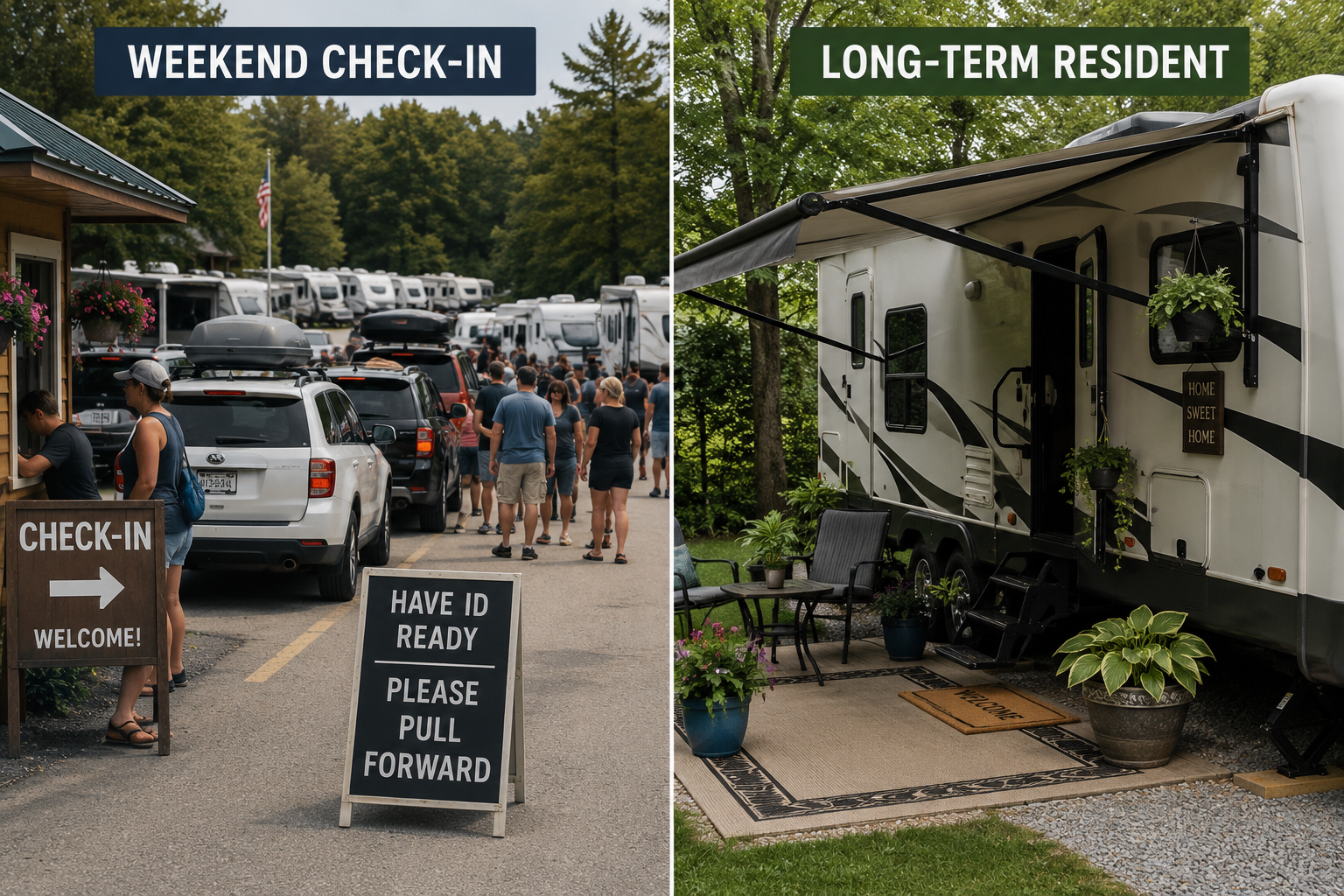
Long-term RV guests are changing the financial model at parks across the country. Parks that used to run almost entirely on weekend campers and short transient stays are watching their long-term population grow. Some of it is workforce housing demand, data center construction crews, traveling nurses, remote workers who found a cheap and flexible way to live. Some of it is intentional, operators who decided consistent monthly income sounded better than the weekend hustle. Either way, if your guest mix is shifting, your books need to shift with it. Most of the time they do not, and that is where the problems start.
This post is about what actually changes on the financial side when long-term stays become a significant part of your revenue, and what you need to have in place to manage it correctly.
Transient vs. Long-Term RV Guests: Two Completely Different Revenue Models
When you are running primarily on transient guests, your revenue is high-frequency and variable. Someone books for two nights, pays at reservation or check-in, and leaves. Your cash comes in fast, your receivables are essentially zero, and your books reflect a stream of small completed transactions. The financial management is relatively simple.
Long-term stays work differently. A guest who stays 30, 60, or 90 days may pay weekly or monthly. They may have a standing balance. They may be on a payment plan you set up informally because they seemed trustworthy. If you have multiple long-term guests on different billing schedules, you now have accounts receivable, and most small park operators have no system for managing that. They are tracking it in their head or on a whiteboard, and it is only a matter of time before something falls through the cracks.
The first thing I ask when a park owner tells me they have shifted toward long-term guests is: how are you billing them and how are you tracking what they owe? The answer tells me almost everything I need to know about the health of their books.
Income Classification Changes, and It Matters
This is one of the most overlooked issues in the shift to long-term stays, and it has real tax and legal implications. In most states, short-term stays under 30 days are subject to transient occupancy tax, or TOT, sometimes called lodging tax or bed tax. Long-term stays, typically defined as 30 days or more, are often exempt from that tax. But the line is not always clean, and the rules vary by state and even by county.
If you are collecting TOT on long-term guests who legally do not owe it, you are overcharging your guests and creating a liability. If you are not collecting it on guests who actually do owe it because you assumed they were long-term, you have a compliance problem. Either way, if your books are not tracking stay length and income type separately, you cannot even audit yourself to find out which situation you are in.
Your chart of accounts needs to reflect this. I set up separate income categories for transient site revenue, long-term site revenue, and any other ancillary income. That separation is not busywork. It is what lets you run a tax report at the end of the quarter and know exactly what you collected, what was taxable, and what was not.
Cash Flow Patterns Are Completely Different
Here is something that surprises a lot of operators when they first make the shift. Long-term stays can feel more stable because you know someone is there for 60 days. But your actual cash flow timing gets more complicated, not less.
With transient guests, money comes in constantly. With long-term guests, money comes in on billing cycles, and if a guest is a week late on their monthly payment, you feel it. If you have six long-term guests and two of them pay late, your bank account looks very different than your occupancy number suggests. I have seen parks with 80% occupancy show negative cash flow in a given month entirely because of timing issues on long-term collections.
This is why your monthly financial review needs to include an accounts receivable aging report, not just a P&L. You need to know, as of today, who owes you money and how old that balance is. Seven days past due is a reminder call. Thirty days past due is a formal notice. Sixty days past due is a policy decision. None of that happens consistently without a system.
What Your Lease or Rental Agreement Needs to Say
Long-term guests are not just guests, they may have legal tenant rights depending on your state. Some states have very specific laws about how long someone can stay before they acquire tenant protections, including the right to a formal eviction process rather than just being asked to leave. I am not an attorney and you should absolutely talk to one if you are moving into extended-stay territory, but I can tell you from a financial standpoint that you need a written agreement with every long-term guest, without exception.
That agreement should specify the rate, the billing cycle, what happens when payment is late, and the terms under which the stay can be ended. It protects you legally, yes, but it also protects your cash flow. When a guest knows the late fee is real and the process is documented, they pay differently than when they think it is casual.
From a bookkeeping standpoint, every long-term guest should have their own ledger in your system. I do not care if you are using QuickBooks, a property management system, or a spreadsheet you built yourself. You need a place where you can see every transaction for that guest, what they were charged, what they paid, and what they owe. That is the minimum.
The Revenue Mix Ratio to Watch
Once you have your income properly categorized, you can start looking at your revenue mix as a strategic metric. What percentage of your total site revenue is coming from long-term guests versus transient? There is no universally right answer, but there are tradeoffs at every point on the spectrum.
Heavy transient means high flexibility on rates and higher potential revenue per night, but more volatility and more operational intensity. Heavy long-term means more predictable cash flow and lower operational overhead, but less pricing power and potential legal complexity. Most operators I work with who have found a balance they like land somewhere in the 30 to 50 percent long-term range, enough to stabilize cash flow through slow seasons without giving up the rate upside on peak weekends.
Know your number. Track it monthly. And make sure your books are set up to give it to you without you having to dig.
Read this next: The Real Cost of Online Travel Agent (OTA) Dependency
I cover revenue mix, income classification, and how to set up your chart of accounts for RV park operations in 𝗙𝗿𝗼𝗺 𝗢𝗳𝗳𝗲𝗿 𝘁𝗼 𝗢𝗽𝗲𝗿𝗮𝘁𝗶𝗼𝗻: 𝗧𝗵𝗲 𝗖𝗼𝗺𝗽𝗹𝗲𝘁𝗲 𝗥𝗩 𝗣𝗮𝗿𝗸 𝗜𝗻𝘃𝗲𝘀𝘁𝗼𝗿’𝘀 𝗚𝘂𝗶𝗱𝗲 ($49). Available at wendipvifinancial.gumroad.com/l/kqmyb and on Amazon under my name, Wendi Rook.
Leave a Reply