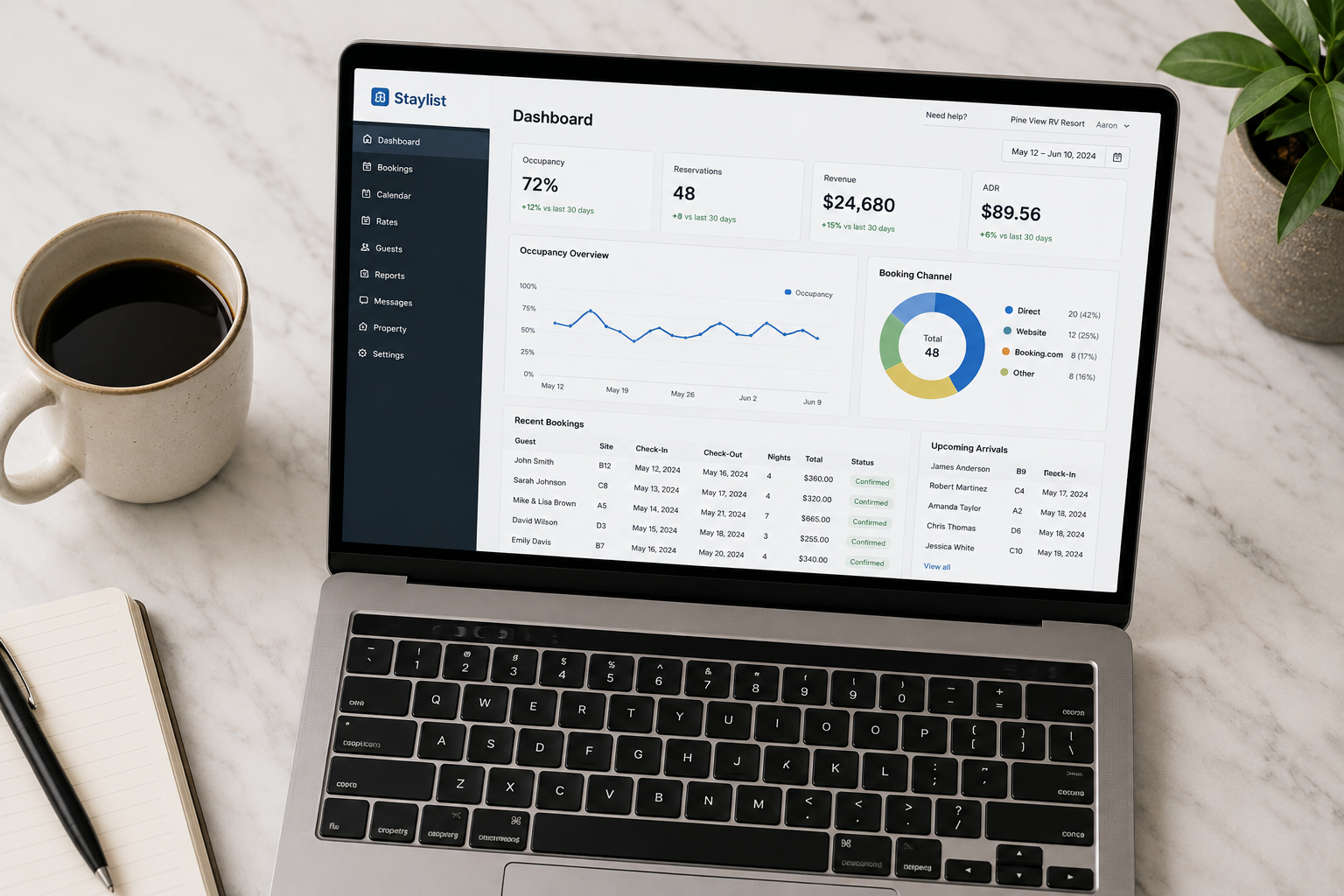
Your RV park booking platform may be filling your sites, but it could also be owning your guests. Most RV park owners do not think of themselves as having a booking channel strategy. They signed up for Hipcamp or Campspot or Harvest Hosts because it brought in guests, the guests kept coming, and the system worked. So they leaned into it. Maybe they optimized their listing, collected some reviews, and let the platform do the marketing. That is completely understandable, and for a period of time it probably made a lot of sense.
The problem is not that you are using an OTA or a booking platform. The problem is when that platform becomes the primary or only way guests find you, and you have no visibility into what that dependency is actually costing you or what happens to your business if the relationship changes. Because platforms change. They raise their commission rates. They change their algorithm. They sunset features. They get acquired. And if your occupancy is built on a foundation you do not control, your financial model has a vulnerability that does not show up anywhere in your P&L.
This post is about how to see that vulnerability clearly in your numbers, and what your financial reporting needs to include if booking channel dependency is a real part of your operation.
What RV Park Booking Platform Dependency Actually Costs You
Let me start with the direct cost because it is larger than most operators realize when they add it up honestly. OTA and booking platform commissions typically run between 8 and 15 percent of the booking value depending on the platform and your agreement. Some are lower, some are higher, and some have tiered structures that reward volume with slightly better rates.
On the surface that feels manageable. But let’s run the actual math. If your park generates $400,000 in annual site revenue and 70 percent of your bookings come through a platform charging 10 percent commission, you are paying $28,000 a year in commissions. At a 10 percent cap rate, that $28,000 in annual expense represents $280,000 in park value that is being transferred to a third party every single year. That is not a small number, and most operators have never calculated it that way.
Now add the indirect costs. Guests who book through a platform often have their primary relationship with the platform, not with you. Their review goes on the platform. Their loyalty goes to the platform. When they want to book again, they go back to the platform and search, which means you may be competing against yourself for a repeat guest who already stayed at your park and loved it. Your marketing spend, your hospitality, your operations, all of that work feeds a guest relationship that the platform owns more than you do.
The Financial Visibility Problem
Here is the bookkeeping issue that I see constantly with parks that are heavily platform-dependent. Their revenue is recorded as a single line item, total site revenue, with no breakdown by booking source. They know how much came in. They do not know where it came from, what it cost to acquire, or what their margin looks like by channel.
That matters for several reasons. First, you cannot manage what you cannot measure. If you do not know that 80 percent of your revenue is coming from one platform, you cannot make an informed decision about whether to diversify. Second, commission costs are often buried in a general expense category rather than broken out as a direct cost of revenue. That makes your gross margin look better than it actually is. Third, if that platform ever changes its terms or you lose your listing for any reason, you have no data to understand the impact or build a response.
What I want to see in a park that uses booking platforms is a revenue breakdown by channel tracked every single month. Direct bookings, Platform A, Platform B, repeat guests, walk-ins. Each one as its own line. And on the expense side, commissions broken out by platform so you can see the true net revenue by channel. That is the reporting that lets you make real decisions.
What a Healthy Channel Mix Looks Like
There is no universally correct answer for how much of your revenue should come from any one source. A new park with no brand recognition may legitimately need to lean on OTAs heavily in year one to build occupancy and reviews. An established park with a strong repeat guest base and good direct booking infrastructure has no business giving 15 percent of its revenue to a platform for guests it could be capturing itself.
What I look for is a trend in the right direction. If a park is doing 80 percent OTA bookings in year one and 60 percent in year three with a growing direct booking share, that is a healthy trajectory. If a park is still doing 80 percent OTA in year five with no change, that is a strategic and financial problem that needs attention.
The goal most operators I work with target is somewhere around 50 to 60 percent direct bookings within three to five years of operation, with the remainder split across platforms and other channels. Getting there requires investment in your own booking infrastructure, your email list, your website, your repeat guest relationships, and your local marketing. Those are real costs, but they are investments in an asset you own rather than payments to a platform you rent.
How to Build the Financial Case for Diversification
This is where I want to be practical, because telling an operator to reduce OTA dependency without showing them the financial logic behind the investment rarely moves anyone to action.
Start by calculating your true net revenue per booking by channel. Take your total revenue from each platform, subtract the commissions paid to that platform, and divide by the number of bookings. Do the same for direct bookings where your acquisition cost is your own marketing spend divided by direct bookings generated. In almost every case, a direct booking that cost you $15 in email marketing to generate is more profitable than a platform booking that cost you $40 in commission, even if the nightly rate was identical.
Then build a simple scenario in your budget. If you shift 10 percent of your bookings from platform to direct over the next 12 months, what does that do to your net revenue? At a 10 percent commission rate on a $400,000 revenue base, shifting 10 percent of bookings to direct saves you roughly $4,000 in commissions. That is $40,000 in park value at a 10 percent cap rate. The cost of generating those direct bookings through your own marketing is almost certainly less than $4,000 if you are intentional about it.
That is the conversation I have with clients. Not that OTAs are bad, they are not, they fill rooms and they reach guests you would never reach on your own. But they should be one channel in a diversified mix, not the foundation your entire occupancy model is built on. And your financial reporting should be showing you exactly where you stand so you can make that decision with data instead of instinct.
What to Do with This Information
If you have read this far and you do not currently know what percentage of your bookings come from each channel, that is the starting point. Pull your reservation data for the last 12 months and sort it by booking source. Calculate the commission expense for each platform. Calculate your direct booking volume and what you spent to generate it. Then look at what you find with honest eyes.
You may discover your channel mix is healthier than you thought. You may discover you have a concentration problem you have been sensing but never quantified. Either way, you will know, and knowing is always better than guessing when it comes to your financial model.
Your books should tell you this story automatically every month. If they do not, that is a setup problem worth solving.
Read this next: The Real Cost of Online Travel Agent (OTA) Dependency
I cover revenue mix, channel strategy, and financial reporting structures for RV park operators in 𝗙𝗿𝗼𝗺 𝗢𝗳𝗳𝗲𝗿 𝘁𝗼 𝗢𝗽𝗲𝗿𝗮𝘁𝗶𝗼𝗻: 𝗧𝗵𝗲 𝗖𝗼𝗺𝗽𝗹𝗲𝘁𝗲 𝗥𝗩 𝗣𝗮𝗿𝗸 𝗜𝗻𝘃𝗲𝘀𝘁𝗼𝗿’𝘀 𝗚𝘂𝗶𝗱𝗲 ($49). Available at wendipvifinancial.gumroad.com/l/kqmyb and on Amazon under my name, Wendi Rook.
Leave a Reply