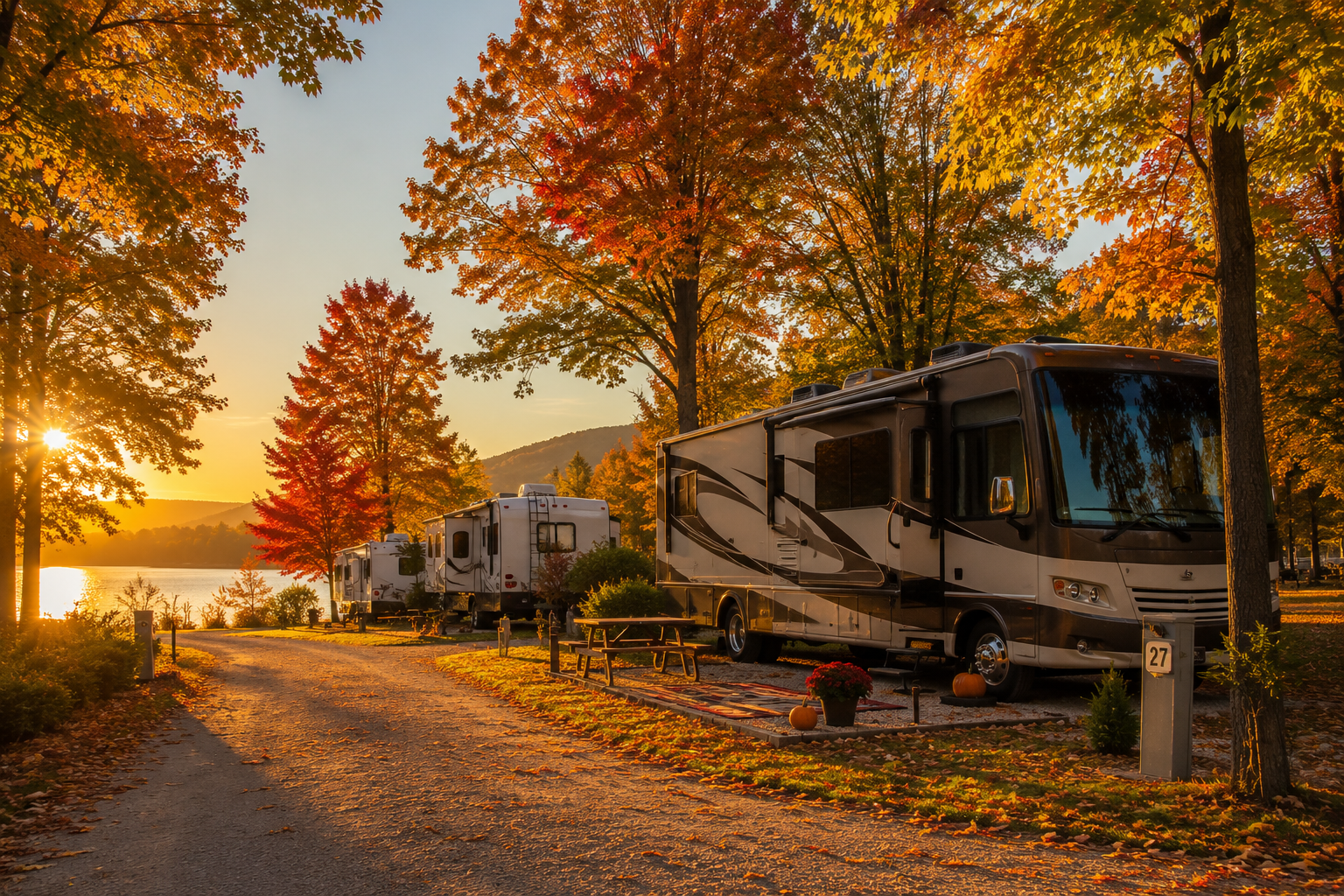
Most RV park owners think about shoulder season when it arrives. The smart ones think about it three to four months before it gets here.
There is a shift happening in outdoor hospitality that changes the shoulder season conversation entirely. Remote work travel, longer stay behavior, and seasonal migration patterns are filling what used to be dead zones on the calendar. The guest who used to show up only in July is now showing up in April and October too, sometimes for weeks at a time, because their laptop comes with them and their boss does not care where they work from.
Extended-stay guests now function as an economic stabilizer. They smooth cash flow and reduce reliance on weekend volatility. Parks that optimize for longer bookings are not just increasing occupancy, they are reducing revenue risk.
But here is the catch. Those guests do not show up automatically just because you are open. They go to the parks that are ready for them, that have positioned themselves correctly, that have the amenities and the marketing in place to attract them. And most of that positioning work needs to happen before shoulder season arrives, not after you are already in it.
Here is what to be thinking about right now if you want shoulder season to actually move your numbers this year.
Know Your Numbers From Last Shoulder Season First
Before you do anything else, pull your occupancy and revenue data from last year’s shoulder season. Not your peak season numbers. Your April, May, September, and October numbers specifically.
What was your occupancy rate in those months? What was your average daily rate (ADR)? What was your revenue per available site night? How did those numbers compare to your pro forma projections for the same period?
If you do not have that data broken out by month you have a bookkeeping setup problem to fix before next shoulder season. You cannot manage what you cannot measure and you cannot improve what you have never actually looked at specifically.
The gap between your peak season performance and your shoulder season performance is your opportunity. Understanding how big that gap is and what is driving it tells you where to focus your energy between now and when shoulder season arrives.
Who Is Your Shoulder Season Guest?
Peak season guests are relatively easy to understand. Families on summer vacation, road trippers, RV club rallies. The demand is predictable and the guests largely find you.
Shoulder season guests are different and understanding who they are changes how you market to them and what you offer them.
The remote worker is the fastest growing shoulder season guest segment right now. They are not constrained by school calendars or peak season pricing. They can come in April when your park is quiet and stay for two or three weeks because the scenery is good and the Wi-Fi works. They typically have higher household income than the average leisure traveler, they stay longer, and they spend more on-site.
The seasonal migrant is another significant segment. Snowbirds moving between northern summers and southern winters, retirees following the weather, full-time RV travelers who plan their routes around avoiding peak crowds and peak prices. These guests want longer term availability and they book further in advance than transient guests.
The shoulder season event attendee is a third segment worth cultivating. Fall festivals, harvest events, local sporting events, hunting season, and fishing season all drive demand in specific markets during shoulder months. Knowing what events happen in your area in April, May, September, and October and positioning your park as the right place to stay for those events is a specific and often underutilized marketing strategy.
What Your Park Needs to Be Ready
The remote worker segment in particular has specific needs that not every park is set up to meet. Reliable, fast Wi-Fi is not optional for this guest. Not adequate Wi-Fi. Fast, reliable Wi-Fi that can support video calls, file uploads, and multiple devices simultaneously. If your Wi-Fi infrastructure is consumer-grade equipment that barely covers the office, you are not competitive for this segment regardless of how beautiful your location is.
A workspace or quiet area where guests can work without being surrounded by children on summer vacation is a differentiator that costs relatively little to create and matters significantly to this guest. A picnic table near a power outlet in a quiet corner of the park is not glamorous but it serves the need.
For longer stay guests generally, the quality of your laundry facilities matters more than it does for transient guests. So does the reliability of your electrical hookups, the quality of your water pressure, and the availability of package or mail delivery. These guests are living at your park, not just sleeping there. Design the experience accordingly.
The Marketing Work That Needs to Happen Now
Shoulder season guests book differently than peak season guests. They are not booking two weeks in advance for a long weekend. They are often planning further out, researching more carefully, and looking for specific features rather than just availability.
This means your listings on Campendium, The Dyrt, Good Sam, and your own website need to specifically call out what makes your park a good shoulder season destination. Do you have reliable Wi-Fi? Say so explicitly and tell people the speed. Are you near fall foliage? Mention it with the specific months. Do you stay open through October or November when other parks in your area close? That is a competitive advantage worth advertising loudly.
Your Google Business listing should have current photos that show the park in shoulder season conditions, not just summer shots. A photo of your park in fall foliage with a guest working on a laptop at a picnic table tells a story that a July Fourth crowd photo does not.
Email your past guest list now if you have one. A simple message that says we are open through October, here is what we have going on this fall, and here is a link to book directly is one of the highest return marketing activities available to you. Past guests who had a good experience are your most likely shoulder season bookings and reaching them costs you almost nothing.
The Financial Payoff
National occupancy in 2026 is projected around 65 to 67 percent annually, but the distribution is what tells the real story. The key shift is shoulder season strengthening. Parks that capture that shift outperform the market. Parks that do not capture it are leaving occupancy and revenue on the table during months when their fixed costs are running whether guests show up or not. RV Park University
Every occupied site night in April or October that would otherwise have been empty is almost pure margin. Your fixed costs, your insurance, your property taxes, your debt service, your base staffing, those are running regardless. The revenue from a shoulder season booking flows to your bottom line at a much higher margin than a peak season booking because you are not adding cost to generate it.
That is the financial case for taking shoulder season seriously. Not as a nice supplement to peak season revenue, but as a deliberate strategic priority with specific marketing, amenity, and operational decisions behind it.
The parks that figure this out before shoulder season arrives will outperform the ones that figure it out after.
If you want help modeling what a stronger shoulder season could do to your annual NOI and asset value, reach out at pvifinancial.com.
And if you have not grabbed a copy of my book yet, 𝗙𝗿𝗼𝗺 𝗢𝗳𝗳𝗲𝗿 𝘁𝗼 𝗢𝗽𝗲𝗿𝗮𝘁𝗶𝗼𝗻: 𝗧𝗵𝗲 𝗖𝗼𝗺𝗽𝗹𝗲𝘁𝗲 𝗥𝗩 𝗣𝗮𝗿𝗸 𝗜𝗻𝘃𝗲𝘀𝘁𝗼𝗿’𝘀 𝗚𝘂𝗶𝗱𝗲 ($49), it covers operations, revenue management, and everything you need to run your park with financial discipline year round. You can get it direct here: wendipvifinancial.gumroad.com/l/kqmyb, or Amazon has it too, just search author Wendi Rook.
Leave a Reply