Tag: RV Park operations

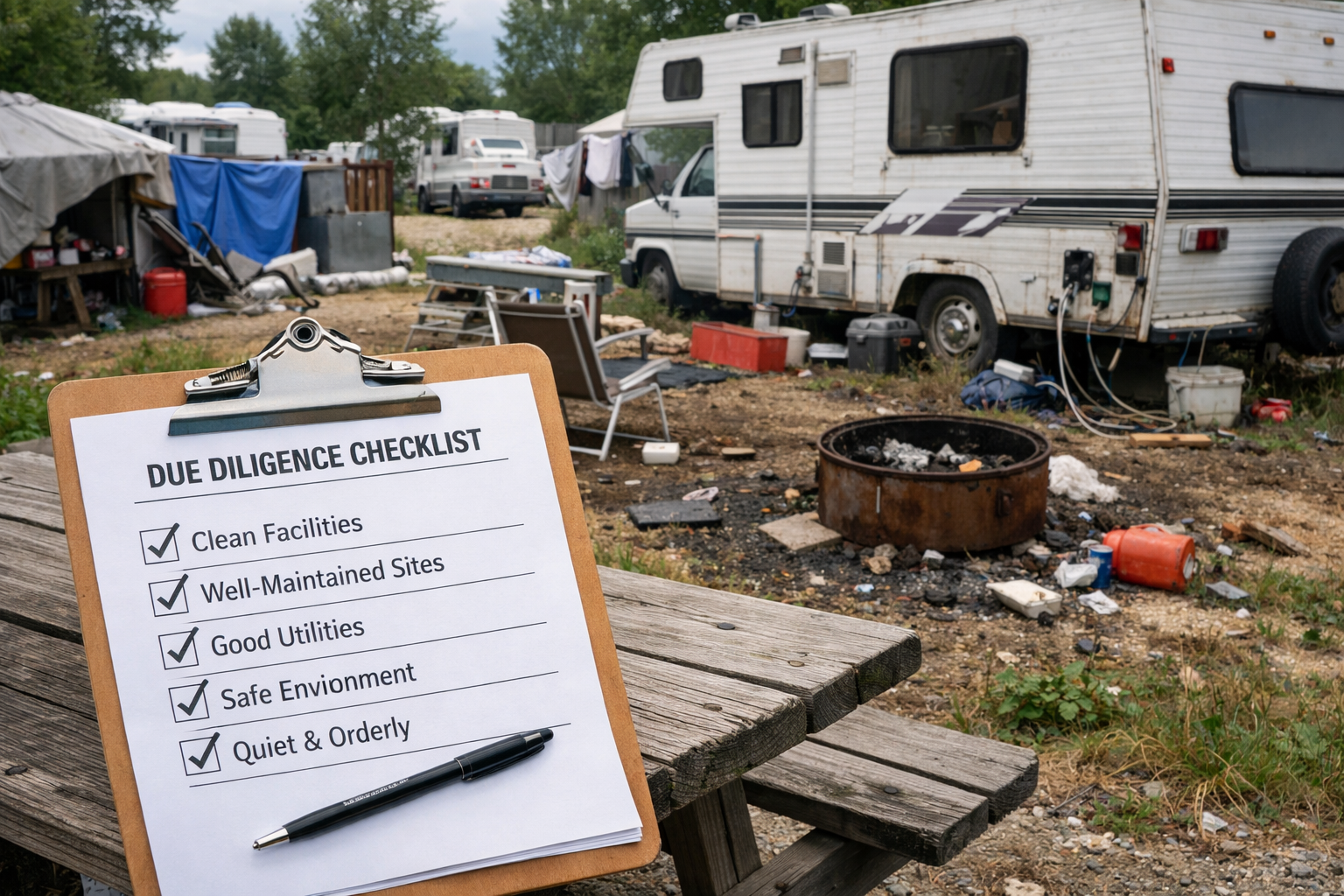
  • 5 Critical Reasons RV Park Operations Are Not Just a Due Diligence Checklist Item

    5 Critical Reasons RV Park Operations Are Not Just a Due Diligence Checklist Item

    If you have spent any time reading buyer guides on how to purchase an RV park, you have probably noticed a pattern. RV park operations gets one section, usually near the bottom, tucked in after cap rates, financing structures, and infrastructure diligence. It reads like a warning label. Watch out for deferred maintenance. Watch out for utility capacity. Watch out for seasonal cash flow. Then the guide moves on to the next deal.

    I get why that happens. Most of the content out there is written by people whose job ends at closing. Brokers, acquisition consultants, and deal sourcing shops are paid to get you to the closing table, not to run the business afterward. So RV park operations shows up as a risk to price around, not as the actual work you are about to take on for the next five, ten, or twenty years. I have written before about the financial side of this gap in my Acquiring an RV Park posts, but the operating side deserves just as much attention.

    Here is the problem with that framing. RV park operations is not a line item you check off during due diligence. It is the entire business. The checklist mentality tells new owners that once they have confirmed the septic system is adequate and the occupancy trend looks stable, the hard part is behind them. In reality, that is the moment the real work starts.

    Why the Checklist Framing Sets Owners Up to Struggle

    When RV park operations only shows up as a diligence category, new owners walk into closing thinking they have already done the operational thinking. They have not. They have confirmed the property is not obviously broken. That is a very different thing from knowing how to run RV park operations well day to day.

    I have talked to owners who did everything right on paper. They hired a good closing attorney, they got a clean environmental report, they verified the T-12 income statement, and the deal looked solid from every angle a checklist could measure.

    Then six months in, they were blindsided by things no checklist ever mentions. Guests testing every rule because nobody enforced them consistently, which I dug into in detail in my post on RV park rule enforcement. A manager who could observe problems but had no real authority to fix them. A seasonal cash flow crunch that the pro forma technically accounted for but that nobody prepared them to actually live through, something I cover more in my Cash Flow Management posts. RV park operations problems do not show up in a due diligence binder. They show up in the day to day.

    Some of the bigger names writing acquisition content lean even further in the wrong direction, treating RV park operations as a pure cost cutting exercise once you own the property, squeeze margins, cut amenities, and call it efficiency. That approach might move a spreadsheet in the short term, but it is a fast way to tank your reviews, your occupancy, and your guest retention. Real RV park operations is not about cutting until something breaks. It is about running a business that guests want to return to while still hitting your numbers, which is a big part of why I built my Fractional CFO Services around ongoing operating support, not just a one-time acquisition review.

    What RV Park Operations Actually Looks Like Once You Own the Park

    It is a daily rhythm, not a one-time review. Due diligence happens once. RV park operations happens every day you own the property, through every season, every staff turnover, every guest complaint, and every slow month that tests your cash reserves.

    It requires real decisions, not just verified numbers. Diligence confirms the T-12 is accurate. RV park operations is deciding what to do when a slow shoulder season shows up exactly as the numbers predicted and you still have payroll and debt service due. Knowing the number ahead of time does not make living through it easy.

    It means enforcing your own standards, not just setting them. A rules page in your welcome packet is a diligence item. Actually enforcing quiet hours, leash rules, and site upkeep standards every single week is RV park operations. This is the piece most acquisition guides skip entirely, because it cannot be reduced to a checkbox.

    It means managing people, not just verifying a staffing plan. Diligence asks whether the current manager will stay on. RV park operations asks whether that manager has the training, authority, and support to actually run the property the way you need it run, and what you do if the answer is no.

    It means protecting the guest experience while still hitting your financial targets. This is where the cost cutting playbook falls short. RV park operations done well means finding efficiencies that do not erode the experience your guests are paying for, not stripping amenities until the reviews turn. If pricing decisions are part of what feels shaky right now, my posts under Revenue and Pricing walk through how to adjust rates without damaging the guest experience.

    How to Actually Prepare for RV Park Operations, Not Just Diligence

    Build your operating plan before you close, not after. Your rules, your staffing structure, your maintenance schedule, and your guest communication standards should exist in writing before you take over the property, not get figured out reactively in your first month.

    Separate your diligence team from your operating mindset. It is easy to let the excitement of a clean diligence report convince you the hard part is over. Treat closing as the starting line for RV park operations, not the finish line for the deal.

    Plan for enforcement, not just for policy. Writing a rule and enforcing a rule are two different skill sets. Decide before you close how you or your manager will actually handle the first rule violation, not just what the rule says.

    Budget for the season you are worst prepared for, not the season you are picturing. Most new owners plan around their best month. RV park operations means planning your cash reserves and staffing around your worst month, because that is the month that actually tests your business. The SBA’s guide on managing your finances is a solid outside resource if you want a general framework before layering in the RV park specific numbers.

    Get help with the parts of RV park operations that are not your strength. Some owners are great with guests but struggle with the financial side. Others can run a spreadsheet in their sleep but freeze up during a difficult guest conversation. Know which one you are, and build a team around the gap. If bookkeeping and financial systems are the weak link in your RV park operations, that is exactly what I cover in my Bookkeeping and Financial Systems posts.

    RV park operations is where the actual business lives. Due diligence tells you whether the property is worth buying. Operations tells you whether you can run it well once you own it, and that second question matters just as much as the first one, even though almost nobody writing acquisition content spends real time on it. If you are further along in the buying process, treat your diligence checklist as the beginning of your RV park operations plan, not a substitute for one.

    If you are working through an acquisition right now and want help building an operating plan alongside your diligence process, not after it, that is exactly the kind of work I do. Reach out at PVIFinancial.com.

    For more on running a profitable, well managed park, check out my Resource Library, and grab a copy of my book From Offer to Operation: The Complete RV Park Investor’s Guide, also available on Amazon.

    ~Wendi | Fractional CFO | PVIFinancial.com

  • 7 RV Park Rule Enforcement Mistakes That Let Guests Take Over Your Property

    7 RV Park Rule Enforcement Mistakes That Let Guests Take Over Your Property

    I keep seeing the same post pop up in RV park owner groups. Someone lays out a laundry list of guest behavior problems, people jumping into the pool instead of walking in, quiet hours getting ignored, dogs off leash, campfires left burning, extra vehicles parked wherever, and they ask the group for advice. RV park rule enforcement is the actual topic buried inside every one of those posts, even when nobody says it directly.

    Here is the truth nobody wants to hear. If you are asking a Facebook group how to handle a guest who will not follow a posted rule, you already have a bigger problem than that one guest. You have an RV park rule enforcement gap, and gaps like that do not stay small. They grow, because guests talk to each other, and guests learn fast which parks actually mean what they post on a sign and which ones do not.

    I read through a long thread on exactly this last week. Owner after owner chimed in with their own version of the same story. A guest jumped in the pool even though the sign clearly says walk in only. A family let their dog run loose near the playground. Someone parked a second vehicle on a site that was only supposed to have one. Every single story was different, and every single one came down to the same root cause. Weak RV park rule enforcement let the first violation slide, so nobody expected the second one to be handled any differently.

    Why RV park rule enforcement falls apart in the first place

    Owning an RV park is not a part time job, even when it feels like one during the slow season. The parks where RV park rule enforcement breaks down are almost always parks where the owner has stepped back too far, whether that is because they hired a manager they do not check in on, they are running the property remotely, or they are just tired of being the bad guy.

    I get it. Nobody opens an RV park because they dreamed of confrontations over quiet hours. Most owners get into this business because they love the outdoors, they love the lifestyle, and they want to build something that supports their family. Rule enforcement is not the fun part. It is not what you pictured when you signed the closing documents. But RV park rule enforcement is not a side task you delegate and forget. It is one of the core jobs of ownership, right up there with knowing your numbers, watching your occupancy, and keeping your reviews strong.

    If you are not on top of RV park rule enforcement, someone else will be, and it will not be you. It will be the loudest guest, the one who tests every boundary because nobody has ever pushed back. And once that guest figures out the rules are optional, every guest around them figures it out too. That is how a well run park slides into a park where the office avoids confrontation, longtime guests start complaining about newer guests, and reviews start mentioning noise, safety, or a lack of oversight. None of that happens overnight. It happens one unenforced rule at a time.

    There is also a financial side to this that gets missed constantly. Weak RV park rule enforcement drives away your best guests, the quiet families and retirees who pay on time, treat the property well, and rebook every season. Those guests do not want drama. If they feel like the park is not managed, they will not complain, they will just leave and book somewhere else next time. You will not see it on a spreadsheet labeled “guest left because of noise complaints.” You will just see slowly softening occupancy and repeat bookings that used to be automatic and now are not, and it almost always traces back to poor RV park rule enforcement somewhere along the way.

    The small stuff that is actually the big stuff

    Every one of these sounds minor on its own. Together, they tell your guests exactly how seriously you take RV park rule enforcement.

    Jumping into the pool instead of walking in. This is not just a house rule, it is a liability issue and an insurance issue. If your posted rules say no jumping or diving and you let it slide because the kid seems harmless, you have now set a precedent for every guest who saw it happen. The next injury claim will ask exactly one question. Was RV park rule enforcement actually happening. If the answer is no, that is a problem for your insurance carrier and for you.

    Quiet hours that exist on paper only. If your rules say quiet hours start at 10pm and someone is still running a generator or blasting music at 11, and nothing happens, you have taught every guest within earshot that quiet hours are a suggestion. This is one of the fastest ways to lose your best long term guests, the ones who came specifically because they wanted a quiet, family friendly atmosphere, and it is a direct result of inconsistent RV park rule enforcement.

    Pets off leash. This one gets people hurt, and it gets parks sued. A leash rule that is not enforced is a rule you do not actually have. Dog bite and related injury claims are not slowing down anywhere. Insurers paid out 1.12 billion dollars in dog related injury claims nationally in 2023, and the number of claims has climbed 110 percent over the past decade (https://insuranceindustryblog.iii.org/dog-related-injury-claims-continue-to-increase-average-payout-declines/). By 2024, the average cost of a single dog bite claim had reached $69,272 dollars. Insurance carriers that specialize in campground and RV park coverage have also flagged animal related incidents as a growing issue specifically within RV parks, which is part of why so many general liability policies now carve out or exclude dog bite coverage unless you add it back separately. If a leash rule is not being enforced on your property, RV park rule enforcement is likely lagging behind your actual exposure, and you may be carrying more risk than your policy covers.

    Unauthorized vehicles and guests. Extra cars parked on sites not built for them, extra guests staying who were never registered, extra RVs squeezed onto one site. Every one of these affects your site capacity, your utilities, and your liability coverage. It also means you are providing services, water, sewer, electric, trash, to people who never paid for them, which is another quiet cost of lax RV park rule enforcement.

    Campfires left unattended or built where they should not be. In dry seasons this is not a rule violation, it is a fire risk to your entire property and every neighboring site. One unattended campfire can undo years of work in an afternoon, and it is exactly the kind of risk that solid RV park rule enforcement is meant to prevent.

    Speeding through the park. Golf carts, trucks, anything moving faster than your posted limit near kids and pets walking around is a serious injury waiting to happen. Speed limits are one of the easiest rules to enforce and one of the most commonly ignored, because it feels awkward to flag someone down over five miles an hour.

    Site upkeep and trash. Guests treating their site like a personal junkyard drags down the experience for every other guest paying to stay there. It also affects your curb appeal for prospective guests driving through, and it can violate local health and sanitation codes depending on your jurisdiction.

    None of these are complicated rules. They are simple, and that is exactly the point. If you cannot manage RV park rule enforcement on the simple ones consistently, your guests will notice, and they will assume the rest of your rules are just as soft. Once that assumption takes hold, it spreads fast, because guests talk to each other at the pool, at the dump station, and in every RV park Facebook group and app review out there.

    How to actually fix RV park rule enforcement

    Put it in writing, and mean every word. Your rules need to be posted at the pool, in the common areas, in your welcome packet, and referenced directly in your rental agreement. Vague rules invite vague compliance. “Please be considerate of others” is not enforceable. “Quiet hours are 10pm to 7am, no exceptions” is, and that clarity is the foundation of good RV park rule enforcement.

    Enforce the first violation, not the fifth. The moment you let something slide because it is easier than the conversation, you have set the new standard for that guest and anyone watching. RV park rule enforcement works because it is consistent, not because it is harsh. A short, polite, direct conversation the first time a rule is broken saves you five uncomfortable conversations later.

    Train your staff or manager to enforce, not just observe. If you have someone else running day to day operations, they need actual authority and actual backing from you to enforce rules on the spot. A manager who has to check with the owner before addressing a leash violation is not managing, they are reporting, and RV park rule enforcement suffers because of it. Give your team a simple script and the confidence to use it.

    Build consequences into your rental agreement. A verbal warning, then a written warning, then removal from the property. Guests respect a process that is clear and applied the same way every time. It also protects you legally if a removal ever gets contested, and it gives your RV park rule enforcement real teeth instead of empty threats.

    Walk your property regularly, even if you have a manager. Owners who show up, even briefly, send a message that someone is paying attention. Absent owners get parks where RV park rule enforcement quietly disappears, one small exception at a time, until the exceptions become the norm.

    Do not confuse being friendly with being permissive. You can be warm, welcoming, and still hold the line on rules that protect your property, your other guests, and your insurance coverage. Guests respect owners who are kind and consistent far more than owners who are only kind.

    Review your rules at least once a year. Rules that made sense five years ago may not fit your current guest mix, your current amenities, or current state and local safety codes. RV park rule enforcement only works if the rules themselves are current, realistic, and clearly communicated.

    RV park rule enforcement is not about being the strict owner nobody likes. It is about protecting the asset you built, the guests who follow the rules and deserve a good experience, and the business you are trying to run profitably. The parks that get RV park rule enforcement right are the parks that keep good guests coming back and keep problem guests from ever becoming the norm. The parks that get it wrong end up with an office staff that dreads confrontation, an owner who feels like they have lost control of their own property, and a guest base that slowly shifts toward the people who caused the problem in the first place.

    If your park is dealing with recurring guest issues and you are not sure whether it is a policy problem or an RV park rule enforcement problem, that is exactly the kind of operational review I help owners work through. If you want help tightening up your rules, your rental agreement language, or your overall operating systems, that is exactly the kind of work I do. Reach out at PVIFinancial.com.

    For more on running a profitable, well managed RV park, check out my Resource Library, and grab a copy of my book From Offer to Operation: The Complete RV Park Investor’s Guide, also available on Amazon.

    If money is quietly slipping out the back of your park through unenforced policies, that connects directly to your bottom line. Take a look at my posts on Cash Flow Management and Operating Your RV Park for more on tightening up daily operations. If you are earlier in the process and still evaluating a park, my Acquiring an RV Park posts cover the due diligence side of spotting these issues before you close. And if bookkeeping systems feel just as loose as your rule enforcement, my Bookkeeping and Financial Systems posts are a good next stop.

    For guidance on the safety side of pool rules and campfire restrictions, your state fire marshal’s office or local parks and recreation authority publishes current codes for organized campgrounds, and it is worth checking those against your posted rules at least once a year.

    ~Wendi | Fractional CFO | PVIFinancial.com