
Tag: RV park acquisition

  • The Due Diligence Items Nobody Talks About (That Could Cost You More Than the Septic)

    The Due Diligence Items Nobody Talks About (That Could Cost You More Than the Septic)

    Everyone who has spent time in the RV park acquisition space knows to inspect the septic. They know to pull the financials and verify the revenue. They know to walk the property and assess deferred maintenance.

    What most buyers, including experienced ones, do not think to dig into are the operational and technology commitments that come with the park. The contracts, platforms, software subscriptions, and commission arrangements that are quietly running in the background and that transfer to you at closing whether you knew about them or not.

    These are not the sexiest due diligence items. They are not the ones that show up in the inspection report or the title commitment. But they are the ones that quietly erode your NOI in year one while you are busy trying to figure out everything else.

    Here are the ones that matter most and what to ask about each one.

    OTA Contracts and What They Are Actually Costing

    Most buyers look at the revenue a park generates through online travel agencies like Hipcamp, Campspot, Booking.com, and Good Sam and see it as a positive. Online bookings mean occupancy. Occupancy means revenue. Revenue is good.

    What they do not look at carefully enough is what that revenue actually costs to generate.

    OTA commissions in the outdoor hospitality space typically run between 8 and 25 percent of the booking value depending on the platform and the agreement. On a park generating $200,000 in OTA-sourced revenue at an average commission of 15 percent, that is $30,000 per year in commission expense. If that $30,000 is not clearly broken out as a line item in the seller’s financials, which it often is not because it gets netted out of revenue rather than shown as an expense, the NOI looks better than it actually is.

    Beyond the commission cost, OTA contracts can contain terms that significantly affect how you run the park after closing. Rate parity clauses require you to offer the same rate on the OTA platform as on your own website, which prevents you from incentivizing direct bookings. Auto-renewal clauses lock you into a platform for another year if you do not give notice within a specific window. Termination provisions can require 30 to 90 days notice and sometimes carry penalties.

    What to ask: Request copies of all active OTA contracts before you remove contingencies. What are the commission rates on each platform? Are there rate parity requirements? What is the termination notice period and are there any penalties? What percentage of total bookings came through each OTA versus direct channels in the last 12 months?

    What to do: Model the true net revenue from OTA bookings after commissions. Assess whether the park has a direct booking strategy and what it would cost in time and marketing spend to shift the mix toward direct over time. Factor the transition period into your first year revenue projections.

    The Property Management Software Situation

    Every operating RV park runs on some kind of reservation and property management system. It might be a sophisticated platform like Campspot, RMS Cloud, or ResNexus. It might be a basic system that was set up ten years ago and has never been updated. It might be a combination of a spreadsheet and a phone.

    The software the park runs on matters for three reasons.

    First, it holds all the historical data. Reservation history, guest contact information, occupancy records, rate history. That data is one of your most valuable operational assets going into year one and you need to confirm it transfers to you at closing. Some platforms make data export straightforward. Others make it difficult or expensive. And if the reservation system login credentials are tied to the seller’s personal account rather than a business account, you could find yourself locked out of your own booking history after closing.

    Second, the software has costs that may not be visible in the financials. Subscription fees, per-booking fees, processing fees. These are often small individually but they add up and they belong in your expense model.

    Third, the software determines what you can and cannot do operationally. A park on an outdated system with no online booking capability is a value-add opportunity but also an immediate operational project in year one. Budget for it, plan for the transition period, and factor the potential occupancy disruption into your projections.

    What to ask: What reservation and property management software does the park currently use? Is the account tied to the seller personally or to the business? Can all historical reservation and guest data be exported and transferred at closing? What are the monthly costs? Is the contract month-to-month or does it have a remaining term?

    What to do: Log into the system with the seller during due diligence and confirm you can see the data. Understand the transfer process before closing day, not after. If the system is outdated or inadequate, get quotes on replacement and include the cost and transition timeline in your planning.

    Wi-Fi Infrastructure and the Contracts Behind It

    Wi-Fi has gone from a nice-to-have amenity to a basic guest expectation in almost every market. Guests arrive with multiple devices and they expect to stream, work, and stay connected. A park with inadequate Wi-Fi coverage or speed gets penalized in reviews in ways that directly affect future bookings.

    What most buyers do not look at carefully enough is what the park’s Wi-Fi infrastructure actually consists of and what contracts support it. Is it a consumer-grade router plugged into a cable modem or a purpose-built outdoor Wi-Fi system with access points distributed across the property? Is there a managed service provider handling the network or is it the seller’s personal internet account?

    Managed Wi-Fi service contracts for RV parks, companies like Tengo Internet or RV Park Wi-Fi, are common and they often have multi-year terms with early termination fees. If the park is locked into a contract for another 18 months at $800 per month and the service is inadequate, you are paying for something that is generating negative reviews until the contract expires.

    What to ask: Who provides the Wi-Fi service and what are the contract terms? Is there a managed service provider or is the internet service tied to the seller’s personal account? What is the monthly cost? Are there any minimum term commitments or early termination fees? What does the coverage look like across the full property including the back sites?

    What to do: Walk the property with your phone and test the Wi-Fi signal in multiple locations including the sites furthest from the office. If coverage is spotty or the system is inadequate, get quotes on upgrade or replacement before closing and include the cost in your acquisition budget.

    Vendor Contracts With Remaining Terms

    Beyond the technology-specific contracts, parks often have vendor relationships with remaining contractual terms that are not immediately visible in a review of the financials. Laundry equipment leases. Propane supply agreements. Pest control contracts. Vending machine arrangements. Pool chemical service agreements. Landscaping contracts.

    Each of these individually is small. Collectively they can represent a meaningful set of commitments that transfer to you at closing. A laundry equipment lease with 30 months remaining at $400 per month is a $12,000 obligation you are inheriting. A propane supply agreement with a price lock that expires next year may mean you are about to face a significant cost increase.

    What to ask: What vendor contracts does the park currently have and what are the remaining terms on each? Are any of these contracts personally guaranteed by the seller? Which of these transfer automatically to a new owner and which require the vendor to consent to the assignment?

    What to do: Request copies of all vendor contracts as part of your due diligence document request. Review the remaining terms and calculate the total committed obligation across all of them. Confirm which require consent to assign and start that process early enough that it does not delay your closing.

    The Guest Database and What It Is Worth

    This one almost nobody thinks about until after they close and realize the previous owner took the guest list with them.

    A park with three or four years of operation has a guest database that represents real value. Past guests are your highest probability future guests. They have stayed at the park, they liked it enough to complete their stay, and if you can reach them directly you can market to them for essentially zero cost.

    The guest database lives in the reservation system. If the reservation system account transfers cleanly to you at closing, the database transfers with it. If the account is tied to the seller personally, they may have the ability to export the guest data and you may end up with nothing.

    This is not hypothetical. It happens in acquisitions when nobody thinks to address it specifically in the purchase agreement.

    What to ask: Where does the guest database live and who controls it? Can you confirm at closing that the full guest history and contact database will transfer to the new owner? Is there any data that is stored outside the reservation system?

    What to do: Address the guest data transfer specifically in the purchase agreement. Require that the full guest database be exported and delivered to the buyer at closing as a condition of the sale. This costs the seller nothing and protects you from losing an asset that has real marketing value.

    Why This All Matters

    None of the items above are individually deal-breakers. But collectively they represent a category of due diligence that most buyers, including experienced ones, give minimal attention to because they are focused on the bigger ticket items like infrastructure, financials, and legal.

    The pattern is this: buyers close on a park, spend the first few weeks getting oriented, and then start discovering commitments they did not know they had, platforms they cannot access, contracts they cannot exit, and a guest database that the seller took with them.

    Every one of those discoveries is avoidable with the right questions asked at the right time in the due diligence process.

    If you want help building a complete due diligence framework for a specific deal you are evaluating, reach out at pvifinancial.com. And if you have not grabbed a copy of my book yet, 𝗙𝗿𝗼𝗺 𝗢𝗳𝗳𝗲𝗿 𝘁𝗼 𝗢𝗽𝗲𝗿𝗮𝘁𝗶𝗼𝗻: 𝗧𝗵𝗲 𝗖𝗼𝗺𝗽𝗹𝗲𝘁𝗲 𝗥𝗩 𝗣𝗮𝗿𝗸 𝗜𝗻𝘃𝗲𝘀𝘁𝗼𝗿’𝘀 𝗚𝘂𝗶𝗱𝗲 ($49), it covers the full due diligence framework in great detail.

    You can get it direct here: wendipvifinancial.gumroad.com/l/kqmyb, or Amazon has it too, just search author Wendi Rook.


    Click here to read “The $312,000 Mistake: What Happens When a Buyer Accepts the Seller’s NOI Without Rebuilding It” (psst, it includes a FREE calculator)

  • The $312,000 Mistake: What Happens When a Buyer Accepts the Seller’s NOI Without Rebuilding It

    The $312,000 Mistake: What Happens When a Buyer Accepts the Seller’s NOI Without Rebuilding It

    This is not a story about one specific deal. It is a pattern that shows up in RV park acquisitions over and over again, different parks, different markets, different sellers, same mistake. A buyer does little investigation, accepts the seller’s NOI nearly at face value, makes an offer based on that number, and closes on a park that is worth significantly less than what they paid.

    Here is what that pattern typically looks like, and more importantly, what to do about it before you make your next offer.

    The Deal That Looks Clean

    Picture a mixed use park, call it Cedar Creek RV and Mobile Home Resort. Sixty-two sites, sitting on twelve acres about twenty minutes outside a mid-size recreational market. Decent reviews, a mix of long-term monthly tenants and transient nightly guests, a motivated seller, and a broker package that looks clean.

    The financials presented look like this:

    Gross Revenue: $524,000 Operating Expenses: $274,000 Net Operating Income: $250,000 Asking Price: $1,875,000 Implied Cap Rate: 7.5%

    On the surface that looks reasonable. A 7.5 cap in a decent market, expenses running at about 52 percent of gross. Nothing obviously wrong.

    But when you rebuild NOI for a real acquisition you do not accept the surface. You go line by line.

    Line by Line: Where the Numbers Change

    Management Fee The seller has owned and operated this park for eleven years. He lives on the property, handles guest check-ins personally, manages all vendor relationships, and coordinates maintenance. There is no management fee in the expenses because he never paid one. He just worked.

    Owner Labor Beyond Management Beyond the management function the seller is also performing the role of maintenance coordinator and handling all bookkeeping internally. To replace those two functions with hired help would cost approximately $28,000 per year combined. Also not in the expenses.

    Utility Costs Pulling the actual utility bills and comparing them to what is in the financials reveals that the seller has been absorbing electrical costs for the long-term tenant sites without passing any of it through to tenants. The actual utility cost when you include the tenant site electrical is $18,400 higher than what is presented in the financials.

    Maintenance The park has not had a significant capital expenditure in four years. The maintenance expense in the financials is running unusually low at $14,200 per year for a sixty-two site property with aging road infrastructure and bathhouses that were last renovated years ago. A normalized maintenance budget for a park this size and age runs closer to $28,000 per year. That is another $13,800 in understated expenses that will land on the new owner whether they budgeted for it or not.

    Insurance The seller’s current policy is significantly underinsured for a hospitality property of this type. An independent quote at appropriate coverage levels comes in $9,600 higher than what is reflected in the financials.

    The Rebuilt Numbers

    Here is what the NOI actually looks like once every missing and understated expense is added back:


    Seller PresentedRebuilt
    Gross Revenue$524,000$524,000
    Management Fee$0$47,160
    Owner Labor$0$28,000
    Utility ExpenseUnderstated by $18,400Corrected
    Maintenance$14,200$28,000
    InsuranceUnderstated by $9,600Corrected
    Total Additional Expenses$0$116,960
    Net Operating Income$250,000$133,040

    Want to run these numbers on your own deal? Use the free NOI Calculator here.

    The seller presented an NOI of $250,000. The real NOI is $133,040. Not because the seller is being dishonest. Because an owner-operator presenting their own financials shows the business the way they experience it, not the way a buyer needs to evaluate it. They absorbed their own labor, let deferred costs accumulate, and presented the numbers the way they actually look from the inside.

    That is not fraud. It is just the natural gap between owner financials and acquisition financials. And closing that gap is the buyer’s responsibility, not the seller’s.

    What That Means for the Price

    At the seller’s presented NOI of $250,000 and a 7.5 cap, the asking price of $1,875,000 is internally consistent.

    At the real NOI of $133,040 and the same 7.5 cap, the supportable value drops to $1,773,867.

    But there is more to it than just recalculating at the same cap rate. A park with this many normalization adjustments required carries more execution risk than a clean stabilized asset. Sophisticated buyers in this market apply a 7.5 cap to well-run stabilized parks. A park with missing management infrastructure, deferred maintenance, and understated utilities warrants a higher cap rate to reflect that risk. At an 8.5 cap the supportable value based on the real NOI is $1,565,176.

    The asking price is $1,875,000. The supportable value based on verified numbers and an appropriate cap rate is approximately $1,563,000. That is a $312,000 gap between what the seller is asking and what the park is actually worth.

    A buyer who catches this before making an offer has a very different negotiating conversation than a buyer who catches it after closing.

    This Is Not a Rare Deal. This Is a Typical Deal.

    The pattern in Cedar Creek shows up in the overwhelming majority of RV park acquisitions that get reviewed carefully. Missing management fees, understated owner labor, deferred maintenance masquerading as a lean expense structure, utility costs that do not reflect actual consumption.

    The specific numbers vary. The pattern does not.

    The buyers who avoid overpaying are the ones who rebuild the NOI from source documents before they make an offer. They pull three years of bank statements and tax returns. They add back what is missing. They normalize what is understated. They apply a cap rate that reflects the real risk profile of the asset. And they make their offer based on that number, not the seller’s version.

    The buyers who overpay are the ones who trusted the broker package.

    Do the Work Before You Make the Offer

    If you are evaluating a park right now, go through the Cedar Creek checklist on your own deal before you make an offer. Is there a management fee in the expenses? Is there market-rate owner compensation reflected? Have you pulled the actual utility bills and compared them to the financials? Have you normalized the maintenance budget based on the age and condition of the property? Have you gotten an independent insurance quote?

    Every one of those questions has a dollar value attached to it. And every dollar of missing expense translates directly into overstated NOI and an inflated asking price.

    To make this easier, there is a free NOI calculator at PVIFinancial.com that walks through this same rebuilding process line by line. Plug in your numbers and see what the real NOI looks like on the deal you are evaluating before you commit to anything.

    And if you want professional eyes on a specific deal before you make an offer, acquisition underwriting is available at PVIFinancial.com. No retainer required.

    If you have not grabbed a copy of my book yet, 𝗙𝗿𝗼𝗺 𝗢𝗳𝗳𝗲𝗿 𝘁𝗼 𝗢𝗽𝗲𝗿𝗮𝘁𝗶𝗼𝗻: 𝗧𝗵𝗲 𝗖𝗼𝗺𝗽𝗹𝗲𝘁𝗲 𝗥𝗩 𝗣𝗮𝗿𝗸 𝗜𝗻𝘃𝗲𝘀𝘁𝗼𝗿’𝘀 𝗚𝘂𝗶𝗱𝗲 ($49), it covers the full underwriting framework including everything you need to know about rebuilding NOI, evaluating cap rates, and structuring your offer.

    You can get it direct here: https://wendipvifinancial.gumroad.com/l/kqmyb, or Amazon has it too, just search author Wendi Rook.


    Click here to use my FREE RV Park NOI Calculator to rebuild the NOI before you make an offer.

    You might want to read this next: “The Seller’s Pro Forma Is Not Your Pro Forma”

  • The First 90 Days: What Nobody Tells You About Running a Park After You Close

    The First 90 Days: What Nobody Tells You About Running a Park After You Close

    You spent months getting to closing day. You did the diligence, negotiated the deal, signed the papers, and wired the funds. And then you got the keys and realized nobody prepared you for what comes next.

    The first 90 days of RV park ownership are unlike anything else in the acquisition process. The due diligence is over. The excitement of closing fades fast. And what replaces it is the reality of running an operating hospitality business that does not care that you are new, does not slow down while you get your bearings, and will surface every problem the previous owner left behind within the first few weeks of your ownership.

    I want to talk about what those first 90 days actually look like across three areas that will make or break your first year: your financial systems, your staffing situation, and your guest experience. Because if you do not have a handle on all three from day one, you will spend the rest of year one playing catch up.

    Your Financial Systems: Set Them Up Before You Need Them

    The single biggest mistake new RV park owners make in the first 90 days is letting the financial systems slide while they focus on operations. They are busy learning the property, meeting guests, dealing with whatever surprises the park throws at them in the first few weeks, and the bookkeeping gets pushed to next week. Then next week becomes next month. And by the time they sit down to look at the numbers they have 60 or 90 days of transactions to untangle with no clean baseline to measure performance against.

    Your first month of ownership is your most important baseline. It tells you what the park actually produces under your ownership, not under the previous owner’s. Every month after that gets measured against it. If you do not capture it cleanly you are flying blind for the rest of year one.

    Here is what needs to be in place before you receive your first dollar of revenue. Three dedicated bank accounts: one for operations where all revenue comes in and all operating expenses go out, one for capital reserves where you transfer a minimum of 5 percent of gross revenue every month without exception, and one for tax reserves where you set aside a percentage of net income every month so a tax bill never catches you off guard.

    Get your bookkeeping software connected to those accounts from day one. Build a chart of accounts that reflects the specific revenue and expense structure of an RV park, not a generic template designed for a retail business. And build a simple tracking document that shows your actual monthly results alongside your original underwriting projections so you can see immediately where you are ahead, where you are behind, and why.

    That financial foundation does not take long to build. But it has to be built before the chaos of ownership sets in, not after.

    Your Staffing Situation: Know What You Have Before You Change It

    One of the most common instincts new owners have is to make staffing changes immediately. They want to put their own team in place, establish their own culture, and make it clear that things are going to be done differently going forward.

    Resist that instinct for at least the first 30 days.

    The staff that was running this park before you bought it knows things you do not. They know which vendor calls back on weekends and which ones do not. They know which guests have been coming for 10 years and what matters to them. They know where the water shutoff is, why the back gate sticks, and which maintenance issues the previous owner was ignoring. That institutional knowledge is worth more in the first 90 days than almost anything else you have access to.

    Your job in the first month is to observe, ask questions, and listen. Find out who your key people are, what they do, and what it would cost you operationally if they left. If you have someone who has been running this park reliably for years, that person is an asset. Treat them accordingly.

    That does not mean you cannot make changes. It means you make informed changes instead of reactive ones. There is a significant difference between letting someone go because you have assessed their performance and determined they are not the right fit, and letting someone go in the first two weeks because you want to put your own stamp on the operation. The first approach protects the business. The second one creates chaos at exactly the moment you can least afford it.

    If you identified during due diligence that a key employee was planning to leave after the sale, you should have addressed that in the purchase agreement. If you did not, address it now. A retention incentive tied to a 90 or 180 day stay is a fraction of the cost of losing that person and the operational disruption that follows.

    Your Guest Experience: You Are Being Reviewed From Day One

    Here is something most new owners do not fully appreciate until they see it happen. Guests who stayed at your park the week after you closed are already writing reviews about their experience. Not about the previous owner’s experience. About yours.

    You inherited the park’s review history the moment you closed. Every star rating on Google, every comment on Campendium and The Dyrt, that is the reputation you are now responsible for. And guests who visit in your first 90 days are going to add to it based on what they experience under your ownership.

    This means your guest experience standards need to be in place from day one, not after you have figured everything else out. Walk the property every single morning as if you are a guest seeing it for the first time. What do you notice? What needs attention? The things you walk past without seeing are exactly what guests write about in their reviews.

    Respond to every review, positive and negative, that exists on your listing. Introduce yourself as the new owner. Thank guests for their feedback. Address negative reviews directly and professionally. This signals to prospective guests that ownership has changed, that someone is paying attention, and that the experience they have been reading about is being actively managed.

    Fix the small things immediately. A broken picnic table, a bathhouse light that is out, a gate that does not latch properly. These are the details that show up in one-star reviews and they are all fixable in an afternoon. New ownership is your best opportunity to reset the guest experience narrative and you only get one chance to make that first impression.

    The One Thing That Ties All Three Together

    Financial discipline, operational stability, and guest experience are not three separate priorities in the first 90 days. They are one. A park with clean financials knows whether it can afford to fix the bathhouse. A park with stable staffing delivers a consistent guest experience. A park with strong reviews fills sites, which funds the financial reserves, which funds the maintenance that keeps the reviews strong.

    Everything connects. And it all starts with how you manage the first 90 days.

    The owners who build real lasting wealth from RV parks are not the ones who close and then figure it out as they go. They are the ones who walk in on day one with a plan for the financials, a clear-eyed view of the staffing situation, and an understanding that their reputation with guests starts the moment the keys change hands.

    That is the version of ownership worth building toward. And it starts on day one.

    If you want help setting up the financial systems for your new acquisition, or want a fractional CFO in your corner as you navigate the first year of ownership, reach out at pvifinancial.com. That is exactly what I do.

    And if you have not grabbed a copy of my book yet, 𝗙𝗿𝗼𝗺 𝗢𝗳𝗳𝗲𝗿 𝘁𝗼 𝗢𝗽𝗲𝗿𝗮𝘁𝗶𝗼𝗻: 𝗧𝗵𝗲 𝗖𝗼𝗺𝗽𝗹𝗲𝘁𝗲 𝗥𝗩 𝗣𝗮𝗿𝗸 𝗜𝗻𝘃𝗲𝘀𝘁𝗼𝗿’𝘀 𝗚𝘂𝗶𝗱𝗲 ($49), it covers everything from underwriting the deal through running the asset, plus a bonus report with 34 red flags to verify before you close. You can get it direct here: https://wendipvifinancial.gumroad.com/l/kqmyb, or Amazon has it too, just search author Wendi Rook.


    If you found this helpful, check out my post on “The One Financial System Every RV Park Owner Needs Before They Close”

  • Not All RV Parks Are Created Equal: What Every Investor Needs to Know Before They Buy

    Not All RV Parks Are Created Equal: What Every Investor Needs to Know Before They Buy

    One of the most common mistakes I see buyers make before they ever look at a single financial statement is assuming that an RV park is an RV park. They find a listing, they like the location, they request the financials, and they start running numbers without ever stopping to ask a more fundamental question.

    What kind of park is this, and does that match what I am trying to buy?

    It sounds basic. It is not. The type of park you are buying determines your revenue model, your financing options, your operational complexity, your guest profile, your risk exposure, and ultimately your returns. Getting clear on park type before you underwrite a deal is not a detail. It is the foundation.

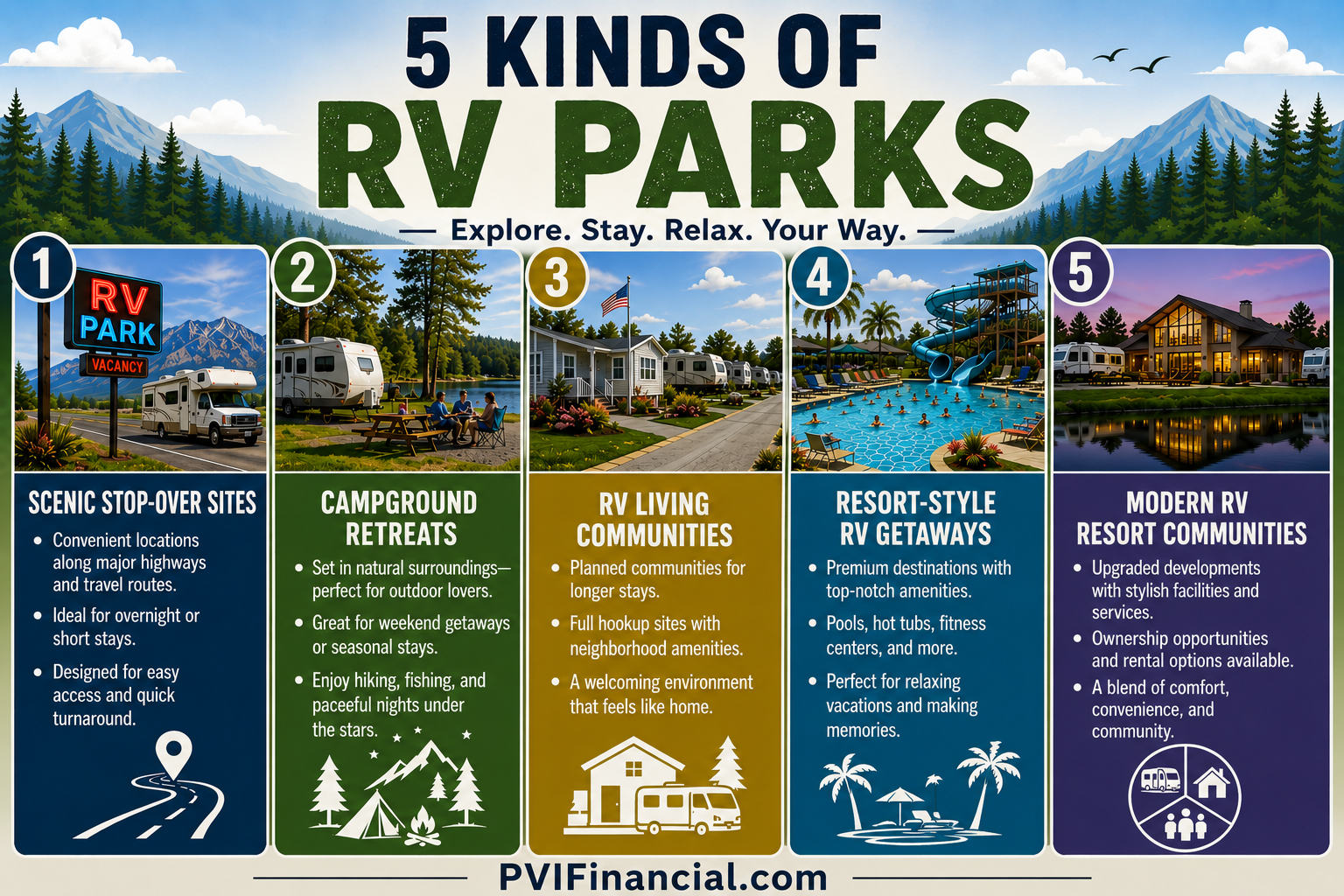
    There are five distinct types of RV parks, and each one operates as a fundamentally different business.

    1. Roadside RV Parks

    These are the highway corridor stops, the parks that exist because a traveler needs to sleep somewhere between Point A and Point B. Guests stay one to two nights and move on. There is no loyalty, no repeat booking relationship, and no reason for the guest to choose your park specifically over the one three exits down except convenience and availability.

    From an investor standpoint, roadside parks are the most traffic-dependent and the most volatile. A new highway bypass, a competing park with better online reviews, or a slow travel season can all hit occupancy hard and fast. They can work as investments but they require the right price, the right location, and a clear-eyed view of the demand drivers before you commit.

    2. RV Park Campgrounds

    Typically located one to two hours outside a metro area, these parks benefit from tourism demand, nearby outdoor recreation, lakes, trails, state parks, and the kind of destination that draws weekend and week-long travelers. Guests are not just passing through. They chose this area.

    These parks tend to have stronger repeat guest potential than roadside parks and benefit from the growing demand for outdoor recreation experiences. They are also more sensitive to seasonal patterns, so monthly cash flow modeling matters significantly when you are underwriting one of these.

    3. RV Park Communities

    Long-term stay communities where residents live on-site full time or for extended periods. The revenue profile looks more like a mobile home park than a hospitality business, predictable monthly income from a stable tenant base with low turnover.

    The tradeoff is rate. Long-term tenants pay significantly less per night than transient guests, and as I have written about before, a heavy concentration of long-term tenant revenue can create real financing challenges with SBA and conventional lenders who classify that income as residential rather than commercial. If you are buying a community-style park, understand the financing implications before you go under contract.

    4. RV Park Resorts

    The premium tier. These parks compete on amenities and experience, pools, water slides, clubhouses, entertainment, the full resort package. Guests come specifically because of what the park offers, not just where it is located. Premium nightly rates are possible and repeat guest loyalty can be very strong.

    The operational overhead is higher, the amenity capital requirements are real, and the management complexity is greater than any other park type. These are not beginner acquisitions. But for an experienced operator with the capital and the team to run them well, the return profile can be exceptional.

    5. Hybrid RV Parks

    The newest and most complex category. Hybrid parks combine multiple revenue models, sometimes including fractional ownership or timeshare-style interests alongside traditional site rentals. The revenue diversification can be attractive but the legal and operational complexity is genuinely significant.

    If you are evaluating a hybrid park, make sure you have both a real estate attorney and a CFO in your corner before you go far down the road. The structures vary widely and the due diligence required goes well beyond what a standard park acquisition demands.

    Why This Matters for Your Underwriting

    Every number in a park’s financials means something different depending on the park type. A 70 percent occupancy rate at a roadside park tells a very different story than a 70 percent occupancy rate at a destination campground. A strong T12 at a resort park built on amenity-driven demand is a different asset than a strong T12 at a community park built on long-term tenant stability.

    When I underwrite a park deal for a client, the first thing I want to understand is not the revenue number. It is the revenue model. What type of park is this, who is the guest, why do they come, and what happens to occupancy if one of those drivers changes?

    The type determines the risk. The risk determines the price.

    The Bottom Line

    Before you request financials on your next deal, ask yourself what type of park you are actually looking at. Each model has different risks, different rewards, and a different operational reality once you own it. Knowing the difference before you make an offer is not optional. It is the starting point for every other analysis you are going to do.

    If you want help figuring out what type of park you are evaluating and whether the numbers support the price being asked, that is exactly what I do at pvifinancial.com.

    And if you have not grabbed a copy of my book yet, From Offer to Operation: The Complete RV Park Investor’s Guide ($49), it covers the full acquisition and operations framework including a bonus report with 34 red flags to verify before you close. I am very confident you will learn something you had not thought of.

    You can get it direct here: https://wendipvifinancial.gumroad.com/l/kqmyb

    Or if you prefer Amazon has it too, just search author Wendi Rook.

    ~Wendi | Fractional CFO | PVIFinancial.com

    Click here to read “The Sellers Proforma is Not Your Proforma” next

  • I Have Never Owned an RV Park. Here Is Why I Am the Person You Want Looking at Your Deal.

    I Have Never Owned an RV Park. Here Is Why I Am the Person You Want Looking at Your Deal.


    I get this question more than you might think. Sometimes it is asked directly. Sometimes I can just feel it hanging in the air when I am talking to a buyer or an owner for the first time.

    You have never owned an RV park. So why should I listen to you? Just the other day someone commented on one of my Facebook posts “why should we listen to you? What makes you special over all the other mentors out there teaching about RV parks?”

    It is a fair question and I want to answer it honestly, because I think the honest answer is actually more useful to you than the polished version.

    I am a real estate investor who has built and sold a seven figure real estate portfolio over the last 30 years. I am a private money lender who has put over $4 million into first trust deeds secured by real estate over the last 8 years. I bootstrapped a seven figure business from $500 and built it into something worth selling. And I am a Fractional CFO and bookkeeper who lives in business financials every single day. That combination of skills is exactly what you need when you are evaluating an RV park deal, and it is not a combination you find very often in one person

    Here is what I mean by that.

    The Investor Lens

    When I look at an RV park deal, I am not looking at it as a consultant who has read about investing. I am looking at it as someone who has personally been through the acquisition process, understands what it feels like to have real money on the line, and knows the difference between a deal that looks good on paper and a deal that actually holds up when you start pulling on the threads.

    I have walked away from deals that did not pencil. I have pushed through deals that had problems because the problems were quantifiable and the price reflected them. I have been the person sitting at the closing table wondering if I did enough diligence. That experience does not come from a textbook and it changes how you look at everything.

    The Lender Lens

    Eight years of lending on real estate has taught me something that most people on the buyer side never fully appreciate. The lender sees everything. Every deal that came across my desk as a private money lender came with a story the borrower was telling me about why it was a good investment. My job was to look past the story and evaluate the collateral, the numbers, and the risk.

    When you have spent years on the lender side of the table, you develop a very specific kind of skepticism about financial presentations. You learn to ask where a number came from before you accept it. You learn that the most important information in any deal package is often what is missing, not what is there. That skepticism is exactly what a buyer needs when they are evaluating a seller’s financials.

    I did not have to take somebody’s word for what a property was worth. I had to verify it independently, every single time, because my own money was on the line if I got it wrong. That discipline is built into how I approach every underwriting engagement I take on for a client.

    The CFO and Bookkeeper Lens

    This is the one people underestimate the most.

    I spend my professional life inside the financials of small businesses. I know what clean books look like and I know what messy books look like. I know the difference between a P&L that was prepared to accurately reflect the business and one that was prepared to tell a specific story to a specific audience. I know where expenses get buried, how revenue gets overstated, and which line items are the first places a seller cleans up before putting a park on the market.

    I also know what it takes to build the financial infrastructure to run a business properly after you close. Not just the acquisition, but the day-to-day systems, the reporting, the cash flow management, the bank account structure, the chart of accounts that actually gives you visibility into how the business is performing. Most buyers close on a park and then figure this part out as they go. The ones who have it in place from day one make better decisions faster and avoid the expensive lessons that come from flying blind in the first year of ownership.

    So Why Not Just Hire Someone Who Owns Parks?

    You can. There are operators out there with direct park ownership experience who offer consulting services. That experience is genuinely valuable, particularly on the operational side.

    But ownership experience alone does not make someone qualified to pressure test your financial assumptions, rebuild a seller’s NOI from the source documents, identify what is missing from a set of financials, or set up the bookkeeping infrastructure that turns your new acquisition into a manageable business. That work requires a specific financial skill set, and it is the skill set I have been building for over a decade across real estate, lending, and CFO work.

    I bring three lenses to every RV park deal I look at. The investor who understands what is at stake. The lender who has been trained to verify everything. And the CFO who knows what the numbers are supposed to look like and what to do when they do not.

    That combination is what I offer. And I think it is exactly what most buyers in this space are missing.

    If you are evaluating a park right now and want that combination working for you before you commit, reach out at pvifinancial.com.

    And if you have not already grabbed a copy of my book, From Offer to Operation: The Complete RV Park Investor’s Guide ($49), it is everything you want to know about how to evaluate, acquire, and run an RV park, plus a bonus report with 34 red flags to verify before you close so you are not buying someone else’s problem.

    You can get it direct here: https://wendipvifinancial.gumroad.com/l/kqmyb

    Or if you prefer Amazon has it too, just search author Wendi Rook.

    ~Wendi | Fractional CFO | PVIFinancial.com

    Read this next “The Two Line Items That Will Wreck Your First RV Park Deal”

  • Your Chart of Accounts Is Lying to You (And It Is Costing You More Than You Think)

    Your Chart of Accounts Is Lying to You (And It Is Costing You More Than You Think)

    Most RV park owners who are using QuickBooks have the same problem. They opened the software, picked the closest industry template, answered a few setup questions, and started categorizing transactions. The books are technically getting done. The bank reconciles every month. Their accountant is happy.

    And they have absolutely no idea what their business is actually telling them.

    The chart of accounts is the backbone of your entire bookkeeping system. It is the structure that determines how every dollar of income and every dollar of expense gets categorized, reported, and ultimately analyzed. Get it right and your financials become a management tool that tells you exactly where you are and what to do about it. Get it wrong and you have a document that satisfies your tax preparer and tells you almost nothing else.

    For RV parks specifically, getting it wrong is the default. Here is why, and what to do about it.

    The Generic Template Problem

    QuickBooks and most bookkeeping software offer industry templates when you set up a new company file. There is no RV park template. There is no outdoor hospitality template. So owners pick the closest thing, usually something in the general services or hospitality category, and start from there.

    The problem is that a generic hospitality chart of accounts was not designed around the revenue and expense structure of an RV park. It does not distinguish between your transient nightly revenue, your long-term monthly tenant revenue, your seasonal site revenue, and your cabin or glamping income. It lumps all of those into a single revenue line called something like “Sales” or “Service Revenue.”

    That single line number tells you that money came in. It tells you nothing about where it came from, which revenue stream is growing, which is shrinking, which is performing above your underwriting assumptions, and which is dragging the whole operation.

    For a business where the revenue mix is one of the most consequential variables in both operations and valuation, that is a significant blind spot.

    What a Proper RV Park Chart of Accounts Actually Looks Like

    A chart of accounts built specifically for an RV park breaks revenue down by stream so you can actually manage each one. At minimum, you want separate income accounts for transient nightly site revenue, weekly site revenue, monthly long-term tenant revenue, seasonal site revenue, cabin and glamping revenue if applicable, utility recovery income, camp store and retail sales, laundry and vending income, and any event or group booking revenue.

    Each of those lines tells a different story. Your transient nightly revenue tells you whether your rate and occupancy are moving in the right direction for short-term guests. Your long-term tenant revenue tells you whether your monthly base is stable or eroding. Your utility recovery income tells you whether your pass-through on electrical costs is covering what you are actually spending. None of that is visible if everything lives in one bucket called “Revenue.”

    The expense side needs the same level of specificity. Payroll should be broken down by function, management, maintenance, and guest services, not pooled into a single payroll line. Utilities should separate electricity, water, sewer, trash, and internet rather than combining them into one utilities expense. Maintenance should distinguish between routine maintenance, repairs, and capital improvements, because those three things are financially and tax-wise very different from each other.

    Why This Matters for More Than Just Reporting

    Clean, properly structured financials do three things beyond keeping your accountant satisfied.

    First, they make you a better operator. When you can see month over month that your transient nightly revenue is up 12 percent but your long-term tenant revenue is down because two sites turned over, you can make a deliberate decision about how to fill those sites rather than just watching the total revenue number and hoping for the best.

    Second, they protect you at resale. When you eventually sell the park, a sophisticated buyer or their CFO is going to request financials and rebuild the NOI from the source. If your books are structured so that every revenue stream and every meaningful expense category is clearly broken out, that process takes days instead of weeks and gives the buyer confidence in your numbers. That confidence translates into a smoother transaction and a stronger price. If your books are a mess of generic categories that require significant interpretation, buyers discount for the uncertainty.

    Third, they are what lenders actually want to see. If you ever refinance, apply for an SBA loan, or bring in a capital partner, your financials need to tell a clear story about the performance of the asset. A lender looking at a single revenue line and three or four expense buckets cannot underwrite your park accurately. A lender looking at a detailed, properly segmented set of financials can. That difference can be the difference between getting the terms you want and not getting the loan at all.

    The Fix Is Not Complicated, But It Has to Be Done Right

    Rebuilding a chart of accounts mid-stream in an existing QuickBooks file is not a weekend project, but it is also not as painful as it sounds when it is done by someone who knows what they are doing. The bigger issue is doing it right the first time, before you have 18 months of transactions categorized into a structure that does not serve you.

    If you are setting up books for a new acquisition, build the chart of accounts before you categorize a single transaction. If you are already operating and your books are on a generic template, the right time to fix it is now, before you need those financials to do something important.

    What I do at PVI Financial is set up bookkeeping systems specifically for RV park owners, with a chart of accounts built around how this asset class actually operates, not how a generic software template assumes it does. Whether you want someone to set it up and hand it back to you, or you want ongoing fractional CFO support to manage it month to month, the conversation starts at pvifinancial.com.

    And if you are still in the acquisition phase and want to understand what clean financials should look like before you buy a park, grab a copy of my book, From Offer to Operation: The Complete RV Park Investor’s Guide ($49). It covers the full picture from underwriting through operations, including a bonus report with 34 red flags to verify before you close so you are not buying someone else’s problem.

    You can get it direct here: https://wendipvifinancial.gumroad.com/l/kqmyb

    Or if you prefer Amazon has it too, just search author Wendi Rook.

    ~Wendi | Fractional CFO | PVIFinancial.com

    If you liked this, you might want to read this next “Your Bank Balance is Lying To You”

    Click here to Download my free guide, “The 5 Numbers Every RV Park Buyer Must Know Before Making an Offer”

  • The Two Line Items That Will Wreck Your First RV Park Deal (And Why They Never Show Up in the Broker Package)

    The Two Line Items That Will Wreck Your First RV Park Deal (And Why They Never Show Up in the Broker Package)

    I have reviewed a lot of RV park deals. Rebuilt the NOI from scratch, stress tested the assumptions, gone line by line through the financials looking for what the seller was not saying out loud.

    And over and over again, the same two things show up after closing that nobody budgeted for. Not because the buyer was careless. Not because they skipped the financials. But because these two items do not live in the financials at all.

    They live in the ground. And in the walls. And by the time you find out they are a problem, you already own the park.

    I am talking about septic and electrical.

    If you are evaluating an RV park right now, or planning to, read this before you make an offer.

    The Septic Problem

    A private septic system does not show up on a profit and loss statement. It does not appear in the T12. It will not come up in a conversation with the seller unless you specifically ask for inspection records, and even then, many sellers have not had the system professionally inspected in years.

    Here is why this matters. A commercial septic system serving an RV park is not the same animal as the system behind a single family home. It is handling waste from dozens or hundreds of connections simultaneously, often for extended periods during peak season. These systems have a capacity rating and a lifespan, and when they are at or near the end of both, the indicators are not always visible. The grass looks fine. The system seems to be draining. And then on your busiest weekend in July, it fails.

    Remediation costs for a failed commercial septic system start around $50,000 on the low end. Parks with larger systems, difficult soil conditions, or local regulatory requirements can be looking at $200,000 to $500,000 or more. I have seen it. The number is real.

    What makes this particularly dangerous in an acquisition is that the seller may genuinely not know the system is approaching failure. They have been running the park successfully for years. The system has always worked. They have no reason to disclose a problem they are not aware of.

    Your job as a buyer is not to assume good faith covers the risk. Your job is to require a professional inspection with a written capacity assessment before you remove contingencies. Not after. Before.

    What you want from that inspection is not just confirmation that the system is currently functioning. You want to know the rated capacity relative to the number of sites, the estimated remaining useful life, and whether the system has ever been pumped, repaired, or expanded. If the seller cannot provide documentation and will not allow an independent inspection, that is your answer.

    The Electrical Problem

    The electrical distribution system at an RV park is infrastructure most buyers never think to interrogate because it is invisible. You cannot see it during a walkthrough the way you can see a deteriorating road or a bathhouse that needs renovation. The pedestals look fine. The lights are on. Guests are plugging in without complaint.

    But here is the reality. The average RV on the road today draws significantly more power than the average RV from 15 or 20 years ago. Modern rigs with residential refrigerators, washer-dryer combos, multiple air conditioning units, and entertainment systems routinely require 50-amp service. Many parks, especially those built or last upgraded in the 1990s or early 2000s, were wired for a world of 30-amp service that no longer reflects the market.

    An aging electrical distribution system creates three problems. First, it limits the guest segment you can serve. Larger, newer rigs will either avoid your park or generate complaints when they cannot get the power they need. Second, it creates reliability issues. Older wiring and pedestals fail more frequently, and a power outage during peak occupancy is a guest experience and revenue problem on top of a maintenance problem. Third, upgrading the system is one of the most expensive capital projects you will face as a park owner. Running new service, replacing pedestals, upgrading panel capacity, and bringing a dated system to current standards can run well into six figures on a mid-sized park.

    Like the septic issue, none of this appears in the financials. The seller is not hiding it. It just is not a line item. It is a future capital requirement that the current owner has been deferring, intentionally or not, and that you will inherit at closing.

    The fix here is straightforward. Hire an independent licensed electrician to assess the distribution system before you close. Not the electrician the seller recommends. An independent one. Ask specifically for the amperage capacity at each site type, the age and condition of the distribution panels, and a written estimate on what it would cost to bring the system to current standards. Get that number before you finalize your offer, because it belongs in your total acquisition cost calculation, not as a surprise in year one.

    Why These Two Items Are Different From Everything Else

    When you find a problem in the financials, you can quantify it and negotiate it into the price. A seller who left out a management fee, a revenue figure that does not reconcile with the bank statements, an expense that looks inflated, these are all things you can put a number on and address at the negotiating table.

    Infrastructure surprises do not work that way. You cannot negotiate a septic replacement after you close. You cannot renegotiate the purchase price because the electrical system you did not inspect turned out to be inadequate. The risk transfers at closing, fully and completely, to you.

    This is why the physical inspection of the utility infrastructure is not a nice-to-have in your due diligence process. It is a requirement. The cost of the inspection is a rounding error compared to the cost of discovering the problem after you own the park.

    What This Means for Your Offer

    If you complete independent inspections of both systems and they come back clean, great. You have eliminated two of the most significant sources of post-close capital surprise and you can price the deal with confidence.

    If the inspections surface problems, you have options. You can negotiate a price reduction that reflects the remediation cost. You can require the seller to address the issue before closing. You can use the findings to renegotiate other terms. Or you can walk away from a deal that does not work at a price that accounts for what you found.

    None of those options are available to you if you skip the inspection.

    A Practical Checklist Before You Remove Contingencies

    Before you finalize any RV park acquisition, make sure you have checked off both of these:

    Septic: Written professional inspection with capacity assessment relative to number of sites, documentation of pumping and maintenance history, and an independent estimate on remaining useful life and any recommended repairs.

    Electrical: Independent licensed electrician assessment of the full distribution system, site-level amperage capacity documentation, age and condition of all panels and pedestals, and a written estimate on what upgrade to current standards would cost.

    If either of those is missing when you are heading into the final stretch of due diligence, get them before you remove your contingencies. Not after.

    The Bottom Line

    The broker package shows you what the park looks like on paper. The physical infrastructure shows you what the park will cost you to operate. Those are two different conversations, and the second one only happens if you go looking for it.

    I help buyers pressure test RV park deals before they commit, including identifying the capital requirements that do not show up in the financials.

    If you are evaluating a park right now and want a second set of eyes on the numbers, reach out at pvifinancial.com, and before you make your next offer, request a copy of my book, From Offer to Operation: The Complete RV Park Investor’s Guide ($49). It covers everything from underwriting the deal to running the asset, and includes a bonus report with 34 red flags to verify before you close so you are not buying someone else’s problem.

    You can get it direct here: https://wendipvifinancial.gumroad.com/l/kqmyb

    Or if you prefer Amazon has it too, just search author Wendi Rook.

    ~Wendi | Fractional CFO | PVIFinancial.com

    Click here to read “The Seller’s Proforma is Not Your Proforma”

    Click here to Download my free guide, “The 5 Numbers Every RV Park Buyer Must Know Before Making an Offer”

  • The Seller’s Pro Forma Is Not Your Pro Forma

    The Seller’s Pro Forma Is Not Your Pro Forma

    Every RV park listing comes with a pro forma. A clean one page summary showing gross revenue, expenses, NOI, and a cap rate that makes the deal look compelling. It is professionally formatted. The numbers add up. And it was built entirely to sell you the park.

    That is not your pro forma. That is the seller’s story.

    Here is what I mean by that.

    A pro forma is only as honest as the assumptions behind it. And the seller’s assumptions are always the most optimistic version of the truth. Not necessarily because anyone is lying. But because every single line item in that document was built from the seller’s cost structure, the seller’s relationships, the seller’s management style, and the seller’s years of accumulated advantages that will not transfer to you at closing.

    Let me show you what I mean.

    The seller self manages the park. No management fee in the expenses. Looks lean and efficient. But you are not moving to that park to work 60 hours a week. You need a manager. Add $40,000 to $60,000 in annual expenses that are nowhere on that pro forma.

    The seller has had the same insurance broker for 20 years. Grandfathered rate. Not available to new buyers. Your quote comes in $8,000 higher. Not on the pro forma.

    The seller’s maintenance guy has been coming out for half price for years because they are old friends. He retires when the seller does. Your maintenance costs double. Not on the pro forma.

    The seller has not put meaningful money back into the property in five years. No CapEx line item because nothing major has broken yet. But the electrical pedestals are aging, the bathhouse fixtures are worn, and the roads need grading. All of that is coming out of your pocket in year one. Not on the pro forma.

    By the time you rebuild the NOI honestly, adding real management costs, market rate expenses, normalized CapEx, and actual vacancy, that 8% cap rate on the flyer is often a 5% cap rate in reality. And at the asking price that is a completely different deal.

    So how do you build your own pro forma?

    This is the part most buyers skip because it feels complicated. It is not. It is methodical. Here is exactly how I do it.

    Step 1 — Start with verified gross revenue.

    Do not use the number on the flyer. Ask for three years of bank statements and tax returns and build the revenue from actual deposits, not reported income. Look at each revenue stream separately. Site rentals, laundry, store sales, event income. Know which ones are recurring and which ones are one time. If the seller cannot provide bank statements that match the reported revenue that is a red flag before you even get to expenses.

    Step 2 — Apply a real vacancy rate.

    Most pro formas use 5% vacancy or less. The reality for most parks is closer to 8 to 12% depending on seasonality and market. This is one variable that sellers almost universally get wrong in a pro forma.

    A seller’s pro forma is typically built on either current peak occupancy, historical best year occupancy, or a stabilized projection that assumes everything goes right. What it rarely accounts for is a realistic vacancy factor based on the actual seasonal patterns of that specific park in that specific market.

    Before you accept any revenue projection at face value, pull the monthly occupancy numbers for the last three years and build your own occupancy assumption from the bottom up. If the park runs at 90 percent in July and 20 percent in January, your annual average is not 55 percent and your cash flow model needs to reflect the monthly reality, not the annual average.

    A pro forma that ignores vacancy is not a financial model. It is a best case scenario dressed up as a projection.

    Step 3 — Rebuild every expense line from scratch.

    Do not accept the seller’s expense numbers. Go line by line and ask yourself one question for each item. Is this what I would actually pay? Here is what to examine:

    Property taxes: Call the county assessor and confirm the current tax bill. Ask whether a sale would trigger a reassessment. In some states a sale resets the assessed value and your tax bill goes up significantly.

    Insurance: Get your own quote before you make an offer. Do not use the seller’s number.

    Management: If you are not self managing add 8 to 12% of gross revenue as a management fee regardless of whether it is in the current expenses. If you are self managing, add it anyway and then decide if the deal still works. Because someday you will not want to self manage and you need to know the park can support that cost.

    Maintenance: Industry standard is 5 to 8% of gross revenue for a well maintained park. If the seller is showing less than that ask why. If the park has deferred maintenance budget more.

    CapEx reserve: This is the one most buyers skip entirely. Every major system in an RV park has a finite lifespan. A healthy CapEx reserve is typically 3 to 5% of gross revenue set aside annually for future capital needs. If the seller has no CapEx in their expenses they have been withdrawing equity from the property and handing you the bill.

    Utilities: Get the actual utility bills for 24 months. Not the seller’s estimate. The actual bills.

    Payroll: Get the actual payroll records. Know who is on payroll, what they make, and whether any of them are family members being compensated below or above market.

    Step 4 — Add your debt service.

    This is where most deals either work or fall apart. Take your actual financing terms, the real loan amount, the real interest rate, the real payment, and model it against the NOI you just rebuilt. Not the seller’s NOI. Yours. The debt service coverage ratio should be at least 1.25. I want to see 1.5 or above before I feel comfortable.

    Step 5 — Model the seasonality.

    Build a 12 month cash flow projection, not just an annual total. Map revenue and expenses month by month. Identify your worst cash month. Make sure you have enough reserves to cover it. A park that generates 80% of its revenue in three months needs a financial cushion that most buyers do not account for until they are sitting in month 9 with an empty park and a full expense load.

    Step 6 — Stress test the assumptions.

    Run the numbers at 10% lower revenue than your projection. Run them at 10% higher expenses. If the deal still works under those scenarios you have a margin of safety. If it only works when everything goes exactly as planned, it is too thin.

    When you have done all six of those steps you have your pro forma. Not the seller’s version. Yours. Built from real numbers, real costs, and assumptions that reflect what this park will actually look like under your ownership.

    That is the number that tells you what the deal is worth. And that is the only number that matters when you are deciding whether to make an offer.

    The seller’s pro forma tells you what they want you to believe. Your pro forma tells you what you are actually buying.

    If you want to go deeper on what to look for before you close; (and to protect yourself) you might want to pickup a copy of my $49 book “From Offer to Operations: The Complete RV Park Investor’s Guide”. This guide covers exactly this and a lot more, and it could save you from a very expensive mistake!

    You can get it direct here: https://wendipvifinancial.gumroad.com/l/kqmyb

    Or if you prefer Amazon has it too, just search author Wendi Rook.

    ~Wendi | Fractional CFO | PVIFinancial.com

    If you liked that one, read this next “What is NOI and How to Find the Real Number in an Acquisition”

    Click here to Download my free guide, The 5 Numbers Every RV Park Buyer Must Know Before Making an Offer

  • What Your P&L Is Trying to Tell You Before You Buy

    What Your P&L Is Trying to Tell You Before You Buy

    Every seller hands you a P&L. Most buyers glance at the revenue number, nod, and move on. That’s a mistake that can cost you everything.

    A P&L is not just a scorecard of what a business earned. It’s a story. And if you know how to read it, that story will tell you whether the deal in front of you is as good as it looks, better than it looks, or a disaster waiting to happen.

    Here’s what to look for before you make an offer.

    Revenue Trends Matter More Than Revenue Totals

    A business that did $800,000 last year sounds great. But was that up from $600,000 the year before or down from $1.2 million? Direction matters as much as the number itself. Always ask for two to three years of P&Ls so you can see the trend, not just a snapshot. A business in decline can still show impressive trailing numbers while the foundation is quietly crumbling underneath.

    Expense Lines Tell You How the Business Was Really Run

    Look at every expense category and ask whether it makes sense for the size and type of business. Payroll as a percentage of revenue, cost of goods as a percentage of revenue, marketing spend, maintenance, utilities. If any category looks unusually low compared to industry norms ask why. Sometimes expenses are being deferred, maintenance skipped, staff underpaid, or costs run through a different entity entirely. Low expenses on paper can mean a capital problem waiting for you on day one of ownership.

    One Time Items Can Inflate the Picture

    Sellers love to show you their best year. What they don’t always volunteer is that their best year included a one time contract, an insurance payout, a PPP loan that hit as income, or a related party transaction that won’t repeat. Always ask what was unusual about any year that looks significantly better than the others. Normalized earnings, what the business actually produces in a typical year, is what you’re buying.

    Owner Compensation is Almost Never What It Appears

    In a small owner operated business the owner’s salary, or lack of one, dramatically affects what the P&L shows. Some owners pay themselves very little and run personal expenses through the business. Some pay themselves above market to reduce taxable income. You need to recast the financials with a fair market owner salary to understand what the business actually earns after replacing the owner’s labor. This is called a recasted or adjusted P&L and it’s the number that should drive your valuation.

    Gross Margin is Your Early Warning System

    Gross margin is revenue minus the direct cost of delivering that revenue. It tells you how efficiently the business converts sales into profit before overhead. If gross margin is shrinking year over year it means either prices aren’t keeping up with costs or the cost of delivery is rising. Either way it’s a problem that gets worse after you own it, not better.

    What the P&L Can’t Tell You

    Here’s the part most buyers miss. A P&L only shows you what was recorded. If bank accounts weren’t connected, if expenses were paid in cash, if revenue was deposited without being invoiced, none of that shows up. A clean looking P&L on a poorly kept set of books is not a clean business. It’s a clean looking document sitting on top of an unknown mess.

    This is why underwriting a deal means going beyond the P&L. Bank statements, tax returns, reconciliation history, and a proper review of the books behind the numbers will tell you far more than the summary document the seller hands you at the first meeting.

    The P&L is where the conversation starts. Not where it ends.

    If you’re looking at a deal right now and want a second set of eyes on the numbers, that’s exactly what I do. I offer a free initial review. Let’s talk.

    ~Wendi | Fractional CFO | PVIFinancial.com

    Click here to read: “The Hidden Financial Risk of Buying a Mom-and-Pop Operation”

    Click here to Download my free guide, The 5 Numbers Every RV Park Buyer Must Know Before Making an Offer

  • Nobody talks about the month after they closed on their RV park.

    Nobody talks about the month after they closed on their RV park.

    They post the keys. They post the sign. They post the big smile in front of the entrance with the caption “we did it” and 200 people like it and leave fire emojis in the comments.

    What they do not post is the phone call two weeks later when the manager who knew every single tenant, every quirky electrical panel, every vendor relationship, and every unwritten rule about how that park actually ran, calls to say she is not coming back. She was loyal to the previous owner. Not to you.

    They do not post the septic inspection they skipped because the seller said it was fine and they were already two weeks past the deadline and everyone just wanted to close.

    They do not post the moment they sit down with the actual financials and realize that the previous owner had been running that park on a handshake with the same three vendors for fifteen years. The landscaper who charged half of market rate because they were old friends. The electrician who came out at midnight for almost nothing because he owed the owner a favor. The insurance broker who had grandfathered them into a policy that no longer exists for new buyers. Those numbers were real. They just were not your numbers. And nobody told you that before you signed.

    They do not post the moment they realize that what looked like a lean, efficiently run operation was actually an operation built entirely around one person’s relationships, one person’s sweat, and one person’s decades of accumulated goodwill that evaporated the day the deed transferred.

    Nobody posts that part.

    I have talked to buyers who are living that story right now. Not one or two. Several. And here is what they all have in common. They are not careless people. They are not inexperienced people. They did their research. They read the books. They listened to the podcasts. They underwrote the deal three different ways and it cash flowed every time.

    But they made their final decisions while they were excited. And excitement is the most expensive state of mind in commercial real estate.

    When you are excited you round up on revenue and round down on expenses. When you are excited the manager seems dependable and the infrastructure seems solid and the seller seems trustworthy and the market seems strong. When you are excited you see the upside and you file the concerns away under “we will figure it out.”

    And then you close. And the excitement fades. And the business does not care about your excitement at all. It just needs to be run.

    Here is the thing nobody tells you before you buy your first RV park.

    The deal does not hurt you. The assumptions do.

    You assumed the revenue would hold. You assumed the manager would stay. You assumed the expenses reflected reality. You assumed the NOI on the flyer was built the same way you would build it. You assumed the infrastructure was as solid as it looked on the surface tour. You assumed that what worked for the previous owner under their cost structure and their debt load and their management style would work the same way for you.

    And every single one of those assumptions felt completely reasonable at the time.

    This is not a story about bad deals. Most of the parks I see are decent assets. The land is real. The income is real. The demand is real. This is a story about what happens when someone buys a business without a clear and honest picture of what it actually costs to run it under new ownership, with new debt, and without the institutional knowledge that walked out the door at closing.

    The gap between the seller’s story and your reality is where deals go sideways. Not at closing. After.

    The buyers who do well are not smarter than the ones who struggle. They are not luckier. They do not have some special access to better deals. They just had someone in their corner before they signed who was willing to tell them the uncomfortable version of the story. Someone who rebuilt the NOI from scratch instead of accepting it. Someone who asked the hard questions about the manager and the infrastructure and the revenue mix before it was too late to walk away or renegotiate.

    Someone whose job it was to be the calm voice in the room when everyone else was caught up in the excitement of the deal.

    If you are looking at a park right now and something feels off but you cannot quite put your finger on it, that feeling is worth paying attention to. It is usually your gut doing the underwriting your spreadsheet missed.

    And if you want someone to look at the numbers with you before you decide, that is exactly what I do.

    ~Wendi | PVI Financial | Fractional CFO and Bookkeeping Services for Small Business and Outdoor Hospitality

    Read this next “The Hidden Financial Risks of Buying a Mom and Pop Operation”

    Click here to Download my free guide, The 5 Numbers Every RV Park Buyer Must Know Before Making an Offer