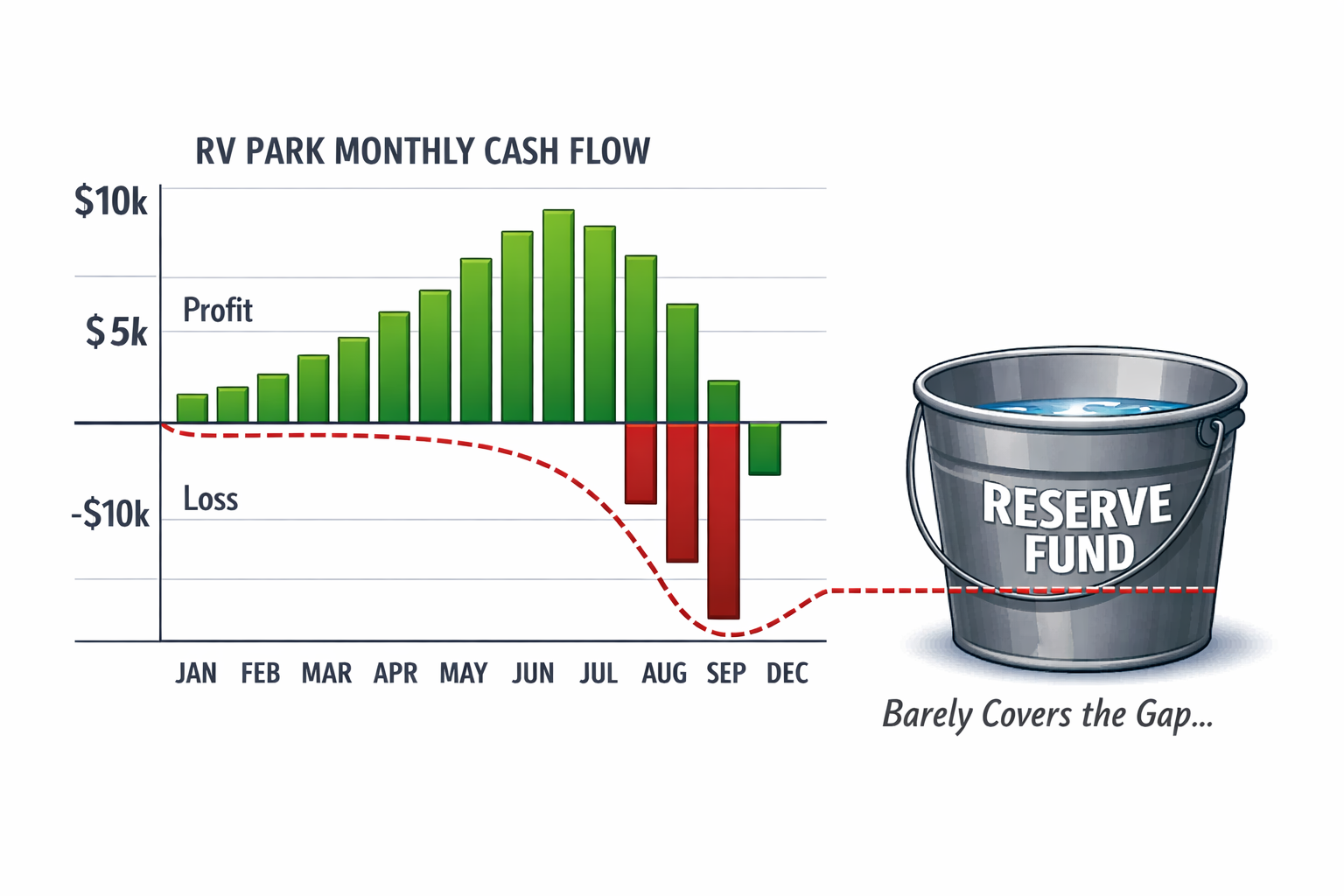
RV park cash flow planning shows up in almost every buyer guide and financing blog in this industry, and it almost always says the same three things. Forecast your revenue by month. Set aside savings during peak season. Consider a line of credit for the gaps. That advice is not wrong. It is just incomplete, and incomplete cash flow advice is exactly what leaves new owners exposed the first time a slow season runs longer than expected.
I read through a stack of these articles recently, from accounting firms, financing companies, and general outdoor hospitality blogs. Every single one told readers to build a reserve fund. Almost none of them told readers how much reserve is actually enough, or walked through what happens to that reserve once real debt service, real payroll, and a real bad season hit it at the same time. That gap is the whole reason RV park cash flow planning needs more than a checklist of good habits.
Why Generic RV Park Cash Flow Planning Advice Falls Short
Most of what passes for RV park cash flow planning online is small business advice with an RV park label attached to it. Forecast your revenue. Track your expenses. Keep three to six months of operating costs in reserve. That is sound general guidance, but it treats every seasonal business the same way, whether you are running a snow cone stand or a 150 site RV resort carrying a seven figure acquisition loan.
The problem is that RV park cash flow planning done right has to account for your specific debt structure, your specific seasonality curve, and your specific capital needs, not a generic three to six month rule pulled from a small business workshop. A park with 50 percent seller financing at a fixed rate behaves completely differently under stress than a park financed with a variable rate SBA loan. A destination park with a long, predictable peak season behaves differently than a park that depends on a handful of local events to fill gaps. None of that shows up in the generic version of the advice.
There is also a habit in this industry of treating RV park cash flow planning as something you do once, usually right after closing, and then set aside. Build the forecast, set up the reserve, move on. Real cash flow planning is not a one time exercise. It is a living model you revisit every quarter, because your occupancy trends shift, your debt service stays fixed, and your reserve either grows or shrinks depending on how disciplined you actually are between now and next season.
What Most RV Park Cash Flow Planning Content Leaves Out
It rarely stress tests the reserve against your actual debt service. Plenty of advice tells you to build a reserve fund. Almost none of it asks whether that reserve would survive a season where occupancy comes in 15 or 20 percent below your forecast while your mortgage, seller note, and payroll obligations stay exactly the same. RV park cash flow planning that skips this step gives you a reserve number that feels safe on paper and might not be safe at all.
It rarely accounts for seller financing or blended debt structures. A lot of RV park deals include seller carry alongside a bank loan, sometimes with different rates, different amortization schedules, and different balloon terms. Generic cash flow advice treats debt service as one flat number. Real RV park cash flow planning has to model each piece separately, because a seller note coming due at the wrong time can undo months of careful reserve building.
It rarely separates operating reserves from capital reserves. Most advice lumps all savings into one bucket labeled “reserve fund.” In practice, the cash you need to cover a slow month is a different pool than the cash you need for a new roof on the bathhouse or a septic repair. Blending the two is one of the fastest ways to think you are covered when you are not.
It rarely models a downside scenario with real numbers. General cash flow guidance likes to mention planning for a slow season in the abstract. RV park cash flow planning that actually protects you means running an occupancy downside of 15 to 20 percent through your specific revenue and expense numbers and checking whether you can still make debt service and payroll without touching your capital reserve.
It rarely connects cash flow planning back to your original underwriting. The DSCR and cash on cash return you modeled before you bought the park should not be a one time exercise you never look at again. Real RV park cash flow planning revisits those same numbers regularly and asks whether your actual performance still supports the assumptions you underwrote at purchase.
How to Build RV Park Cash Flow Planning That Actually Holds Up
Separate your reserves into two buckets. Keep an operating reserve sized to cover a genuinely bad season, and a separate capital reserve sized to cover deferred maintenance and unexpected capital repairs. If you are still working through your acquisition, my posts under Acquiring an RV Park walk through how to size capital reserves during due diligence, before you are relying on guesswork after closing.
Run a real downside scenario, not a vague one. Take your actual monthly revenue and expense numbers and model a 15 to 20 percent occupancy shortfall through the slowest months of your season. If your reserve and your debt service do not both survive that scenario on paper, RV park cash flow planning has more work to do before you feel comfortable.
Model your debt service piece by piece, not as one number. If you are carrying seller financing alongside a conventional loan, map out exactly when each payment is due, at what rate, and when any balloon comes due. I covered a version of this kind of blended debt modeling in my post on RV park rule enforcement, where the same discipline of not treating everything as one flat category matters just as much for staffing decisions as it does here for debt.
Revisit your numbers quarterly, not once a year. RV park cash flow planning is a living process. If your occupancy trend is drifting from what you modeled at acquisition, that is information you want three months into a slow trend, not nine months in when the reserve is already thin. My Fractional CFO Services work with clients on exactly this kind of ongoing quarterly review.
Get your bookkeeping clean enough to trust the numbers you are modeling. None of this works if your monthly financials are inconsistent or delayed. If your books are not giving you a reliable, current picture, my Bookkeeping and Financial Systems posts cover how to get that foundation solid first.
Pressure test your pricing before you lean on debt to fill the gap. Sometimes the fastest way to strengthen a cash flow position is smarter seasonal pricing rather than a bigger reserve. My Revenue and Pricing posts go deeper into adjusting rates without hurting your guest experience or your occupancy.
RV park cash flow planning is not a box you check with a generic reserve fund and a monthly forecast spreadsheet. It is a specific, ongoing discipline built around your actual debt structure, your actual seasonality, and your actual downside risk. The advice that stops at “build a reserve fund” leaves out the exact math that tells you whether your reserve would actually survive the season that tests it.
If you want your RV park cash flow planning built around your real numbers instead of a generic small business rule of thumb, that is exactly the kind of modeling I do with clients. The SBA’s own guidance on managing your finances is a useful general starting point if you want an outside framework, found at sba.gov, but it is written for small businesses broadly, not RV parks specifically, so layering the seasonal and debt structure detail on top is where the real protection comes from.
If you want help stress testing your reserve, modeling your debt service, or building a cash flow plan that actually holds up in a bad season, that is exactly the kind of work I do. Reach out at PVIFinancial.com.
For more on running a profitable, well managed park, check out my Resource Library, and grab a copy of my book From Offer to Operation: The Complete RV Park Investor’s Guide, also available on Amazon.
~Wendi | Fractional CFO | PVIFinancial.com